
Tuesday, November 10, 2026Nov 10

Federal listing gives hope that fish found only in Tennessee can survive

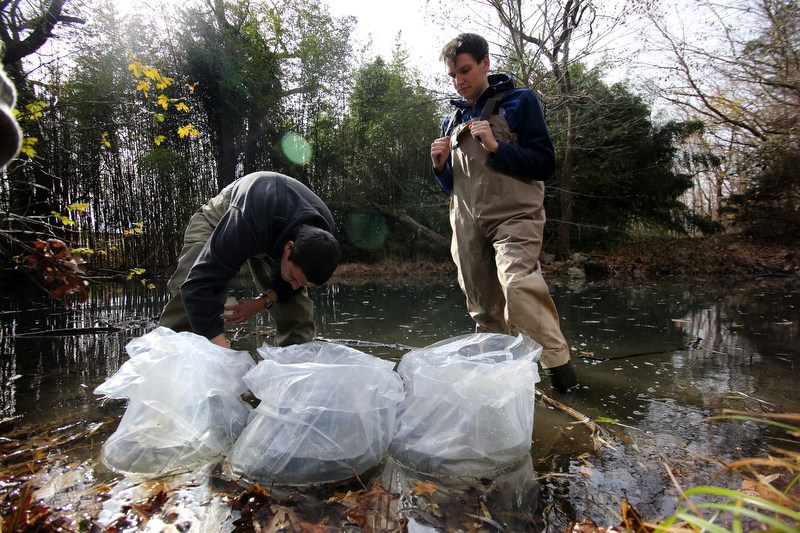
Staff photo by Erin O. Smith / Matt Hamilton, curator of fishes at the Tennessee Aquarium, and Adam Johnson, an aquarist at the Tennessee Aquarium, pours water into bags with Barrens Topminnows as he acclimates the fish to the stream's water Tuesday, November 26, 2019 off of McMinnville Highway in Coffee County, Tennessee. The Barrens Topminnows are a species were recently listed as federally endangered.
Staff photo by Erin O. Smith / Matt Hamilton, curator of fishes at the Tennessee Aquarium, and Adam Johnson, an aquarist at the Tennessee Aquarium, pours water into bags with Barrens Topminnows as he acclimates the fish to the stream's water Tuesday, November 26, 2019 off of McMinnville Highway in Coffee County, Tennessee. The Barrens Topminnows are a species were recently listed as federally endangered. Staff photo by Erin O. Smith / Matt Hamilton, curator of fishes at the Tennessee Aquarium, and Adam Johnson, an aquarist at the Tennessee Aquarium, pours water into bags with Barrens Topminnows as he acclimates the fish to the stream's water Tuesday, November 26, 2019 off of McMinnville Highway in Coffee County, Tennessee. The Barrens Topminnows are a species were recently listed as federally endangered.

One of the last wild populations of Barrens topminnow survives, with help, in a small pond on private property just feet from a Summitville, Tennessee, highway.

The population of colorful fish only found on the Barrens Plateau in Central Tennessee has been decimated over decades, with competition taking it to near extinction. A working group of private and public partners – the Tennessee Aquarium, Conservation Fisheries in Knoxville, Tennessee Wildlife Resources Agency, and U.S. Fish and Wildlife – have monitored the species for decades to ensure its survival. Without their interference, the population would likely be gone, having died off from changes in climate, land use and competition.

The working group unsuccessfully tried for years to introduce the species to new habitats, but those efforts largely proved futile.

There’s little hope the species will ever thrive.

However, there is now a belief the fish – which averages about 4 inches in length when fully grown – may be able to be managed in that existing habitat. The fish received federal protection in October, becoming listed as an endangered species. The listing will open funding opportunities for hatcheries to work with the population to ensure its survival.