
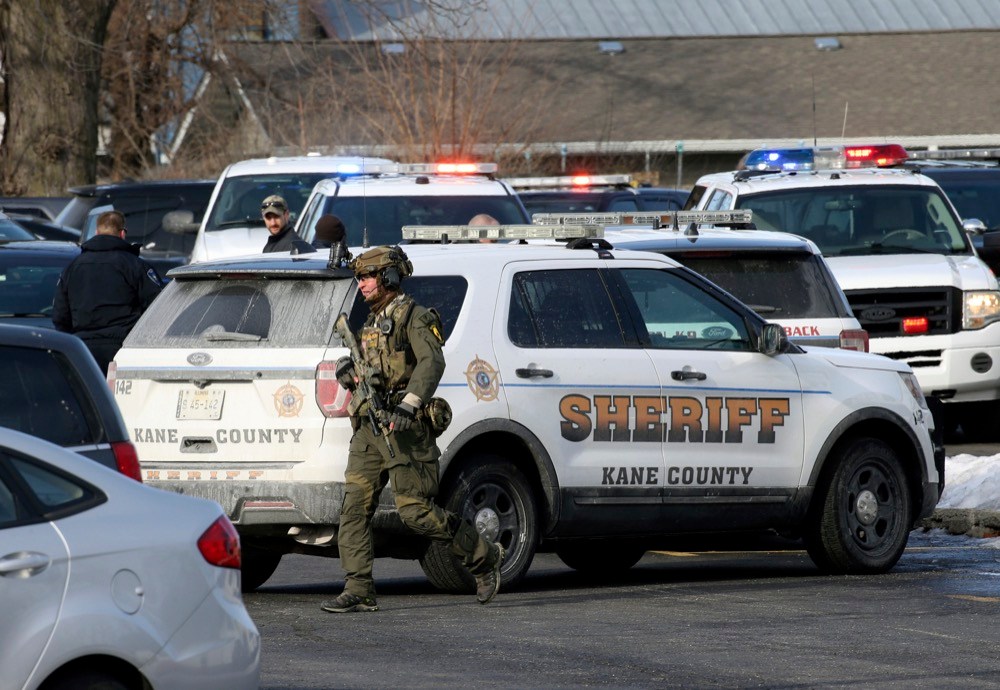
PHILADELPHIA — A week after classes began at Villanova University, panic swept the campus Monday as students’ phones lit up with a text message about a gunman in St. Monica Hall, a freshman dorm on South Campus.
“ACTIVE SHOOTER on VU campus at St. Monica Hall, Shelter in place. Lock/barricade doors. More info to follow,” the alert read.
There was no shooter. Officials later said a student heard a loud noise and reported what she believed were gunshots, prompting the text alert to 10,000 students, staff, and some alumni as police arrived. The school followed up within 20 minutes, writing: “Police are on scene. No indication of a shooting. Building sweep in progress.” And later: “No shots fired. Building is all clear.”
For those who got the alert, and the 160 students housed in St. Monica, it was unimaginable relief after an hour of fear.
“When it’s happening in real time, you don’t know that it’s a false alarm,” said Lisa Yakomin, a parent from Woodcliff Lake, N.J., who counseled her 19-year-old daughter over FaceTime while she hid under her bed in another dorm building. “I have the relief now. But she still lived it as if it was a real situation.”
This is the balancing act colleges face in deciding when and how to alert the university community in an emergency, especially when it involves an “active shooter,” words that have come to paralyze the country.
In August, a Chattanooga police officer was walking to his house near the University of Tennessee at Chattanooga campus after his shift, still in full uniform and with his rifle in hand, when a person saw him, wasn’t sure if he was an officer, and called 911 to report a suspicious person. That’s what sparked an hourslong search for an allegedly armed suspect.
The scare promoted three local schools – Chattanooga Schools for the Arts and Sciences, Brown Academy and Battle Academy – to go into lockout status, meaning students were moving freely within their buildings and classes were normal, but no one was allowed to leave the buildings.
But as far as UTC itself, the campus did not go into lockdown, and classes were not canceled. Instead, once campus was given the all clear from law enforcement, professors were asked to use their discretion on whether to hold classes, according to UTC officials. While some students said they thought the situation was handled well, given the information officials had, others weren’t so sure.
In those first crucial moments, officials often don’t have the time to verify reports. But they also don’t want to unnecessarily spook an entire community with an outburst of texts, emails, tweets, and Facebook posts.
David Tedjeske, Villanova’s chief of police and director of public safety, said he authorized the alert at Villanova University after the school’s dispatch center received a notification from 911 that a student reported shots and Radnor police were on their way. He said he assumed that if 911 found the information credible enough to dispatch police en masse, “that was good enough for me.”
“If nothing else, we were going to have a lot of policemen running into a residence hall with guns drawn,” Tedjeske said. “And I would rather be wrong 100 times in this instance than be wrong just once erring on the other side.”
Striking a balance between speed and accuracy is important, said Ken Valosky, the school’s executive vice president who heads up emergency operations, especially in this time of “hypersensitivity” and a summer marked by several high-profile mass shootings.
The school is reviewing Monday’s events to determine crisis management improvements.
The situation was the second time this summer a local campus experienced an active shooter false alarm. In July, Thomas Jefferson University inadvertently sent a Sunday morning alert that read: “There’s an active shooter on the East Falls campus. Follow emergency procedures. Run. Hide. Act.” Twenty minutes later, it followed up: “ALL CLEAR.” The school blamed “a resolvable system error.”
On the other hand, students at Pennsylvania State University in January criticized the school for failing to send an alert when a gunman involved in an off-campus shooting was on the loose. Officials said there was no “imminent threat” to Penn State students or the campus.
Deciding when to hit the “send” button isn’t an exact science, local college administrators say, and the processes and technology have changed, particularly since 2007, when Virginia Tech took hours to send an alert after a gunman killed 30 people. The school was subsequently fined for violating the Clery Act, a 1990 federal law that requires schools provide timely warnings and emergency notifications.
Federal regulations don’t specify a timeline for issuing alerts, so first responders should be able to use their discretion in the event of an active shooter situation, said Abigail Boyer, associate executive director at the Clery Center in Strafford, Chester County. She recommends that colleges have a detailed procedure, test it frequently, and use message templates.
At the University of Pennsylvania, a group of 12 to 15 senior administrators determine whether an event is a threat, said Maureen Rush, the school’s vice president for public safety and superintendent of Penn Police. After the group immediately convenes a conference call and assesses the situation, it’s up to Rush to decide whether to send an alert to 54,000 people, a move the school makes less than 20 times per year. Armed robberies and inclement weather have made the cut.
The policy allows for faster movement in the event of an active shooter. Dispatchers who monitor 145 street cameras are authorized to send an alert only if they can confirm — through police, security guards or video footage — that there is a shooter.
“We have to investigate it, because we have to get it right,” Rush said. “We can’t say ‘never mind, that didn’t happen’ or ‘actually, it’s a different location.'”
But University of New Hampshire Police Chief Paul Dean, who is co-chair of the Domestic Preparedness Committee for the International Association of Campus Law Enforcement Administrators, said 911 dispatchers on his campus are authorized to send a university-wide alert as soon as a report comes in of an active shooter.
“Villanova did absolutely the right thing, the industry standard,” he said. “That is exactly how I would hope my agency would respond.”