
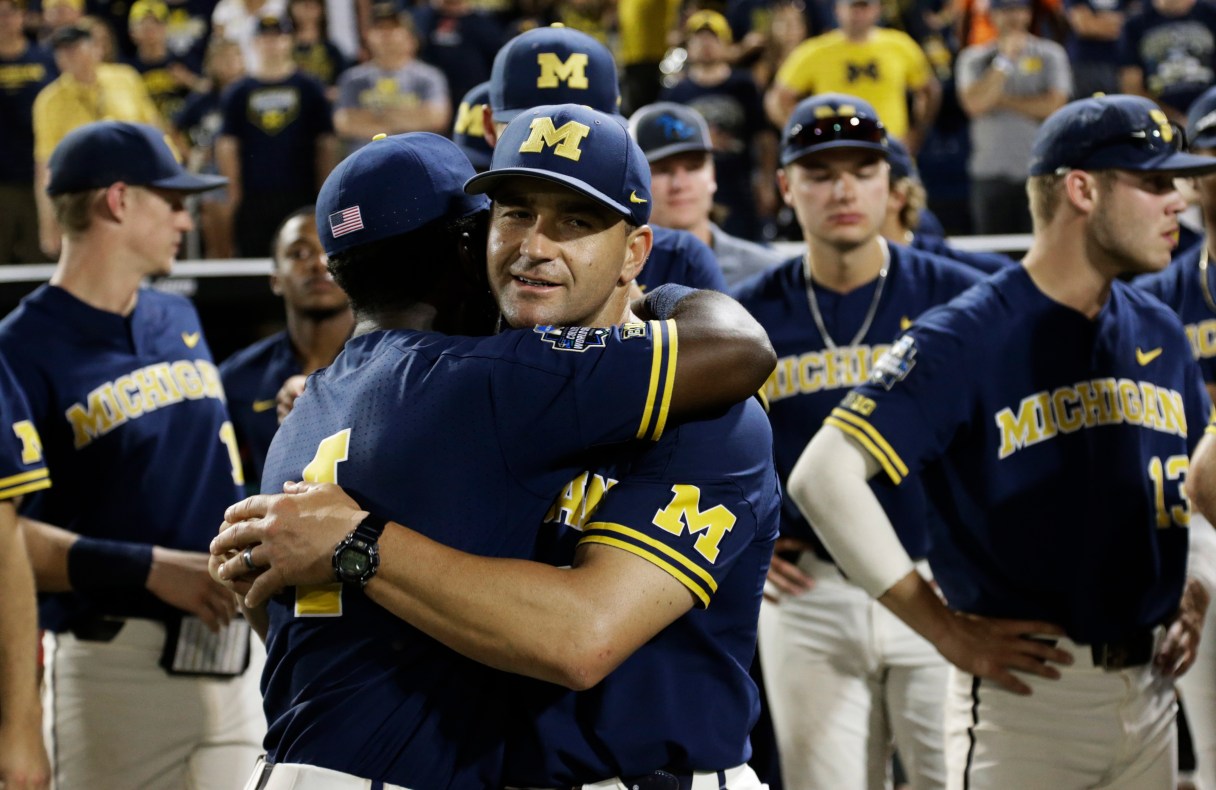
As disappointing as it has been to have the 2020 college baseball season shut down because of the coronavirus pandemic, Michigan coach Erik Bakich sees a silver lining.
“I do think the coming years will be the deepest college baseball has ever been,” he said.
NCAA Division I programs stand to benefit because of two factors. First, the NCAA is allowing players to return in 2021 with the same eligibility standing they had in 2020. Second, and perhaps more important, Major League Baseball is shortening its draft – going from 40 to as few as five rounds – and capping signing bonuses for undrafted free agents at $20,000.
Last year, 131 of 150 of players (87%) taken between the sixth and 10th rounds of the draft were from four-year colleges, with juniors receiving bonuses ranging from $125,000 t0 $250,000. Seniors typically get less because they lack leverage.
Those college players who just miss getting drafted must decide between signing for $20,000, if offered, or returning to school. Elite high school seniors not drafted have the same decision: Take the money or stick with their college commitments.
TCU coach Jim Schlossnagle said $20,000 shouldn’t be enough to entice many players to sign, saying that up-front money doesn’t go very far when it must be used to supplement a small minor league salary. He added that another year of seasoning in college can help a player make a faster rise through the minors.
MLB.com draft analyst Jim Callis predicted a significant number of undrafted players will swallow hard and sign: “They’ll want to get their pro careers started.”
For some players, returning to school would require them to pay $20,000 or more in tuition because they don’t have full scholarships. Division I baseball teams offer partial scholarships to most players, distributing a maximum of 11.7 full scholarships among 27 players. (Eight walk-ons are permitted, taking the roster maximum to 35, with baseball the only NCAA spring sport with a roster limit.)
Callis noted that a junior who returns to school next year would most likely be 22 years old when drafted in 2021. That player wouldn’t be in line for a bonus commensurate with his draft slot because MLB teams don’t place as much value on older draftees. Plus, Callis said, the draft will be deeper next year, meaning a player who would go in the eighth round this year might not go until the 12th next year.
How college rosters are structured is anything but certain for a lot of teams. The draft isn’t until July, so it will be August before some coaches know who is returning. Some freshmen might elect to go to a junior college if they see a long line of returning players ahead of them competing for playing time. There also will be a wave of transfers, perhaps an unprecedented number if the Division I Council votes this summer to remove the requirement that transfers sit out one year before becoming eligible.
What’s certain is there will be more older and experienced players in the college game for the foreseeable future, and Schlossnagle said top to bottom talent that’s as good as ever now will only get better.
Michigan’s Bakich said if MLB goes through its cost-cutting move to reduce the number of minor league teams, most of them at the lowest levels, college baseball will become even more attractive. Fueled by handsome conference distributions from football and basketball revenue, schools are showing greater commitment to the sport with facility upgrades.
“My first year of Division I coaching was the spring of 1993, and there were probably 50 programs in the country that really cared about college baseball,” Schlossnagle said. “Today there’s probably 150.”
That aforementioned silver lining, of course, has a cloud – and not just the season’s cancellation. The eligibility extension is causing consternation for some coaches.
Ohio State’s Greg Beals has said he isn’t worried about 2021, when the 35-man roster limit will be relaxed to accommodate seniors choosing to return for another season.
The problem comes in 2022, when the limit is back in force. Beals has 11 freshmen coming in this fall, and they will join nine players who will be reclassified as freshmen because the 2020 season ended abruptly March 12.
“So I have a freshman class of 20, and that class is going to stay with me for the next four years,” Beals said. “So there’s some challenge there. We’re going to be able to work through it. There’s going to be some tough conversations while the roster is thick and strong. The lineup card still only has nine slots on it.”
Seniors who choose to return in 2021 will be allowed to have the same scholarship amount they had this year, less or none at all. Returning seniors’ scholarships won’t count against the 11.7 limit.
Looming logjams because of the extended eligibility could force coaches to sign smaller recruiting classes and nudge underperforming players to transfer or quit.
“The greater effect might be two or three years from now,” LSU coach Paul Mainieri said. “Most schools in the SEC have their 2021 recruiting classes for high school players already done. So now you’re bunching a lot of kids together, and we’ll see how it plays out.
“As far as this year, the impact is minimal. What is of greater impact is what Major League Baseball does with their draft.”