
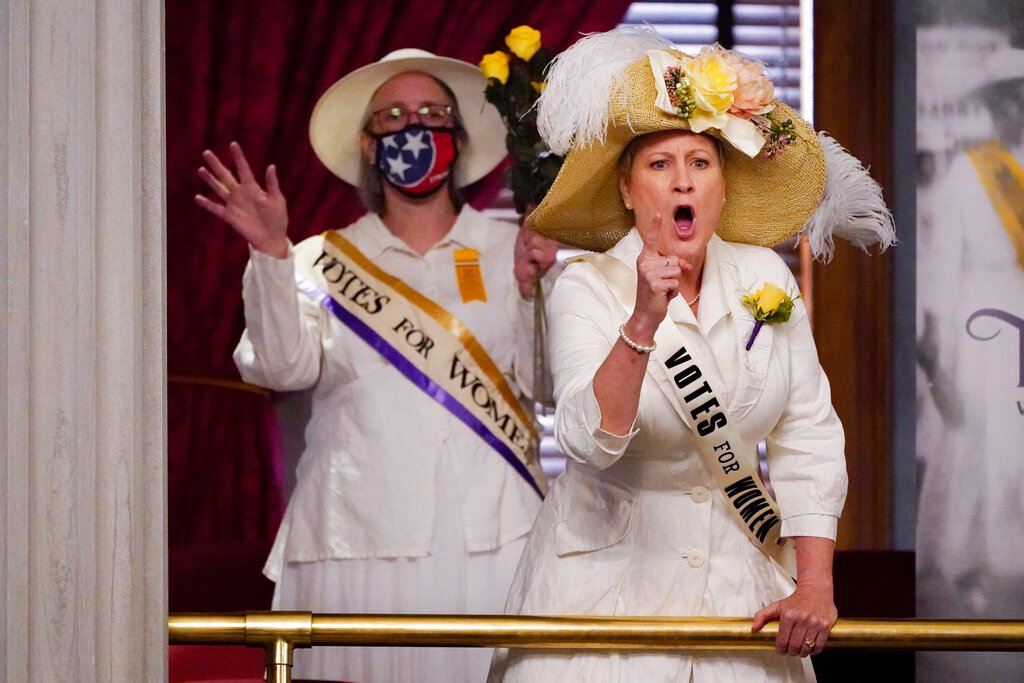

A century ago, Chattanoogans picked up their newspapers to learn that Tennessee had become the 36th and last state needed to ratify the 19th Amendment in a pitched battle in Nashville over the right for women to vote.
The headline on the Aug. 19, 1920, edition of the Chattanooga Daily Times said, “House passes resolution of ratification; rumors of bribery exposure thrill capital; antis training guns for further fight,” describing sensational tales amid the heated battle in the Tennessee House for 17 million women in the U.S. seeking the right to cast ballots.
Other headlines of the day noted the census counted 115,954 people in Hamilton County, the price of coffee was hitting a low and a Georgia senatorial candidate had been thrown in jail for starting a brawl at a hotel in Buford.
But it was the battle for women’s suffrage that led the day. In North Carolina, legislators defeated efforts to revive the amendment the day before Tennessee took it up.
The Tennessee state Senate’s ratification vote less than a week before was a landslide tally, 25 to 4, setting the stage for the battle in the Tennessee House, where the vote deadlocked on Aug. 18, 1920, in a 48-48 tie.
A 24-year-old Republican House member from McMinn County named Harry T. Burn cast the deciding vote that made history.
According to the Daily Times account, suffragists expected defeat when then-House Speaker Seth Walker, a Democrat, declared the motion lost for want of a majority. Burn, the paper said, had voted earlier on the side of anti-suffragists.
To indicate this loyalty, Burn wore a red rose, while suffragists and their supporters wore yellow roses.
But that was before he got a letter from his mother, and the bloom on that red rose would fade.
Susan Zimet, author of “Roses and Radicals: The Epic Story of How American Women Won the Right to Vote,” told the Times Free Press on Tuesday that Burn and his mother would play a role in history that likely never entered their wildest dreams.
Zimet noted that the night before the vote, suffragists in Nashville felt defeated and that the only thing they could do was pray.
Tensions had ratcheted up over the preceding days, and there were rumors of bribery, kidnapping, even fake letters calling legislators home, according to Zimet and accounts in the Daily Times.
“All but three of the 99 members of the House were in attendance,” Zimet said. “The suffragists had 47 yes votes they could count on, two short of ratification. Barring a miracle, the suffragists were certain they would lose a very close vote.
“After debate, Speaker Walker, who had opposed the amendment, rose, struck the gavel and said, ‘The hour has come.’ But then he called for a vote to table or postpone the bill with hopes to then take a vote on ratification itself,” Zimet said.
A roll call vote was taken on the motion to table the measure, and it appeared the motion would pass and the suffragists would lose.
(READ MORE: Suffrage anniversary commemorations highlight racial divide)
“But when the vote got to Banks P. Turner, supposedly an ‘anti’ legislator, he hesitated,” Zimet said of the Gibson County Democrat.
Turner switched his vote, opposing the move to table.
“The vote ended up being a 48-48 tie. The motion to table had failed, suffrage was still alive and Turner now supported ratification, as well,” Zimet said, adding that the retelling of the series of events gives her chills.
“Then the actual vote on the 19th Amendment began, and two aye votes for ratification were quickly followed by four nays,” Zimet said.
The seventh representative to cast a vote was the youngest member of the House, McMinn’s Burn.
“Burn was wearing a red rose, as were many of the other lawmakers. The war of the roses had even continued even inside the legislative chamber. Everyone expected Burn to vote against the amendment,” Zimet said, describing the drama of the moment.
“He responded to his name with a barely audible ‘aye.'” Zimet said. “Had Burn gotten mixed up and said the wrong word? No, he had not.”
In Burn’s pocket, unbeknownst to anyone in the legislative chamber, was the letter from his mother, Febb Ensminger Burn. He’d received it that morning.
(READ MORE: The war of the roses)
His mother’s letter contained the following remarks regarding the amendment: “Hurrah and vote for suffrage, and don’t keep them in doubt. I noticed Chandler’s speech, it was very bitter. I’ve been waiting to see how you stood but have not seen anything yet … Don’t forget to be a good boy and help Mrs. Catt with her ‘Rats.'”
Carrie Chapman Catt was the president of the National American Woman Suffrage Association.
Once Burn changed his vote, and turned the tide, there was celebration and the moment wasn’t lost on reporters in the Tennessee House that day.
“Suffragists everywhere launched an uprorarious [sic] demonstration before the clerk announced the vote, for there was no question suffrage had won. The chamber became a bedlam of cheers and shouts, women screamed at the top of their voices, scores placed their arms around the necks of those nearest them and danced, so far as it was possible to do so, in the mass of humanity,” the Daily Times story reads.
“Hundreds of suffrage banners were waved wildly and many removed the yellow flowers they had been wearing and threw them upward to meet a similar shower from the galleries. There were few tears of joy shed by the suffragists. Some wiped their eyes but on the whole they considered it no time for weeping. Their happiness was far beyond that stage.”
The scene closes with the man with the gavel.
“A motion to adjourn until 10 o’clock tomorrow morning was offered after the official vote was announced but in the uproar it was doubted whether any members heard it or whether it was seconded. The speaker put the question, called for the ayes and noes, and announced gravely that the motion had carried unanimously,” the Daily Times story ends.
(READ MORE: The suffering for suffrage)
Zimet celebrates that victory and Tennessee’s moment of glorious democracy, but like her sisters a century ago, she also thinks of the work ahead.
“Here it is 100 years later, and we don’t even have an Equal Rights Amendment,” she said. “The only right that women have that protects us in the Constitution is the right to vote.”
Contact Ben Benton at bbenton@timesfreepress.com or 423-757-6569. Follow him on Twitter @BenBenton or at www.facebook.com/benbenton1.