
WASHINGTON (AP) – The Senate approved a bipartisan measure Thursday aimed at limiting President Donald Trump’s authority to launch military operations against Iran, with eight Republicans joining Democrats in a post-impeachment bid to constrain the White House.
The rebuke was the Senate’s first major vote since acquitting Trump on impeachment charges last week. Trump is expected to veto the war powers resolution if it reaches his desk, warning that if his “hands were tied, Iran would have a field day.'”
The measure, authored by Sen. Tim Kaine, D-Va., says Trump must win approval from Congress before engaging in further military action against Iran. Kaine and other supporters said the resolution, which passed 55-45, was not about Trump or even the presidency, but instead was an important reassertion of congressional power to declare war.
While Trump and other presidents “must always have the ability to defend the United States from imminent attack, the executive power to initiate war stops there,” Kaine said. “An offensive war requires a congressional debate and vote.”
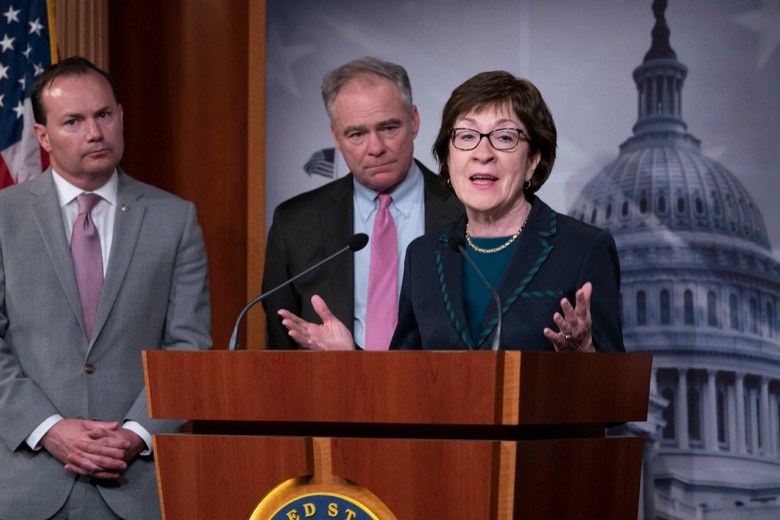
 Sen. Tim Kaine, D-Va., joined at left by Sen. Mike Lee, R-Utah, meets with reporters just after the Senate advanced a resolution asserting that President Donald Trump must seek approval from Congress before engaging in further military action against Iran, at the Capitol in Washington, Wednesday, Feb. 12, 2020. (AP Photo/J. Scott Applewhite)
“This vote is about the United States Constitution,” Alexander said in a statement. “It preserves the commander in chief’s Article II constitutional responsibility to defend the country and Congress’ Article I responsibility to declare war.”