
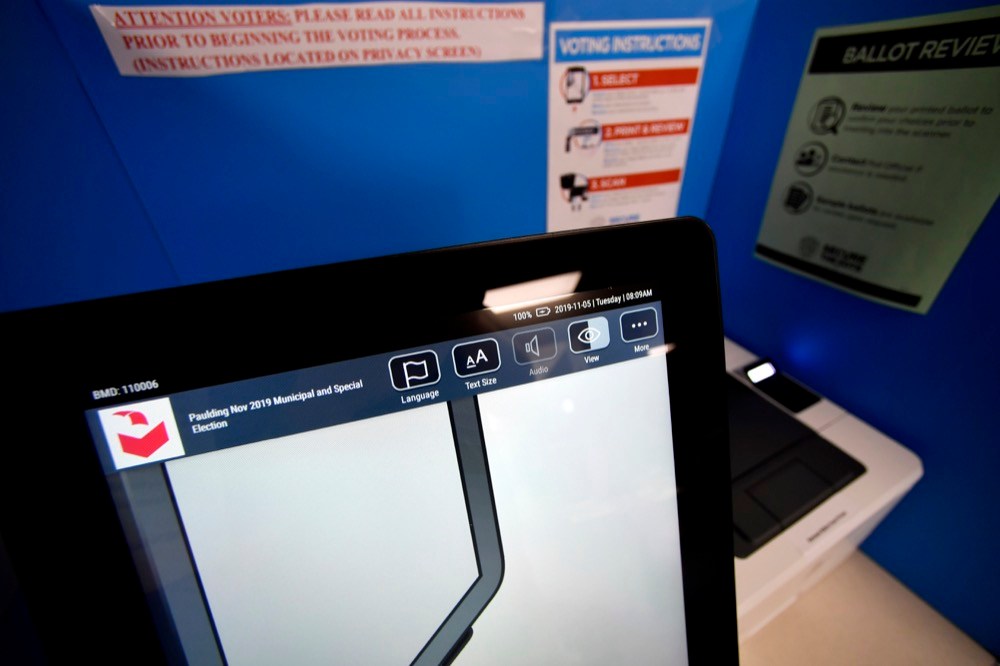
ATHENS, Ga. (AP) – Georgia’s state election board on Wednesday held an emergency hearing to discuss whether election officials in one county violated state law or election rules when they decided not to use the state’s new voting machines for the presidential primary.
The Athens-Clarke County Board of Elections voted 3-2 last week to sideline the new machines in favor of hand-marked paper ballots. Board Chairman Jesse Evans said then that the board found it “impracticable” when using the new machines to protect ballot secrecy and allow sufficient monitoring to prevent tampering as required by state law.
The March 24 presidential primaries mark the first statewide test for Georgia’s new $103 million voting system, which combines electronic touchscreens with printed ballots that are tallied by a scanner. Some election integrity advocates have argued the big, bright touchscreens with their large fonts and upright positioning make it easy to see how other people are voting.
Athens, about 70 miles (113 kilometers) east of Atlanta, is home to the University of Georgia, and surrounding Clarke County represents about 1% of the state’s active voters, according to voter numbers on the secretary of state’s website.
Secretary of State Brad Raffensperger, who chairs the State Election Board, issued a notice two days later setting the Wednesday hearing in Athens. The hearing notice said the county board should be prepared to respond to questions and present testimony and evidence for “its determination that it is ‘impossible or impracticable’ to use electronic ballot markers in the ongoing election.”
As the hearing got underway, Raffensperger, flanked by the rest of the board, presided over the proceedings.
Bryan Sells, a lawyer for the county board, told the state board members that his clients had received drawings from polling places with attempts to fit the machines. He said that in larger spaces they had some success, but that it could be a problem in smaller polling places to arrange the machines to protect ballot secrecy and meet the requirement in state law to have one machine per 250 registered voters.
Sells said his clients had been talking to the general counsel for the secretary of state’s office to come up with a solution. He said they believe there is a technical solution available that wasn’t apparent to them before they voted last week. But he said they were prepared to defend their decision.
Ryan Germany, the general counsel for the secretary of state’s office, reminded the state board members that Georgia law requires that the new voting equipment must be used in all of the state’s 159 counties. The section of law that allows county election officials to substitute paper ballots is an emergency provision that allows some flexibility but doesn’t override the law, he argued.
Sells argued that the county board was caught between conflicting requirements of Georgia election law. It wasn’t possible in some places to provide enough machines while also protecting ballot secrecy, and it was too close to the March 24 primary to switch polling locations, Sells said. That meant that using the machines was not feasible in certain situations, that it was impracticable, he said.