
Thursday, November 12, 2026Nov 12

Cleaveland: Coronavirus reopenings and other questions

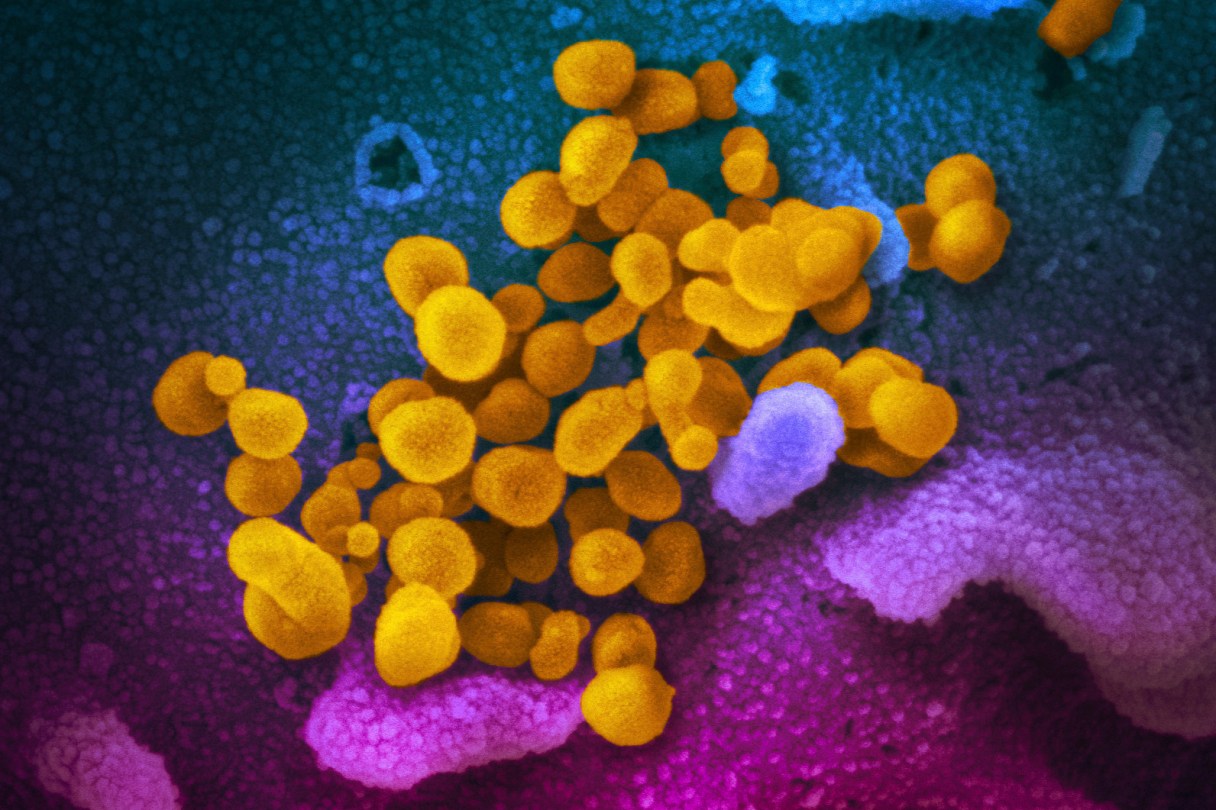
This undated electron microscope image made available by the U.S. National Institutes of Health in February 2020 shows the Novel Coronavirus SARS-CoV-2, yellow, emerging from the surface of cells, blue/pink, cultured in the lab. Also known as 2019-nCoV, the virus causes COVID-19. The sample was isolated from a patient in the U.S. According to a poll from The Associated Press-NORC Center for Public Affairs Research released on Thursday, Feb. 20, 2020, a wide share of Americans are at least moderately confident in U.S. health officials’ ability to handle emerging viruses, and more express concern about catching the flu than catching the new coronavirus. (NIAID-RML via AP)
This undated electron microscope image made available by the U.S. National Institutes of Health in February 2020 shows the Novel Coronavirus SARS-CoV-2, yellow, emerging from the surface of cells, blue/pink, cultured in the lab. Also known as 2019-nCoV, the virus causes COVID-19. The sample was isolated from a patient in the U.S. According to a poll from The Associated Press-NORC Center for Public Affairs Research released on Thursday, Feb. 20, 2020, a wide share of Americans are at least moderately confident in U.S. health officials’ ability to handle emerging viruses, and more express concern about catching the flu than catching the new coronavirus. (NIAID-RML via AP) This undated electron microscope image made available by the U.S. National Institutes of Health in February 2020 shows the Novel Coronavirus SARS-CoV-2, yellow, emerging from the surface of cells, blue/pink, cultured in the lab. Also known as 2019-nCoV, the virus causes COVID-19. The sample was isolated from a patient in the U.S. According to a poll from The Associated Press-NORC Center for Public Affairs Research released on Thursday, Feb. 20, 2020, a wide share of Americans are at least moderately confident in U.S. health officials’ ability to handle emerging viruses, and more express concern about catching the flu than catching the new coronavirus. (NIAID-RML via AP)

Businesses large and small face the challenge of how to reopen safely during the COVID-19 pandemic. Last week, a detailed plan for reopening from the Centers for Disease Control and Prevention was shelved by the Trump administration, with one official stating that it “would never see the light of day.”

As an alternative to the buried CDC guidelines, the Johns Hopkins Bloomberg School of Public Health posted on May 7 a three-part “toolkit” that includes an instruction manual, a business risk worksheet and a risk assessment calculator. Reading through the material, I was impressed by its thoroughness and wide applicability.

* Here are some statistics:

As of May 11, 17,776 new U.S. cases had been reported in the previous 24 hours. The total cases that date was 1.38 million with 81,539 deaths. Because of limited testing, both figures underestimate true figures.

Nursing homes have been especially hard hit by COVID-19. Until recently, senior care facilities did not have to report to the CDC and the Centers for Medicare and Medicaid Services (CMS) their numbers of cases and related deaths. In 14 states, more than half of COVID-19 fatalities occurred among residents. These grim numbers document the extreme vulnerability to seniors who live in the shared space of nursing homes. The statistics highlight the need for repeated testing of both staff and residents of nursing homes.