
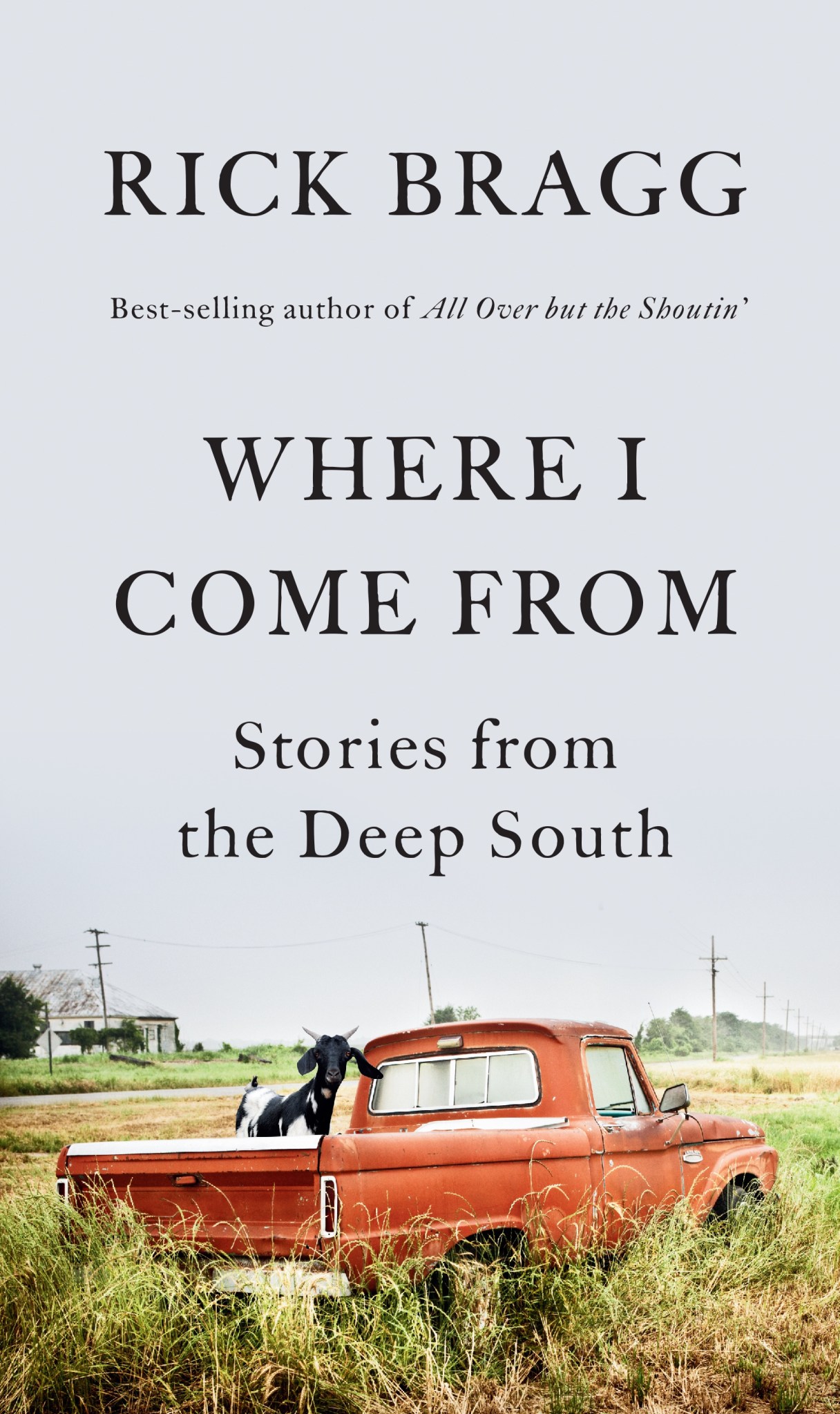
“WHERE I COME FROM: STORIES FROM THE DEEP SOUTH” by Rick Bragg (Knopf, 237 pages, $27).
Rick Bragg is one of the great Southern voices of our time, or any time. That much seems a statement of unassailable truth, in a moment when such things are a rare find, or so some may believe. The name Rick Bragg is a kind of fixture of this region, likely familiar even to those who’ve never read a word of his prose. If that’s the case for you, a new collection of Bragg’s short works, “Where I Come From,” is as good a place to start as any.
A recipient of the Pulitzer Prize for journalism in 1996, Rick Bragg burst onto the national scene shortly afterward as a chronicler of the working-class South with “All Over but the Shoutin’,” a memoir of his northeast Alabama family. Six more books have followed, including, most recently, “The Best Cook in the World.” There, his family’s foodways were the juicy focus of Bragg’s storytelling, rich with memory and the music of his language. In the new book, his subjects range far and wide within the region he has always called home.
The numerous short pieces assembled here originally appeared, for the most part, in Southern Living, with a few hailing from the pages of Garden & Gun. They could be filed under flash creative nonfiction, though I doubt Bragg himself thinks of them that way. They sometimes find him paying tribute to great individuals of the South, reporting from a visit with Jerry Lee Lewis or remembering Pat Conroy and Billy Graham. In others, he muses on small but significant life moments: marooned in a Florida pancake house over Thanksgiving, for instance, or standing at a window in New Orleans, buzzed on brown liquor, staring into the branches of a tree where hangs a strand of white Mardi Gras beads.
Each of these essays is a quick read, rarely lasting more than two pages, which could make them a fine substitute for the habitual doomscrolling that may currently splinter your day. Why not take a snort of Bragg, instead, and linger briefly on his language? His sentences, after all, are things to savor, slowly unfurling delights. “If I were a sandwich, I think, I would be a po’boy, overstuffed, a little sloppy, relatively cheap and bad for you – and, as often as in reality, wearing gravy someplace on me,” he writes. Or here he is on Southern heat: “This was the creature that came in the worst of summer, the boiling eye of it. It was the stunted field, the cracked earth. It was the cloud in a white-hot sky that gave up no rain. Aristotle knew it, and the Romans, and then us, in the American South.”