
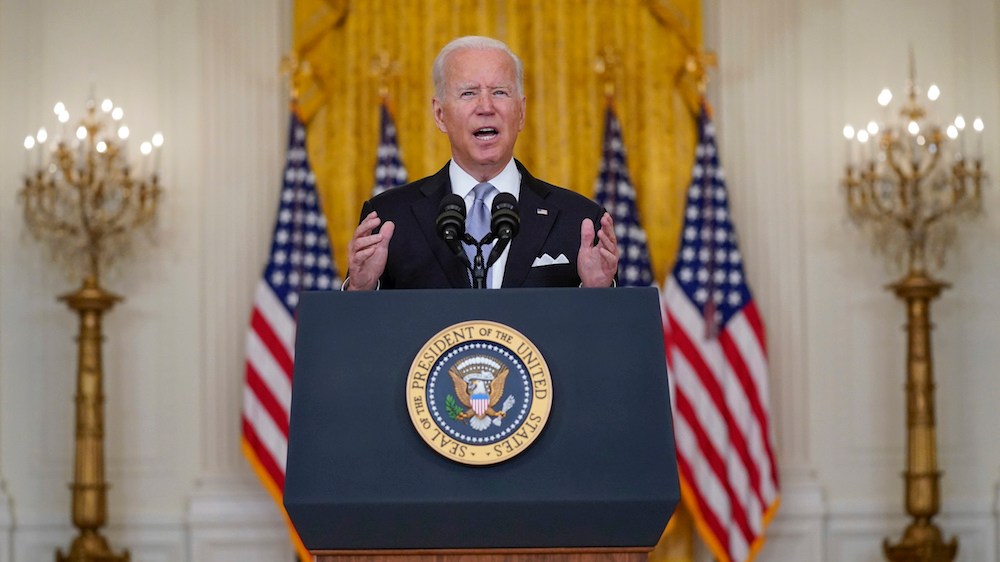
After searing criticism from Democrats and Republicans about how he has mishandled the withdrawal of the remaining American forces, diplomats, their families and contractors from Afghanistan, President Biden interrupted his Camp David retreat to return to the White House for a speech in which he blamed the Trump administration for its failed policies relating to Afghanistan.
The only time he came close to admitting culpability for the scenes playing out on American TV screens was when he paraphrased Harry Truman’s iconic line “the buck stops with me.” Except that for Biden, the “buck” never arrives in the Oval Office. Any failure – whether at our southern border, or in Afghanistan – is someone else’s fault.
In his address, he blamed Afghan forces for not fighting hard enough. What morale and fighting spirit that remained surely evaporated when they realized Biden would no longer have their back. It didn’t help that the government was corrupt, which the Taliban used to persuade many to come to their side. The consequences for Afghan girls and women will be enormous; likewise for Afghan interpreters who helped Americans. Reports of Taliban fighters going door to door searching for them does not bode well for their future.
Military leaders had recommended at least 2,500 troops remain in Afghanistan, along with support from intelligence personnel and contractors to keep the Taliban at bay. As recently as July 8, Biden twisted their advice: “Our military commanders advised me that once I made the decision to end the war, we needed to move swiftly to conduct the main elements of the drawdown. And in this context, speed is safety.”
Clearly, speed has been the opposite of safety. “Walk, don’t run to the nearest exit” is good advice in a movie theater fire, and it should have been our strategy for withdrawal from Afghanistan.