
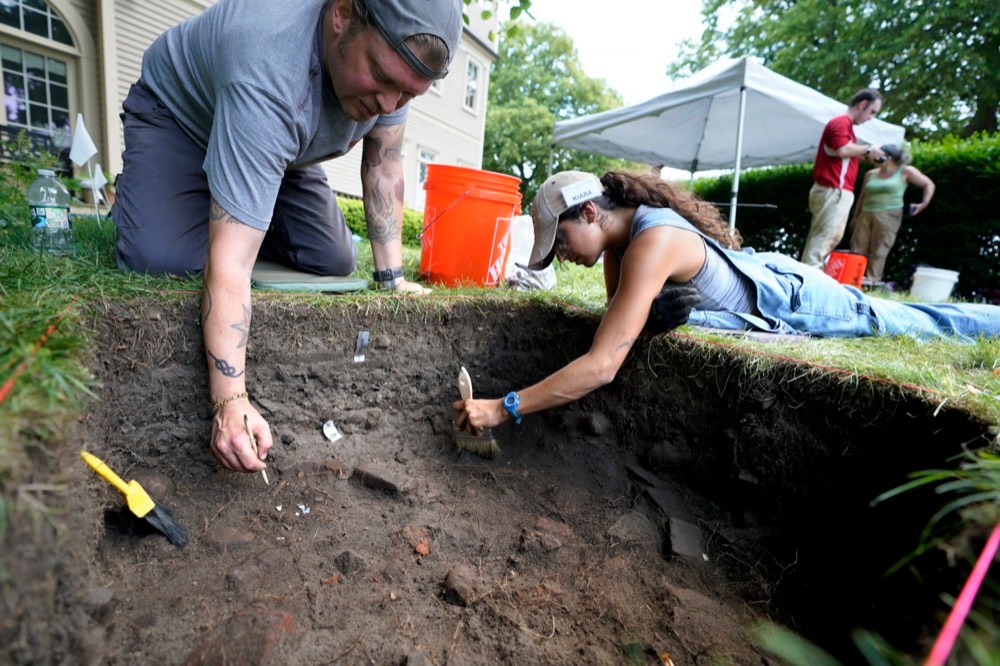
Archaeologists combing a hill near Plymouth Rock where a park will be built in tribute to the Pilgrims and their Native American predecessors have made a poignant discovery: It’s not the first time the site has been used as a memorial.
David Landon of the University of Massachusetts-Boston’s Fiske Center for Archaeological Research says his team unearthed a cache of personal items he thinks were buried there in the late 1800s, most likely by a brokenhearted settler who had outlived all three of her children.
Landon says the objects – eyeglasses, clothing, sewing implements, a pocket watch and a book – gave him chills. That’s because they turned up during final excavations of Cole’s Hill, a National Historic Landmark site in Plymouth, Massachusetts, where Remembrance Park is set to be constructed.
“Someone clearly used that space in that fashion in the past to memorialize members of their family,” said Landon, whose team spent the past month scouring the waterfront site where the Pilgrims are said to have come ashore in 1620.
“It’s an amazing array of things you don’t usually find as an archaeologist,” he said. “It plays very much to the remembrance aspect of the site. The idea of a human memorial there is emotionally powerful.”