
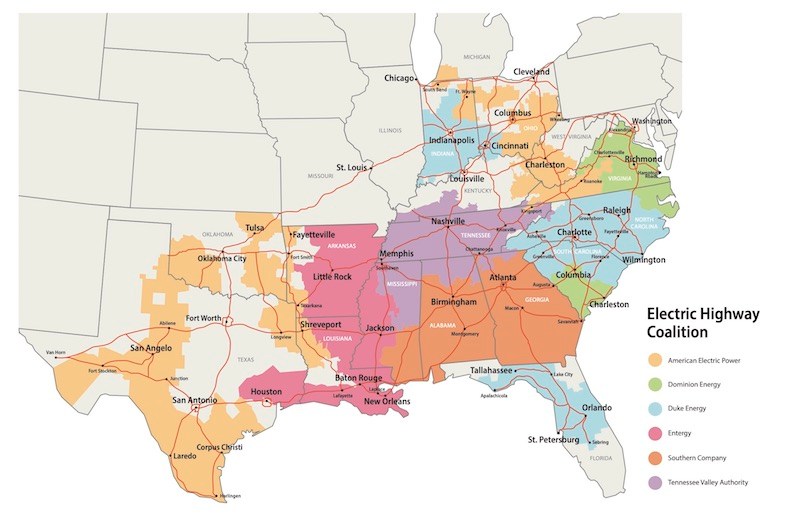
Six Southern utilities are planning to develop a network of DC fast chargers to quickly recharge electric vehicles (EV) traveling along major highways from the Atlantic Coast to the Gulf and Central Plains regions.
The plan was announced Tuesday by the Electric Highway Coalition, made up of the Tennessee Valley Authority, Southern Co., Duke Energy, American Electric Power (AEP), Dominion Energy and Entergy Corp. The companies said they are each taking their own steps to provide EV charging within their service territories and will join with other networks of rapid chargers being added by EVgo in 34 states and Electrify America, which says it should have 800 charging stations with about 3,500 DC fast chargers across the country by December, including at least two cross-county routes.
“Together, we can power the electric road trip of tomorrow by ensuring seamless travel across a large region of the U.S.,” TVA President Jeff Lyash said in an announcement of the new EV initiative. “This is one of many strategic partnerships that TVA is building to increase the number of electric vehicles to well over 200,000 in the Tennessee Valley by 2028.”
The Edison Electric Institute estimates 18 million EVs will be on U.S. roads within the next decade. While EVs can reduce carbon emissions and provide cheaper energy to power most vehicles, many drivers remain concerned with the availability of charging stations during long road trips.
The Electric Highway Coalition is not committing to a specific number of charging stations, but utlity members said they will work to build and operate enough charging options to enable long distance EV travel along major highway routes. Charging stations will provide DC fast chargers that are capable of getting drivers back on the road in approximately 20-30 minutes.