
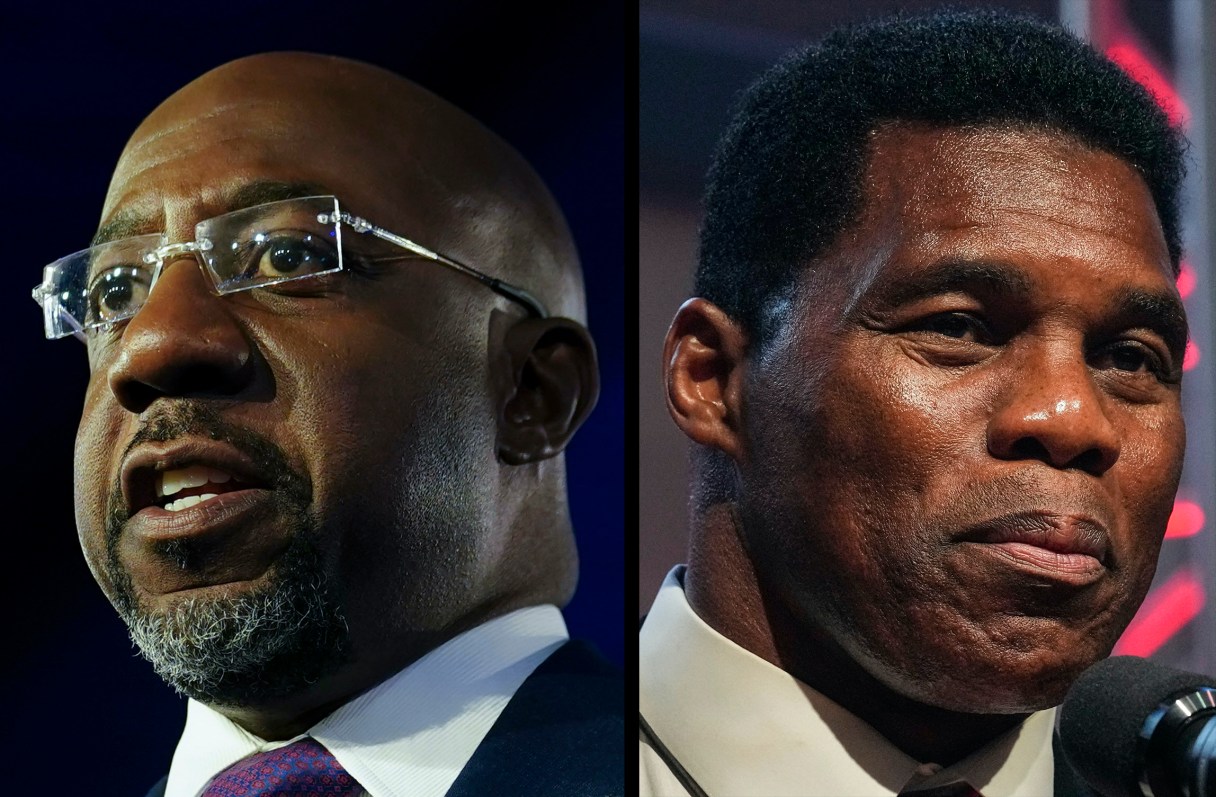
Support for U.S. Senate candidate Herschel Walker grew by about two percentage points in Tuesday’s runoff election in Northwest Georgia, compared to the Nov. 8 general election, although it wasn’t enough to propel a victory over incumbent Sen. Raphael Warnock.
There was a 10.2% drop off in voters between the general election Nov. 8 and the runoff, according to the Georgia Secretary of State’s Office, and that trend held in Northwest Georgia.
“These numbers show that the campaigns were reasonably good at getting people back for another time,” said Charles Bullock, a political science professor at the University of Georgia, in a phone interview.
The 2021 runoff had a similar percentage drop-off, while the Georgia runoffs in 1992 and 1998 had about a 40% loss between contests, he said.
Walker won in Republican-heavy counties like the ones in Northwest Georgia, Bullock said, but with a smaller number of votes — a process that “chipped away” at his potential to win. The Atlanta area carried Warnock to victory, Bullock said, giving the example of Gwinnett County, one of the big five Democrat counties in that area.
In Gwinnett County, Warnock received less than 60% of the vote in the general election, Bullock said, while in the runoff he garnered over 62%. Walker did pretty well for a candidate that had multiple scandals unfold during the election, Bullock said, and that’s likely attributed to voters sticking with the University of Georgia football star because of his affiliation with the Republican Party.
In Walker County, Walker gained 2.2% percentage points between the general election and the runoff; in Catoosa County he picked up 1.74%; and in Whitfield County 2.43% — the biggest gain percentage in Northwest Georgia.
But the loss in total voters — over 2,000 in both Walker and Catoosa Counties and over 3,000 in Whitfield County, for example — kept Walker from victory.
“If you don’t want Atlanta calling all the shots… VOTE!” wrote Janice Williams in a social media post a day before the runoff.
The Ringgold resident said it was unfortunate so many Northwest Georgia conservatives didn’t vote.
It’s important for people in Northwest Georgia to vote, she said in a phone interview, because Atlanta’s population is significantly higher. According to the 2020 Census, the total population of Northwest Georgia’s seven counties is 378,508– far less than the 496,461 who live in Atlanta.
Williams said she doesn’t know why the same people who supported Gov. Brian Kemp so strongly didn’t also support Walker.
“I just don’t understand it,” she said, adding that the Senate runoff election did seem like choosing the “lesser of two evils.”
Only 45.35% of Walker County registered voters cast their ballots in the runoff, while 50.49% of registered voters statewide turned out for the runoff, the Secretary of State’s Office reported.
The Warnock campaign was more aggressive with advertisements and contact by phone and text message, Williams said, noting that her phone has an Atlanta area code.
“No policy comments or opinions, it was all personal” against Walker, she said about the phone calls and texts she received.
Zero pro-Walker phone messages came from the Walker campaign, Williams said, and Warnock ads on television and social media outpaced Walker ads by as much as 5-to-1, she said.
The number of contacts by text and phone was so frequent it bordered on harassment, Williams said. The AP reported that Warnock raised three times more than Walker, and Williams said she thinks it made a difference in the election.
Debby Peppers, chairwoman of the Whitfield County Democrats, commented on the runoff’s election results.
“Of course I’m happy we won, but I’m disappointed that the Democratic turnout wasn’t that good,” she said. “Messaging is something we’re going to have to work on to let people know more about who we are and what we stand for.”
In the General Election, 6,904 Whitfield County residents (25.68% of the vote) voted for Warnock, and that dropped to 6,055 (25,47%) in the runoff. Walker increased his win percentage in Whitfield County from 72.10% in the General Election to 74.53% in the runoff — the biggest jump in Northwest Georgia counties.
Peppers said the surge in support for Walker in Whitfield County could be attributed to the Republican challenger hosting a rally in Dalton the week before the election and a shorter window for early voting.
Whitfield County had 16 days of early voting for November’s general election, which included two Saturdays. There was only a week of runoff early voting, and county elections officials decided not to have Saturday voting for the runoff.
Peppers said she received several complaints from students who had trouble getting their absentee ballots mailed in the shorter early voting window. There were also long lines for early voting, and she said people with long commutes had difficulty getting back to vote in time because polls and drop boxes closed at 5 p.m. most days.
People didn’t vote for Walker because he was a good candidate, Peppers said, it was because he was a Republican. Back in the old days, Peppers said people would say they’d vote for a yellow dog if he was a Democrat — and now she said Georgia has yellow dog Republicans.
Contact Andrew Wilkins at awilkins@timesfreepress.com or 423-757-6659. Follow him on Twitter @tweetatwilkins.