
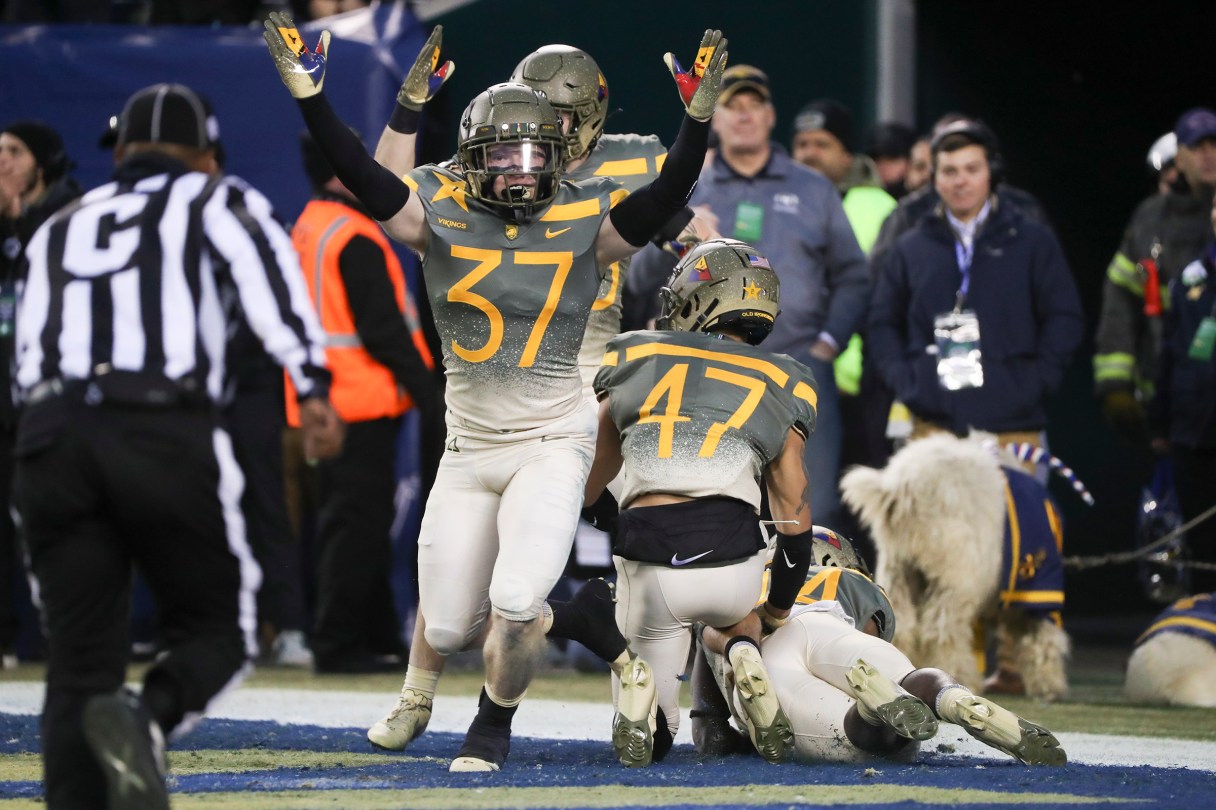
PHILADELPHIA — Navy running back Anton Hall Jr. collapsed to the ground and buried his face in his hands. West Point cadets spilled from the stands onto the field and joined Army players who ripped off their helmets and ran around in celebration.
Hall’s push toward the end zone in the second overtime resulted in a fumble that Army recovered. The Black Knights went from potentially playing for a tie to simply playing for a winning score.
“Somehow, the ball got loose and we hit that thing when we needed to,” Army coach Jeff Monken said.
Quinn Maretzki kicked the winning 39-yard field goal after he had sent the game beyond regulation with a 37-yarder late in the fourth quarter, leading Army past the Midshipmen 20-17 on Saturday in the first overtime contest in the 123 matchups of “America’s Game.”
“It’s obviously a big moment, but I try my best to put that aside,” Maretzki said. “Just being able to block everything out, (my teammates) just made that job so easy for me. So I just had to go out there and not even really think.”
Hall, who earlier raced 77 yards for a touchdown and a 10-7 lead, coughed up the ball as he plunged toward the end zone, and he stood crestfallen as Maretzki prepared to kick the winner. Hall dropped to the ground as the ball sailed through the uprights, and he was consoled by teammate Amin Hassan. But the fullback’s fumble forced by Austin Hill and recovered by defensive lineman Nate Smith will forever be etched on the highlight reel of game-changing plays in the series.
“The game is not lost with him. That could happen to anyone that was carrying the ball on that one play,” Navy quarterback Xavier Arline said. “They made a good play. That’s football. That’s life. The game was not lost within that one play.”
Navy coach Ken Niumatalolo stood hunched on the sideline and could not stomach to watch the final field goal.
“What do you tell them when you get your heart broken?” Niumatalolo said. “We were in the driver’s seat. We were feeling pretty good. Unfortunately, the game slipped out of our hands.”
The offenses were stagnant throughout until the waning moments of regulation, when Maretzki kicked the 37-yarder with 1:53 left to tie the game at 10. A thrilling overtime followed.
The NCAA instituted overtime in 1996, and the series had never had to go a little extra to settle one of the sport’s greatest rivalry games.
Army’s Markel Johnson ran 25 yards for a touchdown on the first play of OT for a 17-10 lead, and Navy matched the Black Knights when Arline tossed a 25-yard touchdown pass to Maquel Haywood that made it 17-all.
It was Navy’s first completion of the game, and Arline had perhaps the sweetest 1-of-1 for 25 yards passing line in Navy history. He also rushed for 102 yards.
Navy still leads the series against Army 62-54-7. The Black Knights, though, have won five of the past seven meetings.
Army finished the season 6-6, while Navy wound up 4-8.
“This team never stopping fighting, they never stopped believing,” Monken said. “Somehow, some way, we found a way to get it done tonight. It was an epic battle. It was one I’ll remember for a long time, probably forever.”
The teams combined for only 53 passing yards.
One of Cade Ballard’s rare throws for Army was a success when a pass interference call brought the ball down to the 28 with four minutes left on a drive that set up Maretzki’s tying field goal. Ballard finished 2-of-10 for 26 yards.
Hall’s run up the middle in the third quarter was the biggest burst of offense of the game for either team — at that point, that run alone had outgained Army’s 69 total yards — and a double gut punch to the Black Knights after quarterback Tyhier Tyler had a 40-yard touchdown run wiped out on a penalty on the previous possession.
Hall provided one of the few highlights in a game full of wobbly punts, errant throws and a dearth of first downs.
The first spark came in the final seconds of the first half when Army’s Noah Short blocked Riley Riethaman’s punt and Jabril Williams recovered — after almost knocking the ball out of the end zone — for the touchdown and a 7-3 lead.
That bit of excitement in front of a packed house of 69,117 at Lincoln Financial Field just about made up for 29 minutes of two offenses that could not move the ball downfield.
The first half ended with 0 passing yards. That stat of futility wasn’t necessarily uncommon for either program. Navy won two games this season without completing a pass, and Army threw for 852 yards all season long, about 2 1/2 games of yardage on the same field for Philadelphia Eagles quarterback Jalen Hurts.
With points at a premium, Navy sent out Bijan Nichols for a long field goal, and his 44-yarder hugged the inside of the right goal post for a 3-0 lead in the second quarter. Army finished the first half 0-for-5 passing, was 5-for-6 on third-down conversions and had 33 total yards at that point.
This game is rarely about quality football anymore, with the focus on the pageantry and revelry of cadets and midshipmen standing, bouncing and cheering for their academy. The hours before kickoff were highlighted by the Army Corps of Cadets and the Brigade of Midshipmen marching onto the field. The Navy “Leap Frogs” parachute team earned a roar from the crowd with each safe landing on the field. Mark Wahlberg even made an appearance and leaped into a crowd of midshipmen and then received an award for his work with the military.
It was the 90th time Army-Navy was staged in Philadelphia, including 38 straight from 1945 to 1982. The game will be played elsewhere the next four years — Foxborough, Massachusetts (2023), Landover, Maryland (2024), Baltimore (2025) and East Rutherford, New Jersey (2026) — before returning to the City of Brotherly Love in 2027.