
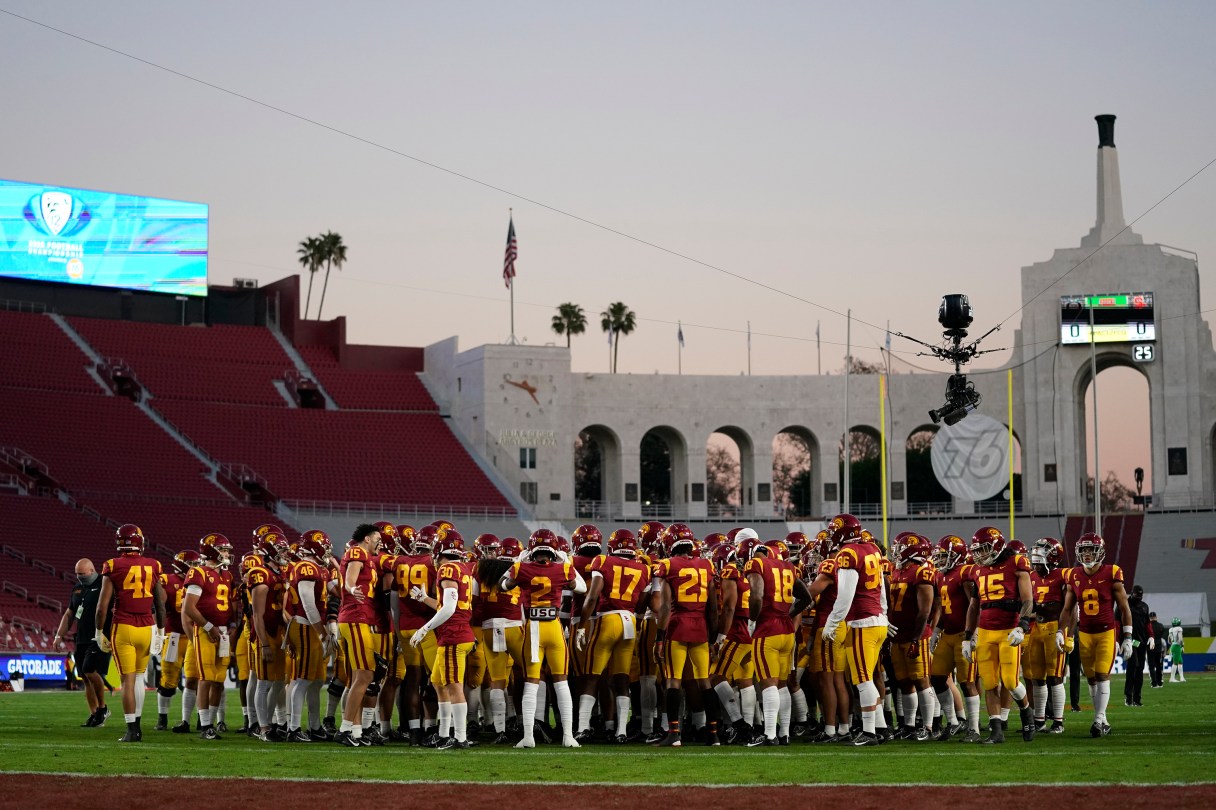
Kyle Kallander has a unique perspective on the latest round of chaos in college athletics. As the final commissioner of the late, great Southwest Conference, he knows nothing is sacred.
Certainly not these days, when everyone is chasing the almighty dollar more than ever.
History and tradition? Those terms carry no weight in what has essentially become a game of Risk, with the Big Ten and the Southeastern Conference taking turns rolling the dice to determine how to divvy up the world of college football.
“Depressing is the first word that comes to mind,” said Kallander, who now leads the Big South Conference, a Football Championship Subdivision league based in North Carolina.
With UCLA and the University of Southern California bolting for the Big Ten – and every indication that more jarring changes are coming – the Pac-12 could very well join the Southwest Conference in the dustbin of history. For that matter, the Atlantic Coast Conference might soon become unrecognizable to its longtime fans, if it even survives. And the Big 12 is looking more and more irrelevant, scurrying around like a mouse seeking whatever crumbs will keep it alive.
Back in 1995, Kallander took over the thankless duties of overseeing a dead man walking as the Southwest Conference completed its final school year.
He knew what he was signing up for with the lame duck league, but it was still a bit jarring to deal with the reality of a historic conference – which had been around since 1914, producing some of the greatest teams, rivalries and players in college football history – going out of business.
“That last year was a great in a lot of ways. We had a great celebration of the history of the conference. We had a lot of success athletically that year,” Kallander recalled in a phone interview Friday.
“But then,” he added, “we got to March and April. It was like overseeing a funeral and holding an estate sale and giving last rites. It got a little bizarre at the end.”
The Pac-12 was apparently caught totally off guard when UCLA and USC defected to the Big Ten, much like the Big 12 was a deer in headlights when its two most prominent programs, Oklahoma and Texas, stunningly announced plans last summer to abandon ship for the SEC. The downfall of the Southwest Conference proceeded in much the same fashion, pushed along largely by the same issue driving the current state of affairs: college football television revenue.
While the Southwest shot itself in the foot with plenty of scandals in the 1980s (resulting most notably in the death penalty for SMU), and was clearly on shaky ground after Arkansas left for the SEC in 1991, Kallander arrived at the conference office in Dallas a year later as assistant commissioner to find plenty of hope for survival.
False hope, it turned out.
“All of us still felt there was no way the conference was going away,” he said. “There was too much history.”
 AP photo by Ben McKeown / UNC Asheville basketball player Dwayne Sutton, right, accepts the Big South Conference tournament MVP award from commissioner Kyle Kallander in March 2016. Kallander’s experience as the final commissioner of the Southwest Conference before it folded in 1996 gives him a unique perspective on the latest round of chaos in college athletics.
Indeed, for those who may have forgotten, the Southwest Conference produced five Heisman Trophy winners and four Associated Press national football champions during its storied existence.
None of that mattered when the Big Eight, which had been in talks with the Southwest regarding a joint media venture, decided instead to just pluck off the four most lucrative members – Baylor, Texas, Texas A&M and Texas Tech – and carry on as the Big 12. The four remaining Southwest members found new homes in less prominent conferences, and that was that.
“We had the rug pulled out from under us by the announcement of the Big 12,” Kallander conceded. “It was shocking to everybody, including some league ADs who didn’t see it coming.”
That sounds very much like today’s Pac-12, which didn’t seem to sense at all that its two Los Angeles behemoths were chatting up the Big Ten. Now the vultures are hovering overhead, eager to pick through the remains.
Oregon and Washington could soon follow UCLA and USC to the Big Ten, which is set to become a 16-school monstrosity stretching from coast to coast. The Big 12, which has more lives than a cat, is reportedly eyeing Oregon and Washington, as well, along with other Pac-12 scraps such as Arizona, Arizona State, Colorado and Utah. No one seems to want Oregon State or Washington State, while academic powerhouses California and Stanford may have to decide whether to downgrade their football programs rather than join de facto pro leagues, especially in the wild, wild world of name, image and likeness.
On the opposite coast, the ACC could soon find itself in a predicament similar to the Pac-12. League and national powerhouse Clemson has long been reported to have its sights on the SEC, and Florida State could be another defector (though the Seminoles’ football program has recently fallen on hard times). If the Big Ten wants to expand its national footprint even more, North Carolina (perhaps in tandem with Duke), Georgia Tech and Virginia are potential targets.
The ACC’s best hope for survival would appear to be somehow persuading Notre Dame to join as a football-playing member, but that’s likely nothing more than a pipe dream. If the Fighting Irish give up their treasured gridiron independence, it almost certainly will be to join the Big Ten. The ACC might have enough schools and potential new members to carry on in some format, but the conference would be a hollow shell of itself.
No one knows how this will all shake out, but there are plenty of reasons to be discouraged at the potential outcome.
Kallander had a front row seat the last time a major conference threw in the towel and saw how it destroyed so many glorious traditions. Now he’s watching it all again, which is especially painful since he’s also a graduate of Washington.
“I think of all the great history, the rivalries and traditions of USC,” Kallander said. “They were a huge rival of ours in football when I was back in Washington in the 1980s and early ’90s. To see that fracture is real unfortunate.”
He’s not naive, of course. Kallander knows dollar signs have always been the driving force behind college athletics.
A privileged group of schools are going to be much richer when this dust finally settles.
But at what cost?