
As sickness and injury go, I’ve been pretty lucky in my life. I did have a concussion at age 12 when I fell off my horse and cracked my head open on the pavement. It was an exciting time, and I got some cool presents while I was in the hospital. But I’ve had no other bones larger than a toe broken and no serious medical problems to speak of. I had surgery on my thumb a few years back, and then again about a year ago on my wrist, but those events were minor, and I didn’t get any presents. I’m not saying I was disappointed, but it seems like it wouldn’t have been a lot to ask.
Now, however, it seems my luck may be running out. Suddenly I have a persistent pain in my right elbow that alternates between a dull ache, a burning sensation and the feeling of important tendons ripping away from important bones. The exciting name for it is lateral epicondylitis; the uninteresting name for it is tennis elbow. Tennis elbow is a bit of a misnomer, because I don’t play tennis, but I’m not here to argue semantics. I’m here to tell you, in case you don’t already know, that pain is boring.
On a pain scale where 1 is “little to no pain” and 10 is “every word you know that is too dirty for church,” my tennis elbow pain hovers at about a 6 throughout the course of a day, as long as my arm is hanging at my side, unemployed. But if I try to use my arm like a real arm, say, to get dressed, wash dishes, carry groceries or retrieve a cup of coffee from the microwave, the pain can approach a 7 or 8. When I play pickleball, which some say I should not do, being as it was the birth mother of my elbow problems, my pain shoots up to every bad word I know plus a few I’m just learning. Which is all to say that my arm hurts a lot, almost all the time.
I don’t know anyone who likes pain. I’ve never liked it, either in myself or in others. I think it has to do with how I was raised. In my family, you were either in constant pain, like my father, who suffered daily headaches and backaches, or you had no pain receptors in your body whatsoever, like my mother, who went through colon cancer wide-eyed and without complaint and who expected the same level of endurance from her children. We had the usual stomach viruses, one or two spectacularly bloody skateboard misadventures and the above-mentioned concussion, all of which were, in her book, inconvenient and received only the amount of attention necessary to convey a message: “Get well. SOON.”
Somehow, I married a man with the physical fortitude of a gnat, which is unfortunate for both of us, because it means that he falls ill easily and that I am therefore annoyed a lot. Were he more like my mother, I might not even know about the episodes of violent vomiting or the unremitting, brain-sizzling fevers, but he’s not like my mother. Not only do I know about them, which he pretty much insists upon, I have been expected to do things about them, like fetch tea, speak sweetly and not be enraged by darkened rooms or pleas for quiet. Pain, boring as it is when it’s yours, is utterly mind-numbing when it’s someone else’s.
Like some sadistic circular loop that is impossible to escape, pain makes you do boring things. It’s as if pain is not happy unless it is causing more of itself. In my case, a few nights ago as I was convalescing after a day of immense arm pain (i.e. many, many bad church words), it suddenly occurred to me that I had never watched “The Blue Lagoon.” “The Blue Lagoon” is a movie that came out roughly a thousand years ago in 1980 and stars Brooke Shields decades before she ever thought about pairing up with Andre Agassi (who may or may not have true tennis elbow from playing true tennis). Prior to being in pain, I have never been even slightly curious about “The Blue Lagoon”; I knew from the day it came out that it was an atrocious movie that traded on people’s desire to ogle a stunning, scantily clad 14-year-old Brooke Shields as she ran around a deserted island with an equally stunning teenage co-star, Ford model Christopher Atkins, pausing frequently to take long, sensuous dips in the water.
I was unable to watch more than a few minutes, fast-forwarding through the setup (as little more than toddlers, Shields and Atkins, who are (thankfully) not related, survive a shipwreck, only to find themselves still there as adolescents, living happy (if intellectually unchallenging) lives on a deserted island and having conversations like this one:
Shields (stunning in a one-piece cotton shift and with humidity-defying long hair that always appears salon-fresh and lies obediently in a partial braid down her back): “I don’t know why I’m so mean to you all the time. I think it’s these thoughts I’m having about us.”
Atkins (equally stunning, wearing only a loincloth and with six-pack abs you can apparently get by spear fishing): “What kind of thoughts?”
Shields: “Oh I don’t know. They’re stupid. I’m sure they don’t mean anything. Let’s swim!”
Atkins: “OK!”
This was the point at which I used my good arm to emphatically shut off the TV. Later that night and most of the next day, however, I found myself returning again and again to the movie, plagued by one persistent, massively boring thought: If you’ve lived half your young life on a desert island with one other person who is not female and not a hairdresser, would you, in fact, know what a braid is?
This is the place pain has delivered me to.
Dana Shavin is the author of “Finding the World: Thoughts on Life, Love, Home and Dogs, a collection of 20 years’ worth of her columns, and “The Body Tourist,” a memoir of recovery. Email her at danaliseshavin@gmail.com. Follow her on Facebook at Dana Shavin Writes. More at Danashavin.com.
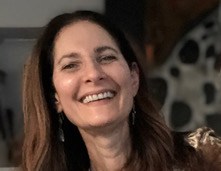
 Dana Shavin / Contributed photo