
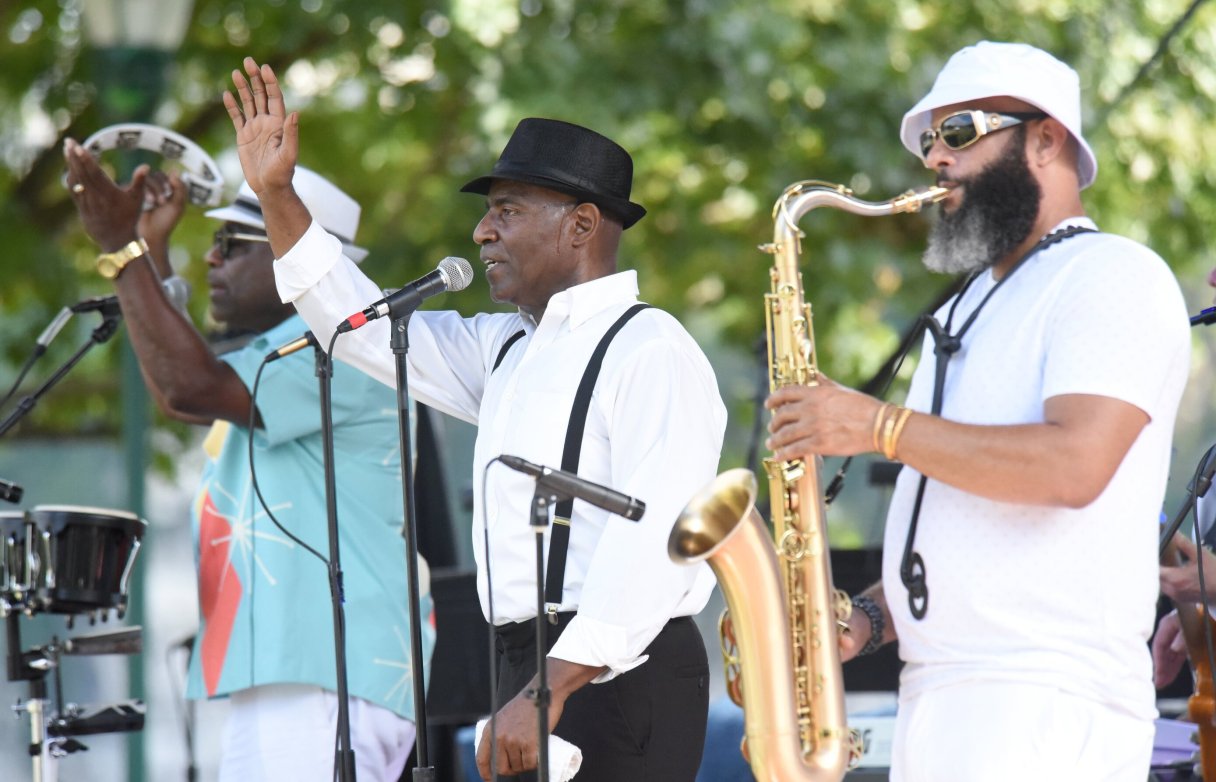
Note: The photo caption was corrected to correctly identify Howard Brown.
A week into the Chattanooga Music Census, organizers and partners in the data-gathering project are encouraged by the number of responses they’ve received but are ready for more.
Donna Elle Harrison, director of cultural tourism and inclusive marketing at the Chattanooga Tourism Co., said she was happy with the early number of respondents, but added, “We want everybody who is involved in the music industry in our area to take the census. Everybody.”
The Chattanooga Music Census is led by Chattanooga Tourism Co. in partnership with the city of Chattanooga, ArtsBuild and Sound Music Cities, through funding provided by Lyndhurst Foundation. Harrison, Kathleen Nolte, program director at the Lyndhurst Foundation, and James McKissic, president of ArtsBuild, the city’s largest promoter of the arts, spoke to the Chattanooga Times Free Press via Zoom this week to discuss the project.
The goal of the census, they said, is to take stock of where the local music industry is now and where it can, and should, go in the next five to 10 years.
Once the results are in, Harrison said they will be shared with the more than two dozen organizations or partners involved in the project.
“We are going to need everybody,” Harrison said, “but today we don’t know what our issues or our solutions are going to be, and that makes people nervous because it seems messy. To me, that is exciting.”
For McKissic, it’s about getting hard data. He said having actual numbers makes going to organizations like the Tennessee Arts Commission for grant money easier, and it helps organizations like ArtsBuild know where it should put its resources.
“Details are so important,” he said. “One of the things that would come to the forefront was that artists wanted more support for individuals and for grassroots artists and organizations.”
The census, which is anonymous, asks respondents to list challenges or issues they’ve encountered, such as mental health, ageism, sexism or racism. It asks people to detail what their job entails and how it fits into the industry overall.
The challenge, according to Harrison and Nolte, is getting the word out that the survey is taking place and that any and all answers from a variety of people in all demographics is wanted and needed.
Terry Clouse, 57, and Valitus Edwards, 72, have been playing music locally for several decades. Neither had heard of the census when contacted by the Times Free Press by phone. Edwards completed the census a short time later and said he appreciated the opportunity for self-examination.
He added that as the leader of local party band Love, Peace & Happiness for the past 28 years, he might be in a different place than some younger musicians.
“I consider myself fortunate maybe to have not had some of the problems that some others might have,” he said. “I never tried to make music my livelihood. For me, with marriage and children when I was younger, I knew I needed to make a living and go to school and that music would not provide that.”
He added that when people reach out to book his band, they don’t consider the amount of equipment they need, the travel time or the rehearsal time it takes to learn new material when negotiating the band’s fee.
He thought the census and the results could help others better deal with some of those issues.
Micah Chapman, co-founder of the Hip-Hop Summit taking place this week in Chattanooga, is one of the partners for the census project and said organizers have been encouraging summit attendees to fill out the census. He believes the data is necessary and important for him as an event planner and for the community as a whole.
He said he is trying to make the summit as big as Riverbend or other local successful events and being able to learn from others would be a tremendous boost.
“We have so much music in our community,” he said. “For me, (taking the survey) made me look at myself as an event coordinator and realize there are so many other people out there doing the same thing. How do they deal with venues, or artists? I hear promoters or artists say, ‘How do I get in there? I can pay for the venue, but how do I get in touch with the person?’ This can help in figuring out where everyone is, and by sharing that experience level and housing that information, we can hopefully highlight and present this diversity so that everyone has a turn.”
Tom Zutaut, best known as the guy who signed Mötley Crüe to Arista Records in 1981, moved to Chattanooga about three years ago and believes Chattanooga is “on the verge of a renaissance.”
“I see it the next city to emerge as a musical force,” he said. “The city needs to find a way to support and promote it and it sounds like this could be it.
“I love it here. I’ve never leaving.”
The census is available online and will be open through early November at visitchattanooga.com/music-census. It can be completed by anyone 18 and older who works in the music industry in any capacity and lives in Hamilton, Marion or Sequatchie counties in Tennessee and Catoosa, Dade or Walker counties in Georgia.
Organizers will present the results to the public for input and will then form a strategic plan. The partners will start breaking it down to see what people think the music community wants and needs and the partners will then see how or where they fit in.
Harrison is a former local radio personality and said she especially hopes the people who have felt left out will participate.
“To the cynics, I was that person before, and I understand,” Harrison said. “I felt like I was an influencer for 20 years, but I wasn’t part of the last survey in 2013. I would say to the skeptical people, be skeptical if you want, but you may miss out on the opportunity to express your opinion on something that needs to be expressed.”
Contact Barry Courter at bcourter@timesfreepress.com