
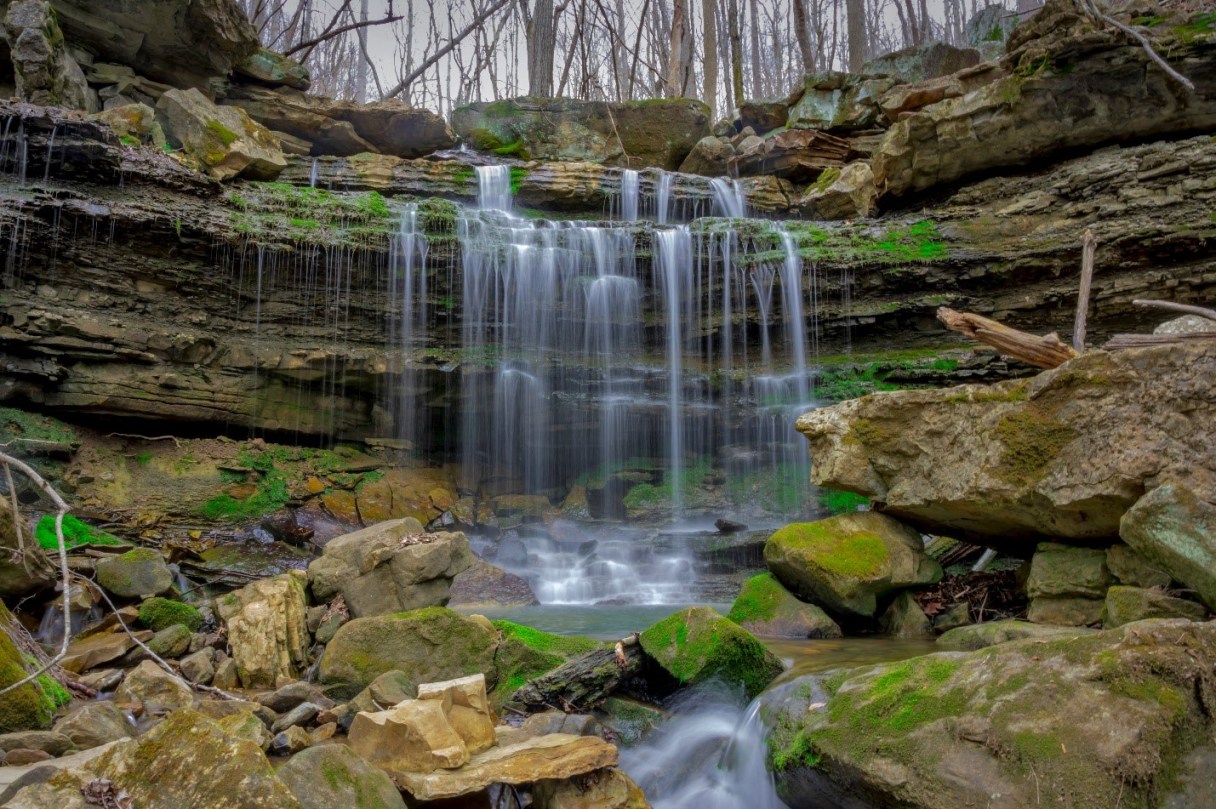
NASHVILLE — State officials announced Thursday that one of the state’s premiere parks, Fall Creek Falls State Park, will be acquiring an additional 833 acres of land thanks to a purchase arranged by multiple partners to expand the park’s already extensive footprint on the rugged Cumberland Plateau.
The acquisition came about as a result of a collaboration by TennGreen Land Conservancy, The Nature Conservancy in Tennessee and the Conservation Fund and purchased with the support of the Open Space Institute and the Chattanooga-based Lyndhurst Foundation, according to a news release from the state Department of Environment and Conservation.
The park in Van Buren County, one of the largest and most visited state parks in Tennessee, already encompasses more than 29,800 acres on the Cumberland Plateau in Van Buren County.
“This is a magnificent addition to this popular state park,” Tennessee Department of Environment and Conservation Deputy Commissioner Greer Tidwell said in a statement. “We are grateful to the partners who put this acquisition together. They serve Tennesseans in outstanding ways, and we look forward to park visitors enjoying this expanded boundary of the park.”
The property is within the Dry Fork watershed. It contains nearly nearly 5 miles of streams, including Dry Fork, Benton Branch and Mount Pleasant Branch. Waters from these streams flow within the park to Cane Creek. In addition to pristine waters, the property is within the headwaters of numerous nearby caves, officials said. The land also serves as a buffer area that protects several known Indiana bats (Myotis sodalis) and other rare species.
During a visit to a cave on the property, Tennessee Wildlife Resources Agency scientists documented the threatened tricolor bat (Perimyotis subflavus), according to the Department of Environment and Conservation.
The property shared nearly a mile of its border with the park and contains steep bluffs, rock houses and caves that provide significant habitats for species threatened by climate change.
(READ MORE: Fall Creek Falls State Park’s new $2.7 million visitor center opens)
The land lies within the Cradle of Southern Appalachia Initiative, a conservation blueprint adopted by the Thrive Regional Partnership’s Natural Treasures Alliance (of which TennGreen Land Conservancy is a partner). Although the tri-state region around Chattanooga is one of the most biodiverse areas in the world, only 15 percent of the area is protected. Acquisition of this property is the most recent step among decades of collaborative efforts to expand conservation work in the region, officials said.
“Like many places in Tennessee, and in large part the result of its scenic beauty, the Southeast region’s population is booming — putting its natural assets at risk,” Alice Hudson Pell, interim executive director of TennGreen Land Conservancy, said in the news release “The Natural Treasures Alliance’s goal is to double the amount of conserved land within this region by 2055, improving water quality, protecting at-risk species, fostering conservation awareness and education, and expanding open space for the health of our communities.”
TennGreen Land Conservancy is “proud to play a role in advancing these efforts” through the expansion, Pell said. She thanked project partners from the Open Space Institute, The Nature Conservancy in Tennessee, The Conservation Fund and the Department of Environment and Conservation.
“Fall Creek Falls State Park, and public land in general, is a huge driver of Tennessee’s recreation economy,” Ralph Knoll, The Conservation Fund’s Tennessee state director, said in the release. “This addition of state park land is a perfect example of how environmental protections and economic sustainability can go hand in hand, and how partnerships can make it happen.”
Joel Houser, Southeast field coordinator for Open Space Institute, said in the release that expanding the park’s footprint and securing fragile forests are “important to all of us” in the state, and thanked groups for “their outstanding efforts to protect this property, forever.”
(READ MORE: Pilot program seeks to ease climate change in Chattanooga-area communities)
The acquisition was funded through the Open Space Institute’s Appalachian Landscapes Protection Fund, and the Lyndhurst Foundation. The Open Space Institute’s fund supports land protection along the Appalachian Mountain range.
The area is home to the world’s largest broadleaf forest, stores most of the nation’s forest carbon and provides essential refuge for plants and animals at risk of habitat loss from climate change, according to state officials.
The fund is made possible thanks to major support from the Doris Duke Charitable Foundation and additional funding from the Lyndhurst Foundation, Riverview Foundation, Footprint Foundation and the McKee family in Collegedale.
— Compiled by Andy Sher