
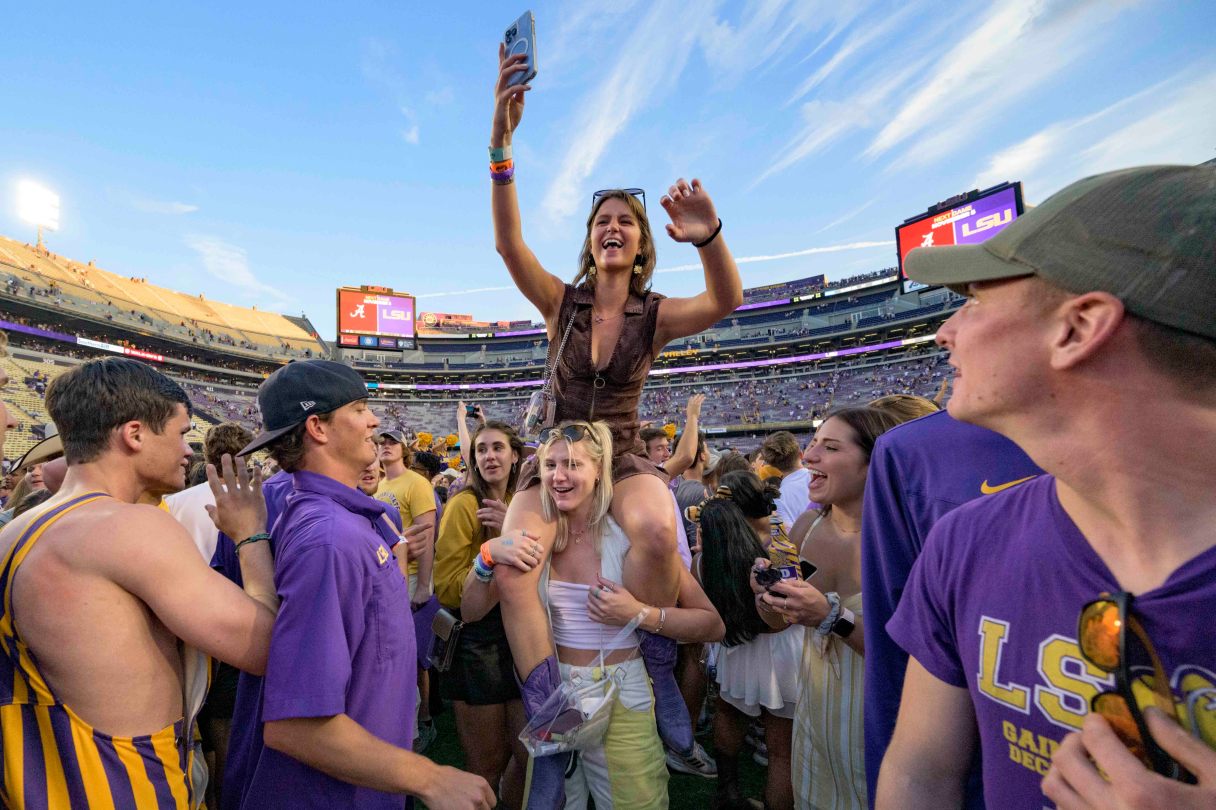
COLUMBIA, S.C. — They are iconic moments in college football: Fans rushing the field to celebrate landmark victories, almost all with joyous intentions of honoring their team’s success.
The unforgettable scenes have never been more unwelcome in the Southeastern Conference, at least by league leadership.
The SEC has tried to curtail crowd rushing for nearly two decades with hefty fines and pregame planning amid concerns about safety and potential liability.
“When people want to go, they want to go,” league commissioner Greg Sankey said on the SEC Network last week. “But we have to retrain people to stay in the stands.”
Fans at Neyland Stadium in Knoxville filled the field after the Tennessee Volunteers ended a 15-game losing streak to Alabama with a wild 52-49 victory on Oct. 15. There was barely space to move — Crimson Tide players and staff had trouble finding a clear path to the visitors’ locker room — and fans tore down the goal posts and took them to the Tennessee River.
Days after that, a video emerged that appeared to show Alabama receiver Jermaine Burton making deliberate contact with a female fan while coming off the field at Neyland.
“I talked to him,” Tide coach Nick Saban said at the time. “He was scared. I was scared. Some of our other players were scared.”
The SEC has had a policy on field or court storming in place since 2004. Currently, it fines a school $50,000 for a first offense, then increases it to $100,000 for a second offense and $250,000 for each one after that. The fine money is deposited into a league fund for postgraduate scholarships.
The SEC fined Tennessee $100,000 for its second violation of the policy. The LSU Tigers, whose fans rushed the field moments after last Saturday’s 45-20 home win over previously unbeaten Ole Miss, were docked $250,000 for a third violation.
Brian Kelly, a former Notre Dame head coach in his first leading LSU, was doing an on-field postgame interview when his police detail told him to leave as people rushed forward.
“It didn’t appear to me there as anything in my mind where this would be a game where we would storm the field. Let’s do more of it, I guess. I hope I don’t get in trouble for that,” he said. “I mean, let’s win more.”
Williams-Brice Stadium was sold last Saturday night when host South Carolina won 30-24 to beat Texas A&M for the first time since the Aggies joined the SEC in 2014. Security personnel surrounded the field late, and several announcements were made cautioning people to stay off the field. Some in the crowd booed, but they remained in the stands as the teams exited.
Other Power Five conferences have different ways of dealing with field storming.
In the Big 12, schools are fined only if there isn’t a clear path for teams to get off the field and into their locker rooms. Fans overstepping their boundaries led to public reprimands and $50,000 fines this season for TCU (after an Oct. 1 win against Oklahoma) and Texas Tech (after a Sept. 24 overtime victory against Texas).
TCU was not fined for fans on the field after the Horned Frogs topped previously unbeaten Oklahoma State in double overtime two weeks ago, but TCU athletic director Jeremiah Donati said on social media that the school “fell short of meeting the conference’s sportsmanship standards post-game. We must always be respectful to the opposing team when celebrating in these moments.”
The Atlantic Coast Conference has no policy on field storming, spokesman Kevin Best wrote in an email to The Associated Press. In fact, Clemson has a postgame routine, “Gathering at the Paw,” in which fans enter the field after all contests at Death Valley.
The Pac-12’s policy for storming the field or court is a $25,000 fine for the first offense, rising to $50,000 and $100,000 for subsequent violations. The other Power Five conference, the Big Ten, did not respond to calls or messages, though it had no policy as of 2019.
In the end, how safe you feel depends on whether you won — and perhaps where you play, South Carolina tight end Austin Stogner said.
The Oklahoma transfer had to deal with fans on the field twice last season. The first was his Sooners’ comeback victory over Texas in the Red River Showdown rivalry, which is played at a neutral site in Dallas.
“That’s when we won, so that was kind of cool. I knew all those guys,” he said.
The other was at Baylor, which won 27-14 to end the Sooners’ nation-leading 17-game winning streak.
“No one was going to hit me,” Stogner said. “I mean, it’s Baylor.”