
Tuesday, November 10, 2026Nov 10

Bills would curtail objections at future Jan. 6 vote counts

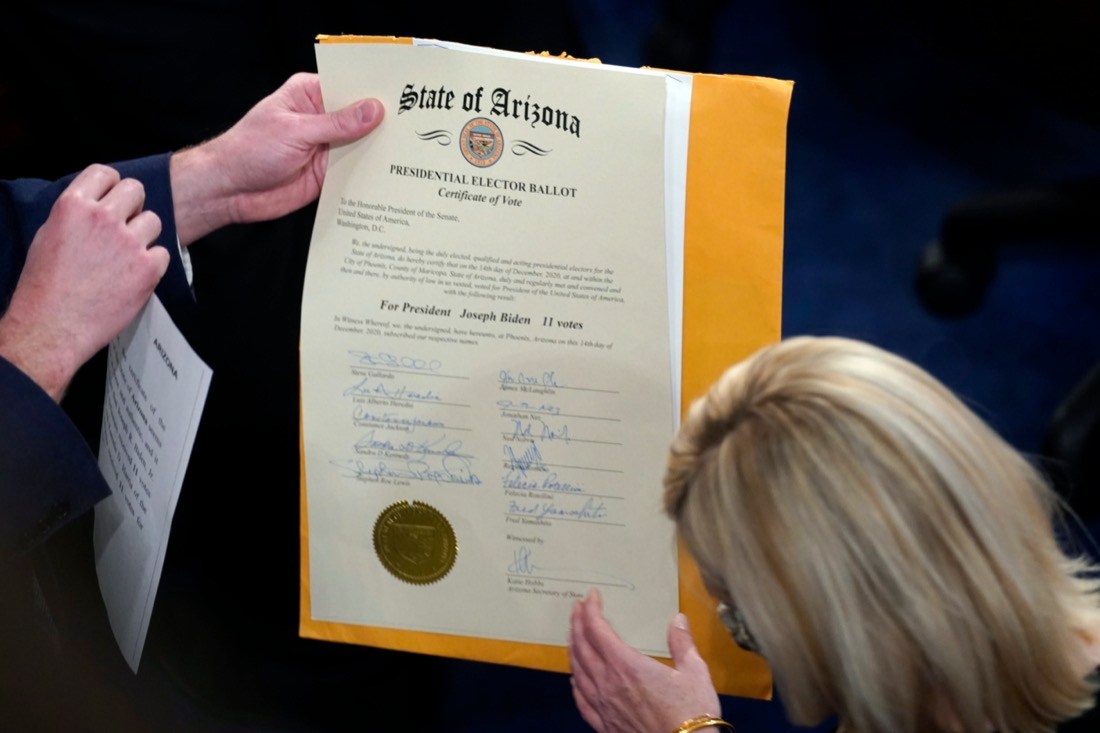
FILE - The certification of Electoral College votes for the state of Arizona is unsealed during a joint session of the House and Senate convenes to confirm the electoral votes cast in November's election, at the Capitol, Jan 6, 2021. Members of Congress have officially objected to the results in four of the last six presidential elections, a partisan practice that has been legal for over a century but became much more fraught after a violent mob of former President Donald Trump’s supporters attacked the Capitol last year. (AP Photo/Andrew Harnik, File)
FILE - The certification of Electoral College votes for the state of Arizona is unsealed during a joint session of the House and Senate convenes to confirm the electoral votes cast in November's election, at the Capitol, Jan 6, 2021. Members of Congress have officially objected to the results in four of the last six presidential elections, a partisan practice that has been legal for over a century but became much more fraught after a violent mob of former President Donald Trump’s supporters attacked the Capitol last year. (AP Photo/Andrew Harnik, File) FILE - The certification of Electoral College votes for the state of Arizona is unsealed during a joint session of the House and Senate convenes to confirm the electoral votes cast in November's election, at the Capitol, Jan 6, 2021. Members of Congress have officially objected to the results in four of the last six presidential elections, a partisan practice that has been legal for over a century but became much more fraught after a violent mob of former President Donald Trump’s supporters attacked the Capitol last year. (AP Photo/Andrew Harnik, File)

WASHINGTON (AP) — Members of Congress have officially objected to the results in four of the last six presidential elections, a partisan practice that has been legal for over a century but became much more fraught after a violent mob of then-President Donald Trump’s supporters attacked the U.S. Capitol last year.

In an effort to prevent another Jan. 6, 2021, bills moving through the House and the Senate would make it harder to lodge those objections when Congress counts the electoral votes in a joint session after every presidential election. The move to curtail the objections is part of a larger effort to overhaul the 1800s-era Electoral Count Act and safeguard the integrity of the vote after Trump tried to persuade his Republican allies in Congress to vote against Democrat Joe Biden’s victory and overturn his 2020 defeat.

Under current law, only one member of the House and one member of the Senate has to challenge a state’s results to trigger votes on that state’s electors in each chamber. If a simple majority in each chamber votes to sustain the objection, that state’s votes can be thrown out.

The House and Senate bills would each raise that threshold substantially, with the House bill requiring a third of each chamber to object and the Senate bill requiring a fifth of each chamber to object. The House legislation, passed last week, would also lay out new requirements for the grounds for an objection.

“It is just too easy to trigger an objection when it only requires one person in each chamber,” says Maine Sen. Susan Collins, a Republican co-sponsor of the Senate version. Eleven GOP senators have signed on to the legislation, which is up for a vote in a Senate committee on Tuesday.