
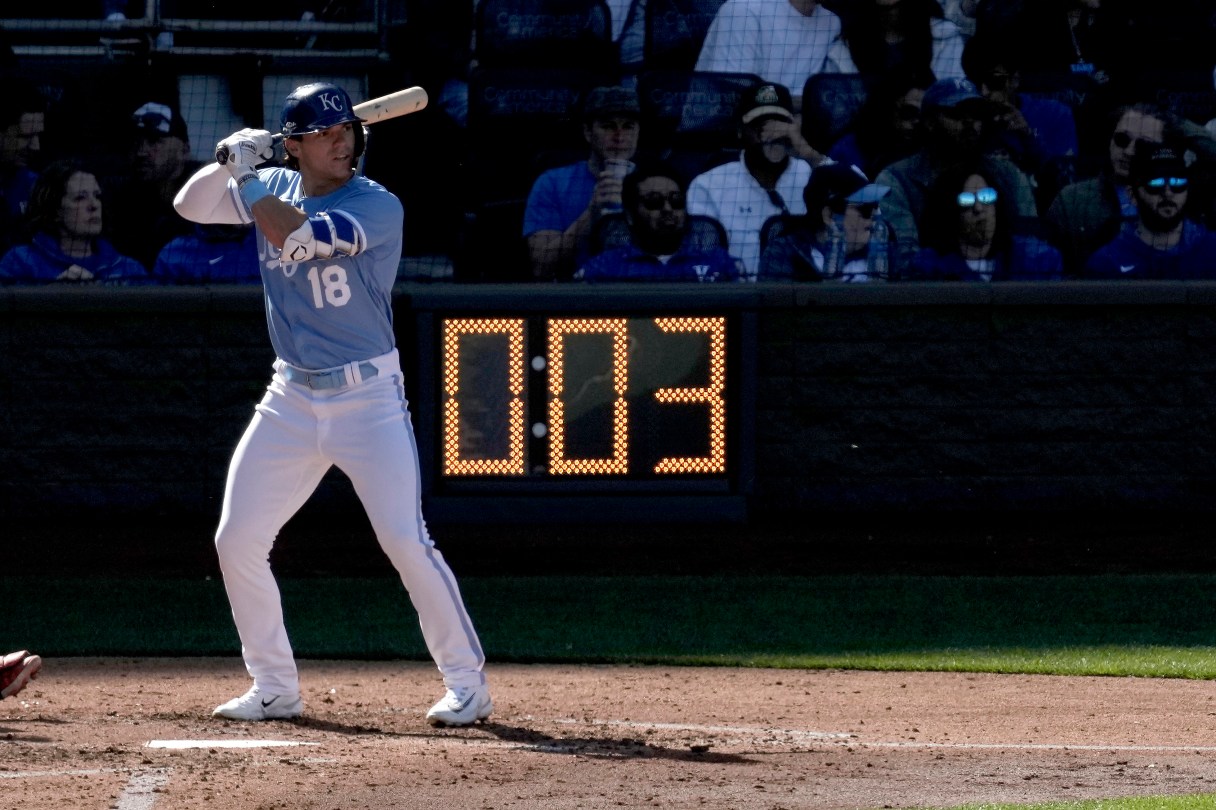
NEW YORK — Major League Baseball’s new rules worked as hoped through the first four days of the season.
The average game time has dropped by 30 minutes, stolen bases have doubled, and batting average has increased by 16 percentage points compared to last year’s opening weekend.
Games averaged 2 hours, 38 minutes through Sunday with the new pitch clock, down from 3:08 for the first four days of the 2022 season and a 3:04 final average.
In the first year of restrictions on defensive shifts, the .246 batting average for nine-inning games was up from .230 over the first four days last year, when many games were played in cold and wet weather. Left-handed batting average increased to .232 from .229 in last year’s first four days, and right-handed average went up to .254 from .230.
“We are extremely pleased with the early returns,” commissioner Rob Manfred said Monday. “Fan reaction has been positive to the brisker pace with more action. And players have made a great adjustment to the changes.”
Larger bases have cut the distance between bags by 4 1/2 inches, and stolen bases rose to an average of 1.4 per game from 0.6.
“I think it’s in everybody’s mind, like, whoa, I can run more. And the more you run and you’re successful with it, the more you’re going to run,” Los Angeles Angels manager Phil Nevin said.
Success rate on steal attempts rose to 85% from 67.4%.
“If teams are going to be successful at it, then you’re going to continue to see a high volume of teams pushing the envelope,” New York Yankees manager Aaron Boone said.
MLB felt it was about time for drastic change after the average time of nine-inning games rose from 2:33 in 1981 to 2:46 in 2005 and a record 3:10 in 2021. With the introduction of the PitchCom electronic device to signal pitches, the average dropped to 3:04 for the full 2022 season.
Over objections from players, the 11-man competition committee adopted a pitch clock of 15 seconds with no runners on base and 20 seconds with runners. It also required two infielders to be on either side of second base and all infielders to be within the outer boundary of the infield when the pitcher is on the rubber. Players supported increasing bases to 18-inch squares from 15-by-15, proposed as a safety measure.
These were the most significant rules changes since the pitcher’s mound was lowered from 15 inches to 10 for the 1969 season and the American League adopted the designated hitter in 1973, a rule that was extended to the National League in 2022 following its temporary use during the 2020 pandemic-shortened season.
“There’s a lot more action and a lot more appealing product for the fans,” Milwaukee Brewers owner Mark Attanasio said.
The clock has had a noticeable impact, with games between the Colorado Rockies and San Diego Padres taking 2:03 on Sunday, the Cleveland Guardians and Seattle Mariners taking 2:04 on Saturday and the New York Mets and Miami Marlins taking 2:09 on Friday.
“I don’t think it’s wrong to take a semi-victory lap right now,” Mets manager Buck Showalter said, “but we’ll see how it evolves.”
There were 41 pitch-clock violations in the first 50 games, an average of 0.82. Of those, 29 were on pitchers, 11 on batters and one on a catcher.
Obviously the sample size is small, with 50 games played of a scheduled 2,430, or just 2%. And early season offense tends to be depressed because of weather in the northwest and midwest; the ball travels better as temperature rises.
Stolen bases reached a live ball-era high of a 0.85 per game in 1987, when Vince Coleman swiped 109. No one has reached 70 since Jacoby Ellsbury in 2009, and the 0.46 average in 2021 was the lowest in a half-century before an uptick to 0.51 last year.
Shift restriction impact has been more modest. Batting average on balls in play has increased from .295 for all of last year to .310 for right-handed hitters, while it rose from .283 to .288 for left-handed hitters.
Specific instances stand out from the first few days, such as a tying single to the right of second base by the Milwaukee Brewers’ Jesse Winker during a three-run eighth-inning rally in Saturday’s 3-1 road win against the Chicago Cubs.
Said Cubs manager David Ross: “Man, if we were shifted there, probably a double play and we get out of that.”