
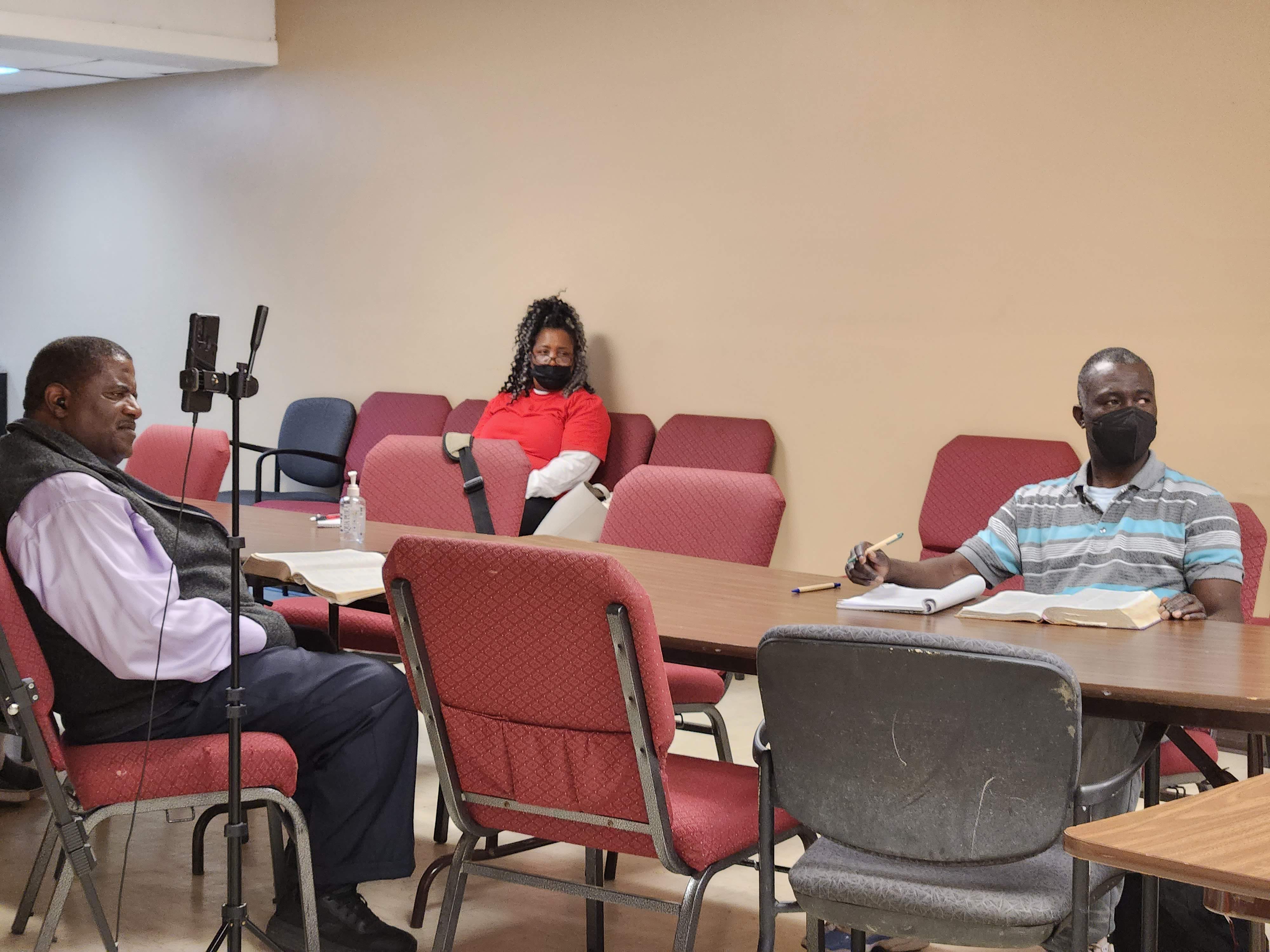
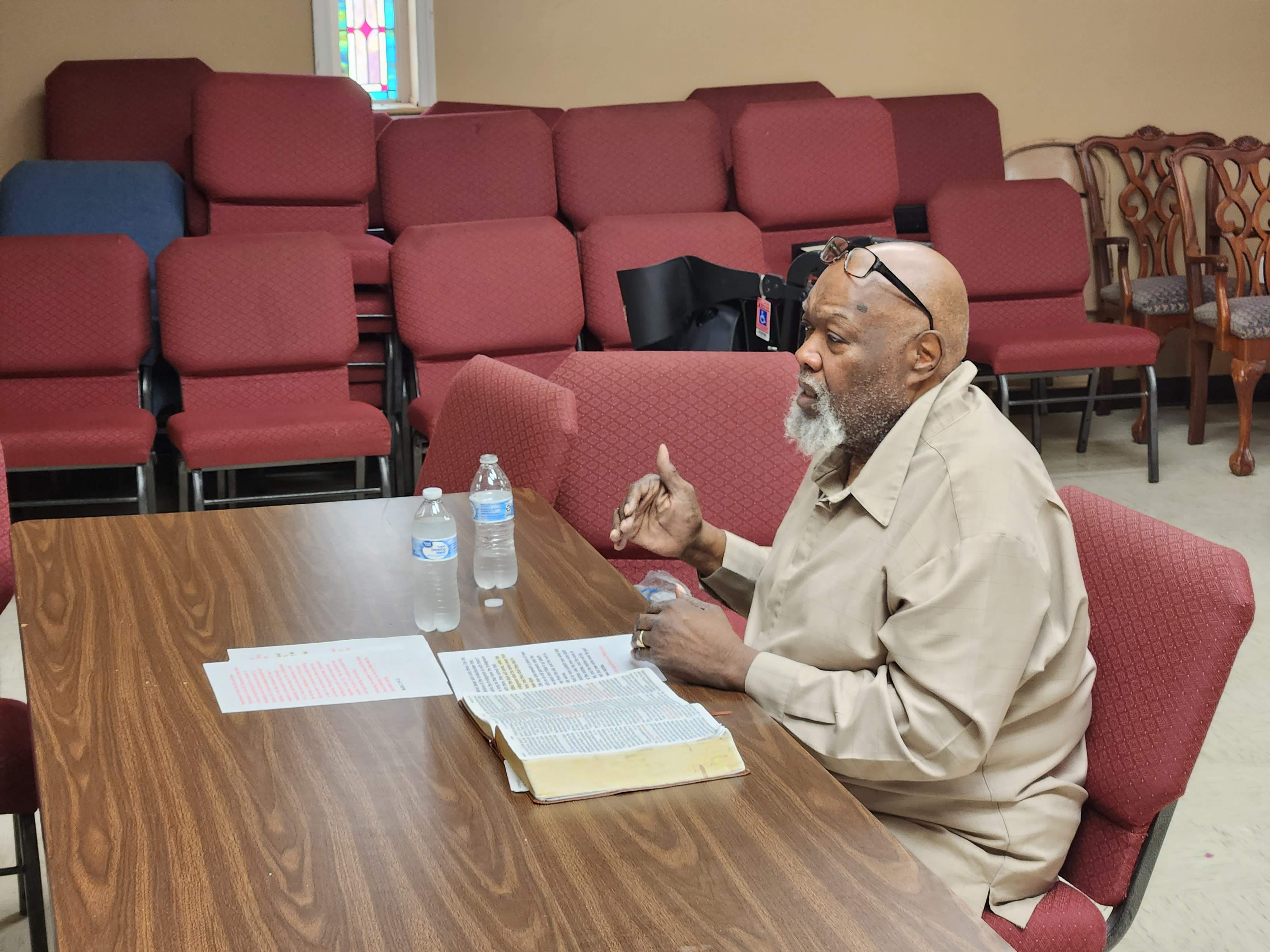
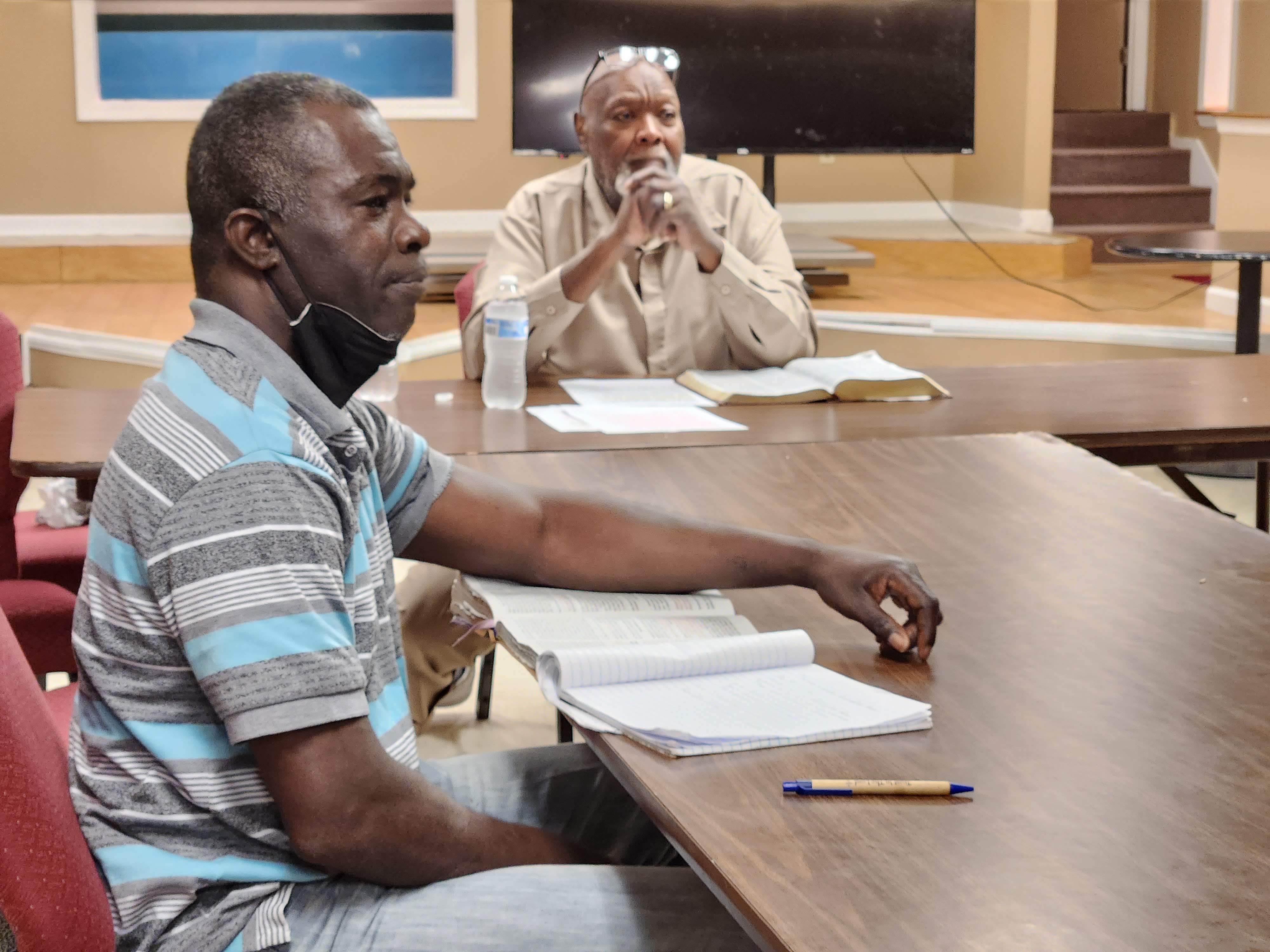
At the Wednesday noon Bible study at Chattanooga’s Church Of The First Born, assistant pastor Randolph Higgenbotham drew the day’s theme from a chapter in the Book of Mark, in which Jesus’s detractors tried, repeatedly, to discredit his miracles. A lesson emerged.
“Anytime, God bless you — and you can put this in the bank — somebody’s gonna come along and try to destroy you,” Higgenbotham said.
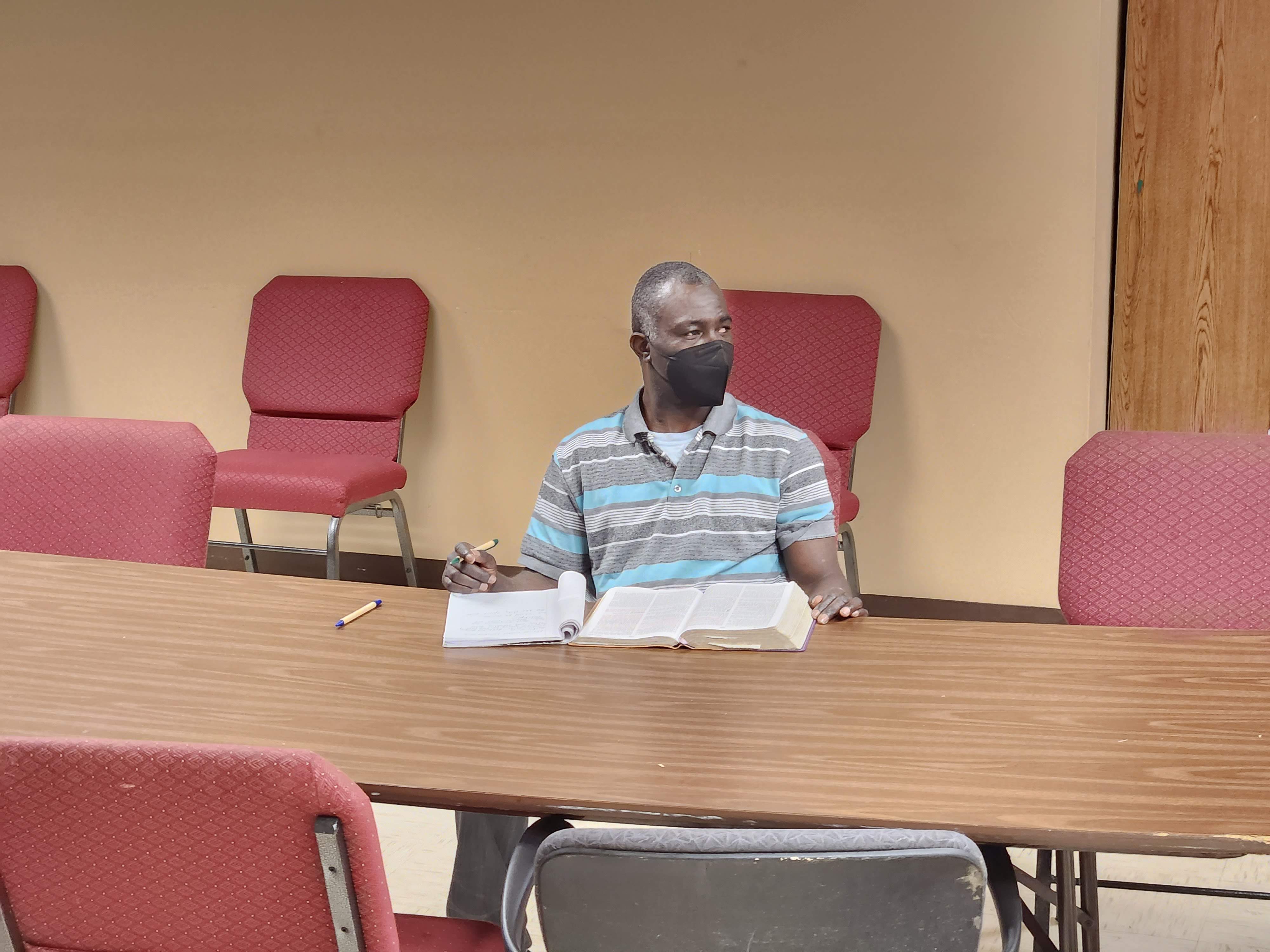
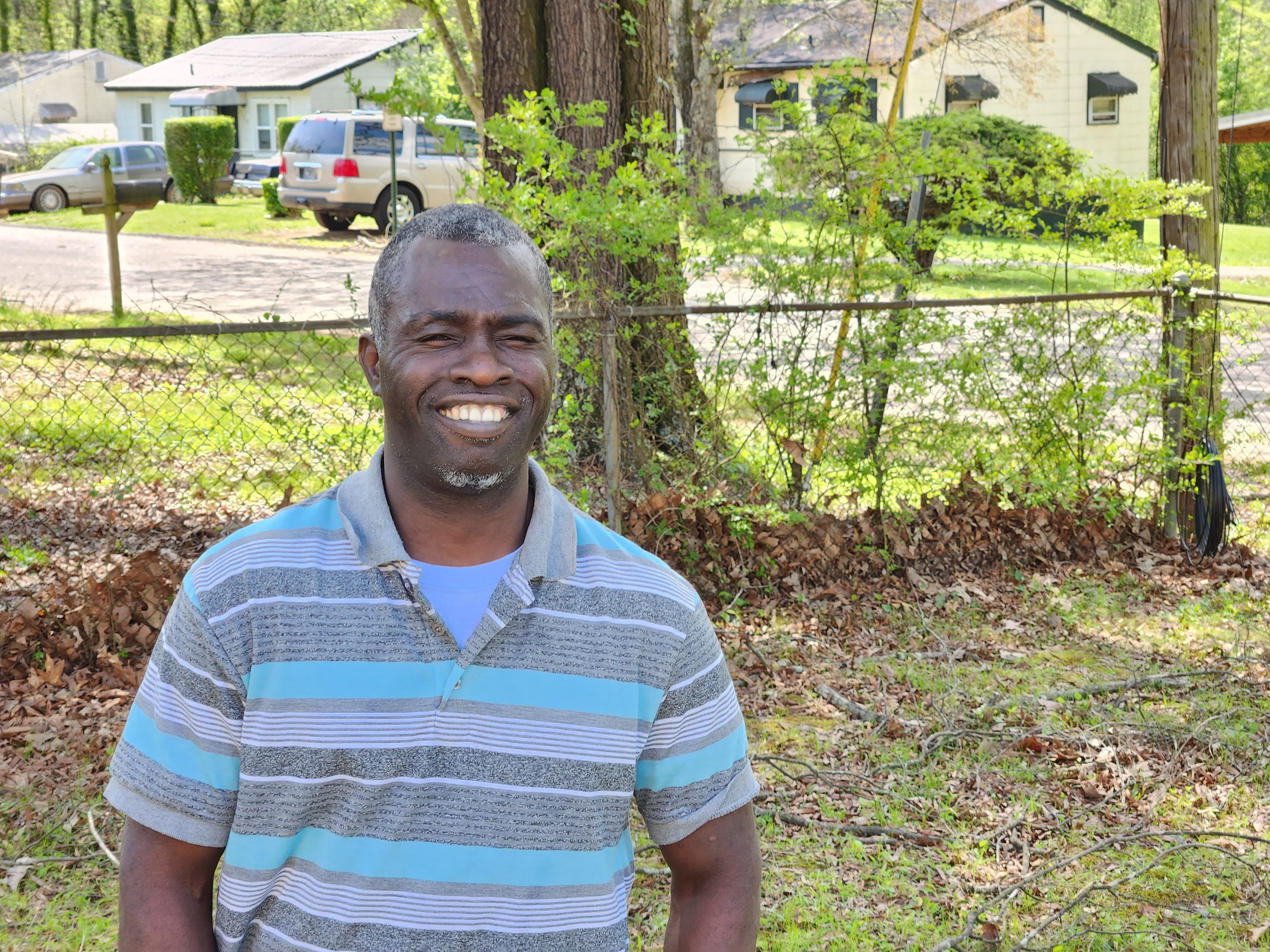
Markill Moore nodded along, took notes and periodically chimed in, raising his hand to contribute. He’d spent years addicted to crack cocaine, cycling through the bleakest realms of Chattanooga and the soul, but now he’d settled into new routines.
In Jesus he found purpose, and in his wife, Diane, Moore found an ally, resolutely in his corner as he proclaims his love of God and learns to love himself.
His pastor, Alfred Johnson — who was sitting across the table at the Bible study — said Jesus had no need to prove himself in words, for he was validated by the life he led.
“Your life will speak for itself,” Johnson said. “It will testify whether or not you’ve been with God.”
The discussion flowed to the concept of radical forgiveness, and Moore cut in, noting that to forgive someone does not mean you need to hang out with them.
“I’m still gonna keep it real,” Moore said. “I ain’t gonna let you just take from me and take advantage of me. But I forgive you.”
Johnson said the idea with forgiveness is not to make yourself appear humble but rather to embody redemption for all to see.
“There’s hope in that,” Johnson said. “The story of redemption — Sunday, a lot of people are gonna be celebrating the commemoration of the resurrection of Christ — that’s just joyous. It’s a good feeling to know that you can be redeemed.”
“YOU, TOO?”
Moore said he grew up in an alcoholic household in Eastdale. He and his friends biked around and went fishing near the levy on Chickamauga Creek.
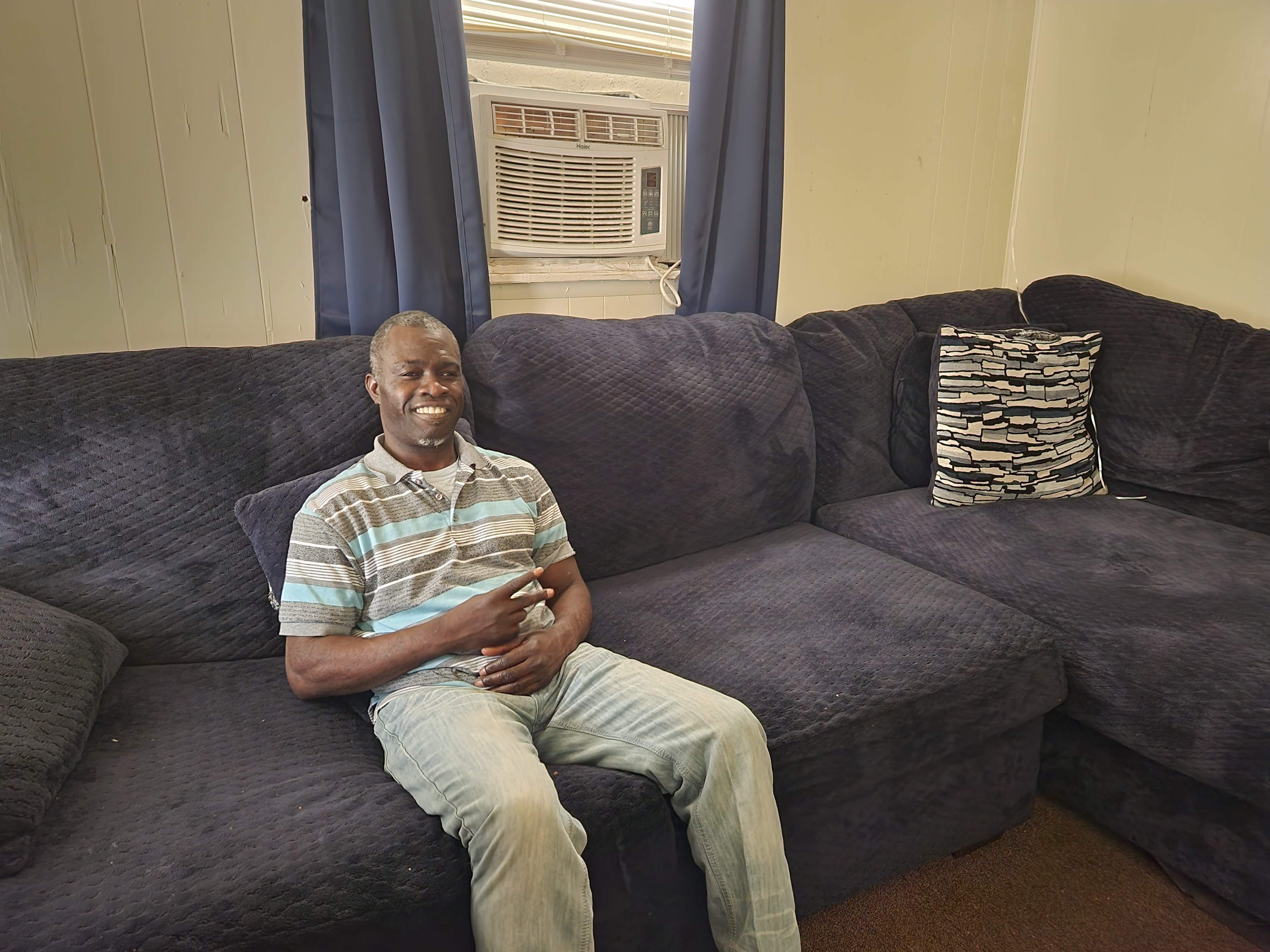
“Then we got in a little trouble,” he said from the couch in his house after the Wednesday Bible study.
They stole bikes, and eventually cars, Moore said. He got caught and was sent to foster care before moving in with an aunt. Soon, when he was about 13 years old, Moore said, he ran away and moved in with a cousin who had amassed what seemed an impressive little fortune selling crack cocaine.
Roaming the city, the duo sought “functional addicts” with jobs — and money. Moore dropped out of school, spent his earnings on clothes and a car he didn’t know how to maintain.
He and his cousin pushed their luck. One time when he was about 16, they stole drugs from a local kingpin’s stash, he said, but the kingpin, mercifully, just asked for the drugs’ return.
Moore hadn’t been curious to try the drugs himself, until one day in his early 20s, he and his cousin were riding around Main and Jefferson streets on the Southside, and his cousin was high.
“I smelled it,” Moore said. “I was like ‘you too?'”
His cousin looked at him crazy, Moore said.
“Then my dumb butt — guess what I do? ‘Let me try it.'”
He mixed the crack with some weed and got extremely high — a major rush.
“It was like, out of this world,” he said. “Do you hear me? It was mind blowing.”
For a few weeks they sold and smoked crack. Moore thought he might fund his new habit by cleaning dishes at Red Lobster, he said. He quickly stopped showing up, earned a reputation for being an undesirable house guest, and soon he and his cousin ran out of money and dope.
“Reality kicked in,” Moore said. “When it kicked in, I didn’t have anything. That’s the moment I became homeless.”
He occasionally scrounged some drugs to sell, keeping some for himself and hastily spending any excess money on more. His car broke down, so he roamed Chattanooga by foot. He hung out in Alton Park for a while and eventually he started sleeping in tent encampments on 11th Street near downtown or at a nearby church. He didn’t have a tent because he preferred to stay mobile, but he had a sleeping bag in which he kept some clothes. He felt sad, anxious, miserable — at least when the drugs were gone.
Days and years cycled. He’d go to the Community Kitchen, then the downtown public library, where he could rest, relax, and get out of the sun.
On his couch Wednesday, he snapped back to the present: “Is this story interesting?” he asked.
THE BATTLE
At the Church of the First Born a few hours prior, the subject had turned to pride.
“I think the biggest battle that we fight, is the battle that we fight on the inside. It ain’t the battle we fight with people. It’s the battle that we fight with ourselves. That’s why the word of God is so important,” Higgenbotham said, before sketching out the unfortunate human tendency.
“I can see I’m wrong, but I’mma hold on to it.”
He paused, and yelled, “Whoooooooo!” like he’d just had ice water dumped on his head.
Moore cut in: “Can I add to it?”
Pride comes before the fall, Moore said.
“Jesus – when he went through what he went through, don’t you know he didn’t say a word? He ain’t had to defend himself!”
Discussion flowed onward until Higgenbotham returned to the main theme: “Don’t be shocked, Markill, if somebody gonna put a knife in your back.”
“Can I add to it?” Moore asked. “I was thinking about that this morning. When you give your life to Jesus — like for real — the devil comin’. He comin.’ It’s like you going to the Army. You gotta put on the helmet, the breast plate.”
The room rustled in agreement.
“It’s like going to war.”
“THE GRAVEYARD”
As he walked the streets of Chattanooga, homeless, Moore often got caught — with drug paraphernalia, or for being too drunk. He’d do six months in jail here, he said. Eleven months there.
One time, he believed a woman was cheating on him, he said. He was on crack and planned to take a cup of gas and throw it on her face, he said. He said he ended up throwing it on some grass and got an arson-related charge — his most significant legal trouble.
Johnson suspects he met an incarcerated Moore in the 2000s. The pastor had years prior determined that when Black men were missing from families, he could generally find them in jail, on drugs or dead.
“I obviously couldn’t go to the graveyard to get ’em,” he said by phone Wednesday.
So he ministered in jail and bought an old house for men to recover in.
There were certain requirements of staying there: A year commitment, church attendance and addiction counseling.
Inhabitants generally worked outside jobs. They would get a small stipend to live off, but their earnings went to a savings account, to be returned in full when they left, Johnson said.
Moore cycled in and out of what became known as the House of Refuge.
“He was a problem,” Johnson said.
One time, he said, Moore was cooking and fell asleep, and a fire broke out.
“He would promise that he was gonna do right, and for months would do well,” Johnson said, before finding himself back outside.
In jail around 2011, Moore was feeling optimistic, he recalls.
Moore said he told a friend there, “We gon’ get married, we gon’ have wives, we’re not gon’ be homeless no more.”
Moore said he started a Bible study with other inmates, was released, once again to the House of Refuge and mingled conspicuously in Church of the First Born. Diane Moore also attended that church, and a friend who was seeing a different guy at the sober-living facility mentioned Markill Moore.
“I was like’ you’re talking about the guy who’s always up at the altar asking for prayer for everybody besides himself,'” she remembers thinking.
Markill Moore said he noticed his future wife’s beauty — “Oh, my, God” — and her intelligence too. They took up a relationship, and he quickly demonstrated uncommon compassion. When her dad, deep into a cancer battle, stopped breathing, she told Markill Moore the news by phone.
He got off the phone, she said, and immediately told everyone in the House of Refuge that if they all didn’t start praying he would beat them up.
“There was just something about him,” Diane Moore recalled by phone Thursday. “He’s used to people putting him down. People would tell them that they would be there for him and they wouldn’t. But he would still try to give them everything.”
Markill needed to feel that someone would be there for him no matter what was going on in his life, Diane Moore said.
“And I just wanted to be that person,” she said.
Markill Moore immediately moved in with her when he graduated at last from House of Refuge around 2013, and they planned a lavish wedding.
He worked at this time at the Pilgrim’s Pride plant on Broad Street. Sometimes he stacked boxes of slaughtered chickens on a pallet. Or he put live chickens on a moving hook shortly before they got decapitated.
One day, Markill Moore was out with family — a context in which he’d often played the role of addict, Diane Moore said. He came home drunk and off-kilter, Diane Moore said. He’d been smoking crack, and she said she kicked him out of the house. The wedding was off. She’s older, had been married before, and there were certain things she no longer put up with.
“I was like, ‘This just ain’t the life I wanna live, and it’s not the life that I’m gonna live,” Diane Moore said.
Eventually though, she let him back in. Diane Moore has the spirit of a caretaker, Johnson, their pastor, said.
“And Markill was a person who needed a lot of care,” Johnson said.
Markill Moore felt accepted by her, Johnson said. Plus, Johnson added, laughing, she was good at keeping him in line.
Markill Moore stayed clean a few months before relapsing around 2014. And again Diane Moore booted him out of the home. His other contacts would no longer host him, but he stayed in a hotel, smoking crack, until one day he said he asked God to take the taste from his mouth.
“I just surrendered,” he said. “I took that crack pipe and threw it down. I took that quart of beer and threw it down.”
Markill Moore said he told Diane Moore on the phone he didn’t want to come home and he needed help. She remembers him telling her, “I’m trying,” and asking her to pay for his hotel bill but take away his bank card, so he couldn’t misuse his money.
“I didn’t pay his rent for that week,” she said.
Instead, Diane Moore brought Markill home.
He attended Alcoholics Anonymous meetings. A leader at Church of the First Born sponsored him and explained to him the dynamics of addiction.
Markill Moore said he learned he can’t feel sorry or down on himself.
“You’re fighting a battle,” Markill said. “Just surrender.”
Their ambitious wedding plans repeatedly dashed, Markill and Diane Moore came dressed fancy to a Wednesday Bible study in the fall of 2014. Johnson married them in the sanctuary right after.
VISION
Today, Markill Moore makes garbage bags at Hamilton Plastics. He can work pretty much any machine in there, he said, but he often staffs Line 11.
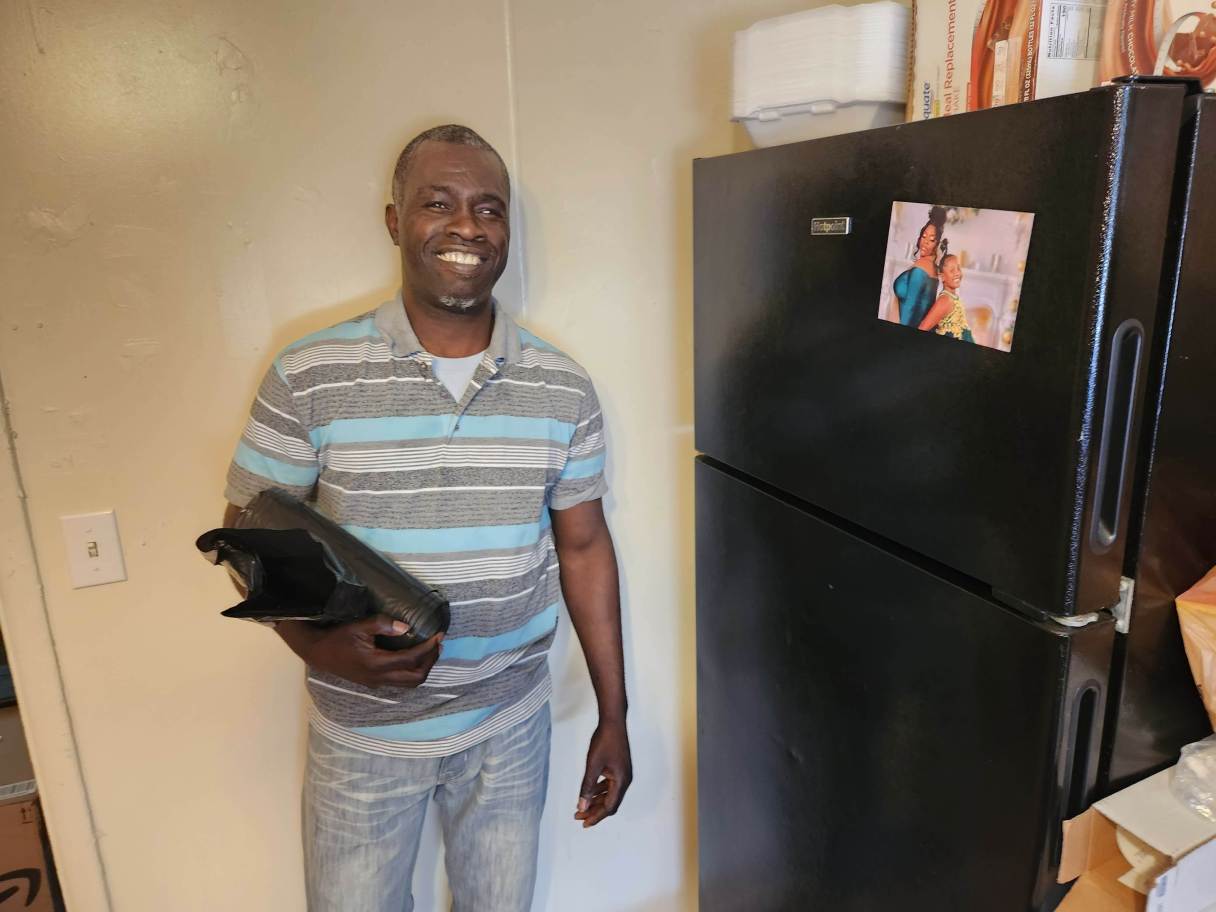
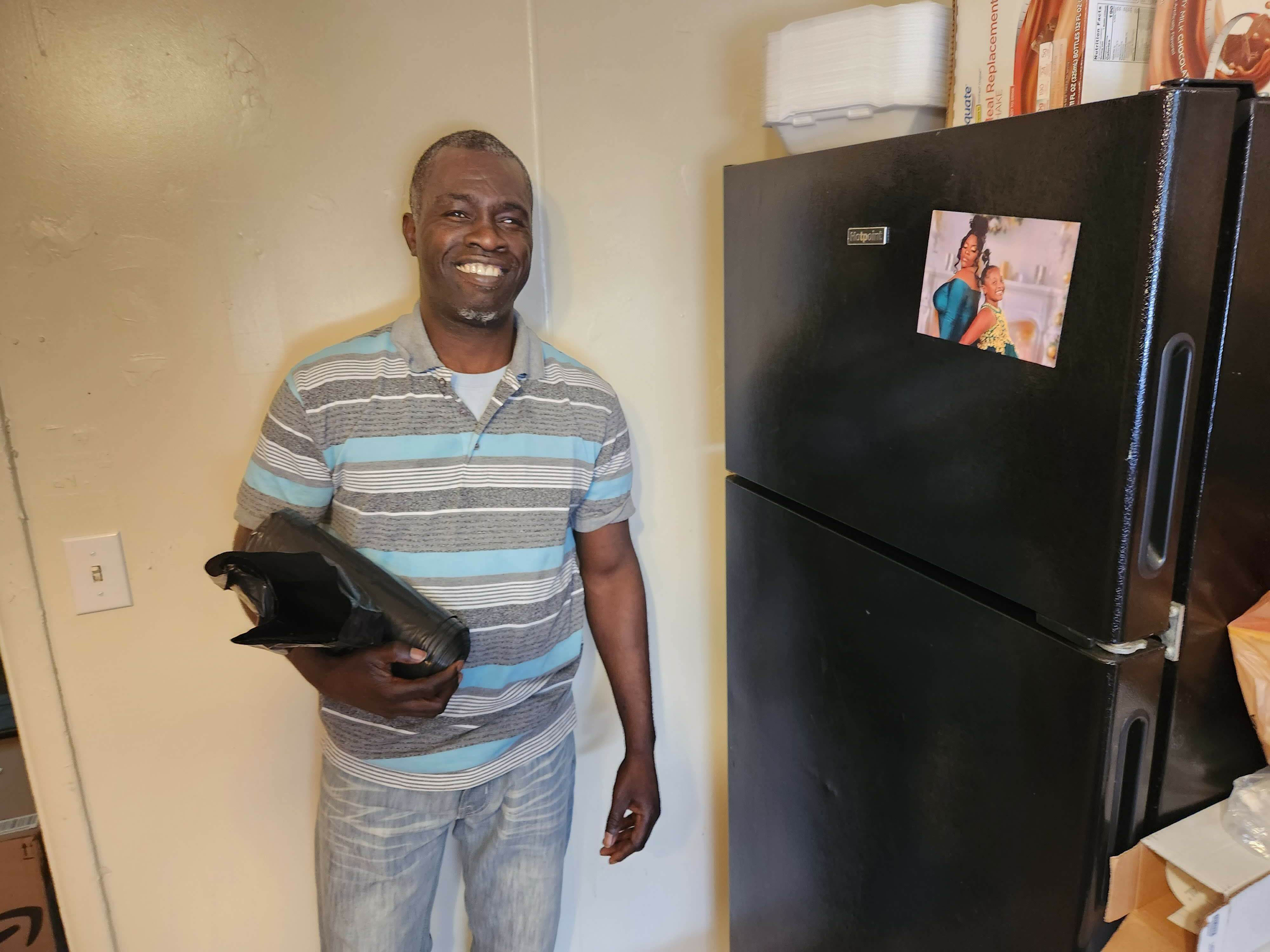
At his house Wednesday, he got up and went to his kitchen and took out a roll of trash bags from under his sink.
“This is what I make,” he said, and explained the assembly process. “I love what I do.”
He got the job a few years ago. Around that time Markill and others would get food and bring it to feed the homeless people on 11th Street. He envisioned it as a proper ministry, but no one was hearing about it or donating, he said.
The pandemic shut it down, but then his wife gave it a new life, he said.
“She turned it to a ministry!” Markill said. “She took it to a whole ‘nother level.”
Diane Moore organized and networked, got the wealthy Lookout Mountain Presbyterian Church and others — already involved with the House of Refuge — to support their newly-minted Vision of Mercy. She said it surveys homeless people in different known encampments to find out what they need, and on a periodic basis brings them supplies and food.
Markill Moore typically has to work his job but sometimes goes out on these expeditions himself. He said many old friends are still out there, and they’re stocked by new dangers, like fentanyl.
“They’re putting it in everything,” Markill said. “People are dying. I wanna live.”
Asked to elaborate, he paused and said “Life is good,” then laughed, raising his voice. “Life is good! Do you hear me!?”
In recent years Markill Moore has won over some skeptics, but Johnson said many long assumed he’d be back out on the streets.
Markill Moore has perceived this too.
“But I’m learning to let stuff go,” he said. “Work on me. Don’t you know people still doubt me. Don’t you know they bring up my past? Why you think that man was teaching us that they gon’ throw knives in your back? That’s true. I don’t give up. You can throw all the knives you want. I still trust God. Does that make sense?”
Contact Andrew Schwartz at aschwartz@timesfreepress.com or 423-757-6431.