
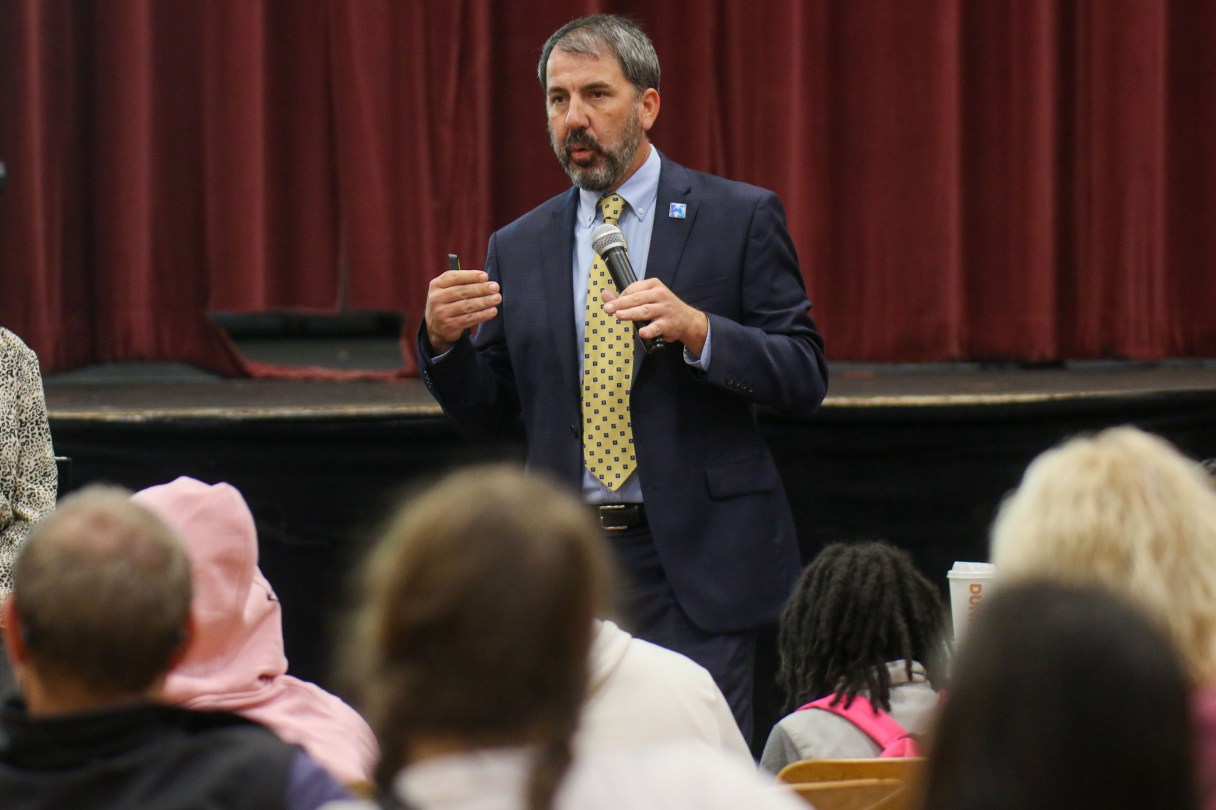

Hamilton County Schools Superintendent Dr. Justin Robertson told school board members Monday night he thinks it’s no mere coincidence the state Department of Education is about release letter grades for individual public schools just as the state legislature is poised to discuss Gov. Bill Lee’s proposal to expand private school scholarships.
“I’m not trying to be a conspiracy theorist or pessimist, but I believe the emotion around the letter grades is intentional,” he said. “My thought is that the two are very much connected.”
Low grades for individual schools will make parents believe schools are “not serving our kids well,” he said, and implied that would prompt an exodus of public school students at just the moment the state might be ready to hand them a scholarship to a private school.
However, there is no evidence children given scholarships during the first year of what has been a pilot program for Education Savings Accounts are doing any better than public school students, he said. Indeed, in the small data available, they haven’t done better, Robertson noted.
The superintendent was commenting on points in a draft document several school board members discussed Monday night. The document — a consensus of board members on issues that may come up in the 2024 legislative session — will be sent to the Hamilton County legislative delegation and other state education advocates once the full board approves it.
We have stated previously that while we support more education choice, we prefer the Education Savings Accounts pilot program stay in place until several years of data are available to determine how the program has performed. If it is a success, then we would support a gradual widening of the scholarships across the state.
However, Lee has proposed expanding the scholarships to a broader demographic of families in the fall of 2024 and then opening them to any student for the fall of 2025. Although the governor has sketched out broad aspects of the plan, all the details haven’t been revealed.
Two of the school board’s points in the draft document — written by board member and legislative representative Ben Connor — addressed letter grades for schools and the education scholarships.
Among the suggestions to legislators are that grades A through F be changed to numbers 1 through 5, which gives room for a more accurate score, and that the formula to calculate the results be changed to balance growth and achievement (rather than more achievement).
Deputy Superintendent Sonia Stewart said she had no problem with the accountability of a grading system but believed letter grades would result in more hasty, adverse decisions being made around students.
On expanded scholarships, the document suggests that the board favors tighter income parameters for recipients (as the current program has) and suggests the students receiving the scholarships be subject to state tests like public school students and that the schools be given grades (or numbers) as public schools will soon.
We’d be on board with the testing, especially if the scholarships are expanded because parents would need some way of judging the soundness of a school other than, for instance, its religious component or racial makeup.
The five board members present were somewhat split on the advocacy of education scholarships in general but seemed to be less divided about the need to keep income parameters tighter for parents of scholarship recipients and to expand education accountability measures for private school students.
Board member Jill Black said the governor’s expansion proposal was “incredibly infuriating” and had “no accountability” (though details haven’t been completed), while board member Larry Grohn said “the point is we have to offer a better product.” He told district administrators he knew “you’ve assembled a staff among you that thinks that just being average is OK, but it’s not good enough.”
The draft document also made funding requests about school safety and mental health professionals, and suggested the state continue to accept $1.8 billion in federal education money — with whatever strings are attached — for certain disadvantaged students and their schools.
(Legislators are studying the possibility of giving up the federal funds because of the strings attached and replacing them with money from the state’s rainy day fund.)
The document’s final, catch-all point solicited more money for, among other things, career technical education, early childhood learning, school-based health clinics, expanded broadband access, universal free school meals and more federal funding for disabled students.
Like a State of the Union message or a child’s letter to Santa, the list is somewhat aspirational. Board members know they’ll never get everything they ask for, but they hope their voices will be heard on at least the major issues in Nashville early next year.
After all, as Robertson said about the expanded education scholarships, this is “the biggest moment maybe in the history of public education” in Tennessee.