
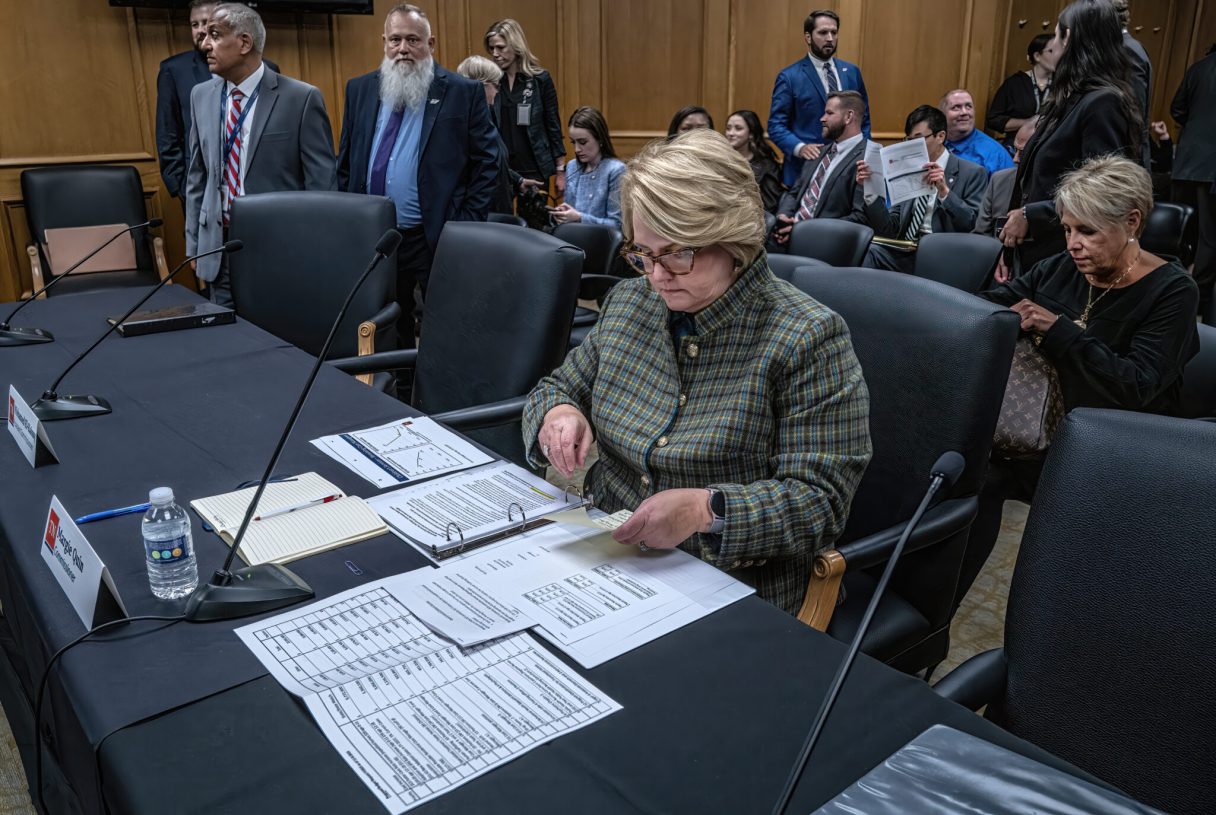
The Department of Children’s Services continues to make progress in filling caseworker vacancies, limiting staff turnover and lowering caseloads, Commissioner Margie Quin reported to lawmakers before facing critical questions about a series of recent news reports detailing the mistreatment of children on her watch.
“I think we are placing a lot of value on making the numbers sound good versus making sure children are actually being impacted in a positive way,” said Sen. Charlane Oliver, a Nashville Democrat.
“I do find myself still troubled to find more reports in the news that keep coming out about kids that are in harms way by staff,” she said. “Are these reports true? Are staff being asked to make things appear good versus what is actually good?”
Quin appeared before lawmakers Tuesday.
In recent weeks, Nashville radio station WPLN reported that at a Knoxville juvenile detention center licensed by DCS, children are placed for long periods in seclusion. The facility’s supervisor said his philosophy towards children was to “treat everybody like they’re in here for murder.”
Nashville NewsChannel Five reported that a 12-year-old boy with intellectual disabilities was “hog-tied” at a transitional home, airing a photograph of a masked security guard on top of a child pressed face down a bare mattress.
The news station separately reported on two agency whistleblowers who alleged Quin directed them to rewrite a memo detailing dangerous conditions at a different transitional home for children, including a lack of food, to keep the information from the press.
“No staff member was ever asked to change any report,” Quin said in response. “In fact, a staff member was asked not to change any report. That’s the truth of the matter. We were going to schedule a second inspection of the (transitional home). And that’s the truth of the matter. We would never, ever want to issue any reports that were untrue, that lacked documentation … I hope that clears up the matter.”
Quin did not directly address the other news reports.
(READ MORE: Department of Children’s Services spending $400M on intake, juvenile detention project)
Other lawmakers praised the department leader for trying to usher in a culture shift at the agency. Quin is the fifth person appointed to lead the $1.1 billion child welfare agency since 2013.
Quin’s appearance before the legislature’s Government Operations Joint Subcommittee on Education, Health and General Welfare was part of a regular update on the agency’s steps in addressing a series of findings by the Tennessee comptroller. The comptroller’s report last December detailed dangerous and disturbing conditions faced by children taken into custody in Tennessee — typically children who were suspected of being abused or neglected in their own homes.
Following the report’s release, lawmakers have approved millions in additional funding for the agency.
The agency has reduced its case manager vacancies from a high of 620 to 268, capped first-year social workers caseloads at 10 and seen a steep drop in caseworker turnover and average caseloads per worker, Quin told lawmakers.
Addressing the “crisis level” shortage in places to care for children taken from their own homes identified in the report, Quin said was “still a work in progress.” A plan to add more temporary facilities in the next 12-24 months is designed to address this.
The department has completed 11 inspections of transitional homes and expects to finish all inspections by year’s end, she said. Transitional homes were established in partnership with churches and community organizations after reports emerged that children were forced to sleep on the floors of state office buildings because there was nowhere else for them to go. Currently, Quin said, there are only isolated cases of children sleeping in state office buildings in an emergency situation.
Jasmine Miller, a staff attorney with the Youth Justice Center, said her organization’s core concern is that transitional homes that have featured prominently in recent news reports — temporary shelters to house children taken into custody and before they are placed in foster care, group homes or residential facilities — appear to be largely unregulated by the state, she said.
Miller said it’s not clear how many of the facilities exist, who runs them, how many children are being housed in them, whether they are licensed or unlicensed or whether the state has created any standards for the homes.
Quin did not provide a response to Miller’s concerns.
Read more at TennesseeLookout.com.