
Tuesday, November 10, 2026Nov 10

Dolphins, humans both benefit from fishing collaboration

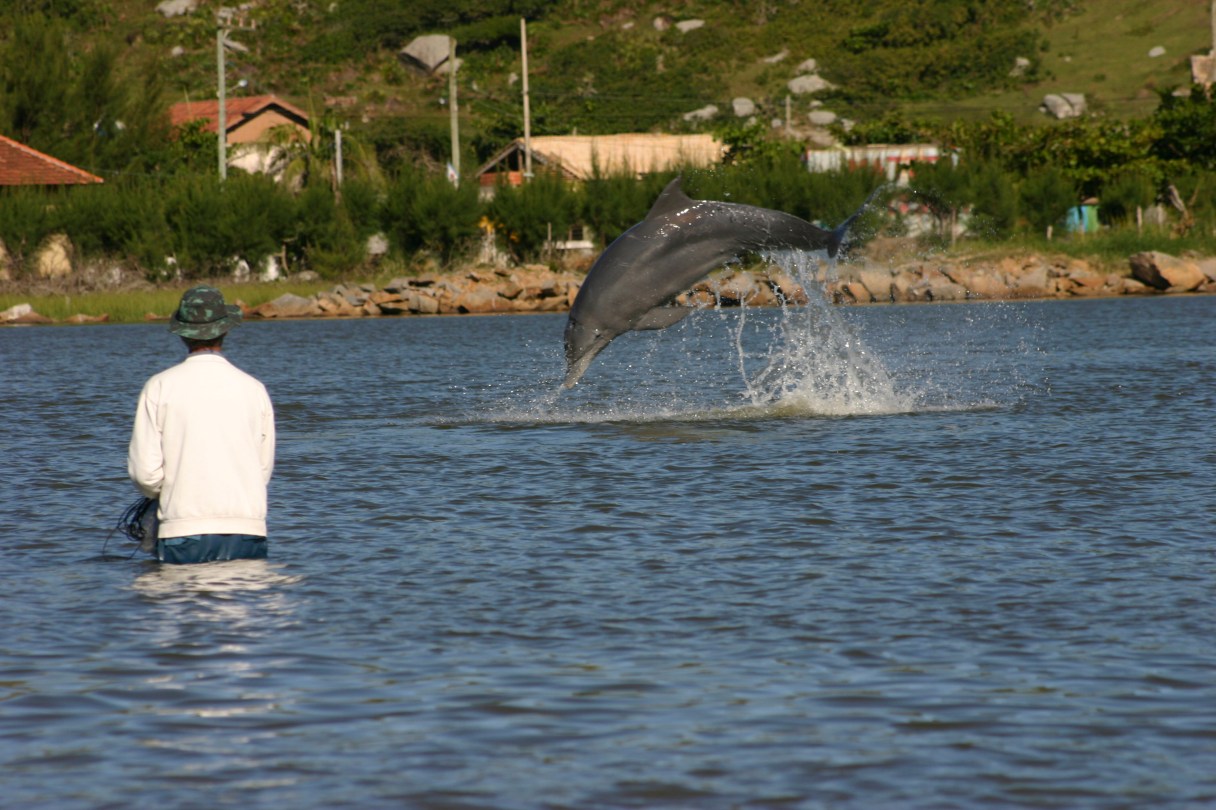
In this 2008 photo, provided by Oregon State University, dolphin jump in front of fishermen at Praia da Tesoura, in Laguna, Brazil. In the seaside city of Laguna, scientists have, for the first time, used drones, underwater sound recordings and other tools to document how people and dolphins coordinate actions and benefit from each other’s labor. The research was published Monday, Jan. 30, 2023, in the Proceedings of the National Academy of Sciences. (Dr. Fábio G. Daura-Jorge/Universidade Federal de Santa Catarina via AP)
In this 2008 photo, provided by Oregon State University, dolphin jump in front of fishermen at Praia da Tesoura, in Laguna, Brazil. In the seaside city of Laguna, scientists have, for the first time, used drones, underwater sound recordings and other tools to document how people and dolphins coordinate actions and benefit from each other’s labor. The research was published Monday, Jan. 30, 2023, in the Proceedings of the National Academy of Sciences. (Dr. Fábio G. Daura-Jorge/Universidade Federal de Santa Catarina via AP) In this 2008 photo, provided by Oregon State University, dolphin jump in front of fishermen at Praia da Tesoura, in Laguna, Brazil. In the seaside city of Laguna, scientists have, for the first time, used drones, underwater sound recordings and other tools to document how people and dolphins coordinate actions and benefit from each other’s labor. The research was published Monday, Jan. 30, 2023, in the Proceedings of the National Academy of Sciences. (Dr. Fábio G. Daura-Jorge/Universidade Federal de Santa Catarina via AP)

A fishing community in southern Brazil has an unusual ally: wild dolphins.

Accounts of people and dolphins working together to hunt fish go back millennia, from the time of the Roman Empire near what is now southern France to 19th century Queensland, Australia. But while historians and storytellers have recounted the human point of view, it’s been impossible to confirm how the dolphins have benefited — or if they’ve been taken advantage of — before sonar and underwater microphones could track them underwater.

In the seaside city of Laguna, scientists have, for the first time, used drones, underwater sound recordings and other tools to document how local people and dolphins coordinate actions and benefit from each other’s labor. The most successful humans and dolphins are skilled at reading each other’s body language. The research was published Monday in the journal Proceedings of the National Academy of Sciences.

The Laguna residents work with wild bottlenose dolphins to catch schools of migratory silver fish called mullet. It’s a locally famous alliance that has been recorded in newspaper records going back 150 years.

“This study clearly shows that both dolphins and humans are paying attention to each other’s behavior, and that dolphins provide a cue to when the nets should be cast,” said Stephanie King, a biologist who studies dolphin communication at the University of Bristol and was not involved in the research.