

In the winter of 2009, former Ole Miss football coach Houston Nutt was criticized for signing 37 players despite knowing that only 25 would be allowed under NCAA guidelines to enroll for the fall semester.
Such a sizable signing day number no longer seems so obsolete.
With the advent of the transfer portal and with this final wave of players who are able to use an extra year of eligibility due to the outbreak of the coronavirus, the NCAA Football Oversight Committee last Wednesday recommended to the Division I Council to extend a waiver used this past signing cycle through 2024-25 that eliminates an annual signing limit as long as the Football Bowl Subdivision members remain at or below 85 scholarships before the start of a season and Football Championship Subdivision programs are at or below 63.
The Division I Council approved the recommendation last Friday.
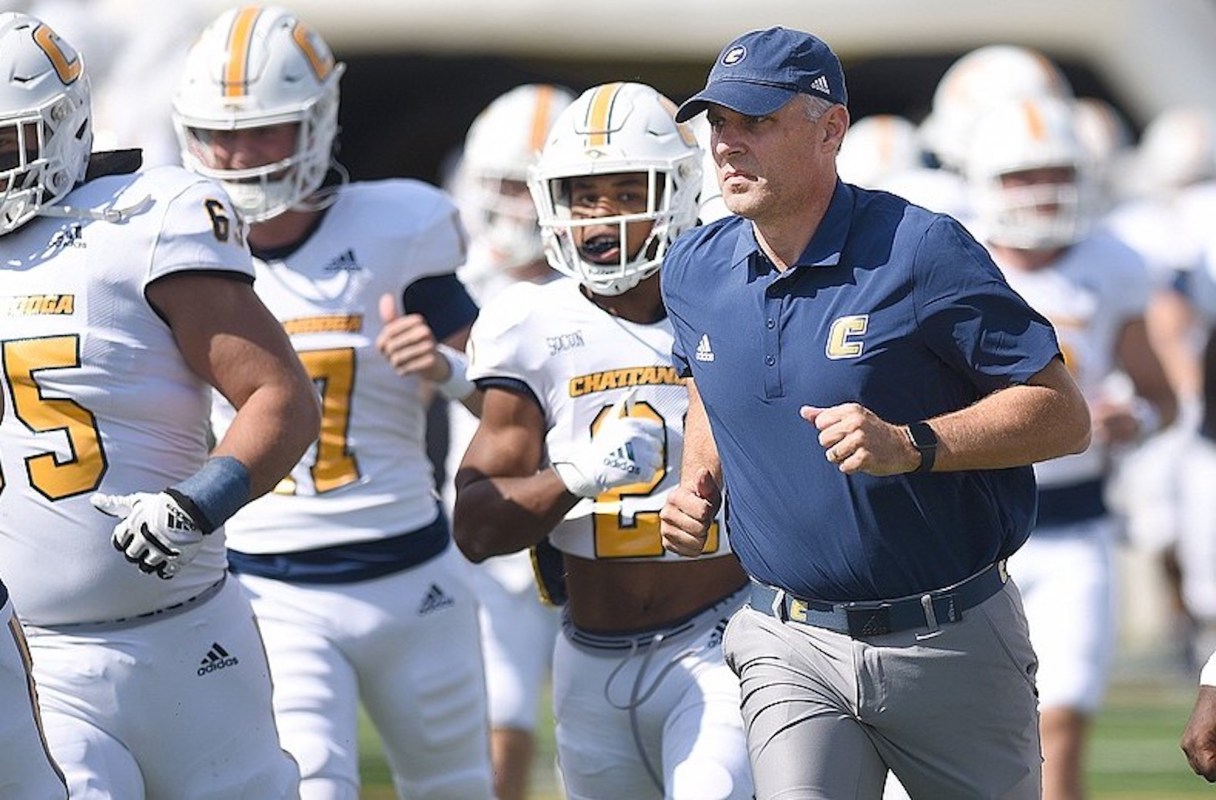
“Roster management is out of control right now,” University of Tennessee at Chattanooga fifth-year coach Rusty Wright said, “and it drives me crazy about once a month in trying to figure it out. This just makes it so much easier, and it’s only fair in this day and age.
“If you’re a new head coach, there is no way you can sign only 25 guys at the FBS level and 30 guys at our level. Guys are leaving, and it’s a lot harder now to stay at that number.”
The NCAA initially implemented the waiver to lift annual signing limits in May 2022.
Wright is among the 17 members of the Football Oversight Committee, including one of the two head coaches. He is representing the 130 FCS coaches across the country, with Florida International’s Mike MacIntyre serving as the representative for the 131 FBS coaches.
“We’ve spent a lot of time the last two or three months talking about this and getting it squared away,” Wright said. “Honestly, the NCAA is trying to get out of the waiver business, and it’s really not fair in this day and age with the transfer portal and having one more year with COVID. We’ll look at this again in December or January.”
A year after Nutt signed 37 players — Ole Miss certainly wasn’t alone, as Troy University’s 2009 class had 35 signees — the Southeastern Conference capped the signee limit at 28, with a maximum of 25 who could enroll for the fall semester. More strengthening of rules led to 25 becoming the signing day max, thus schools could sign no more than 100 players over a four-year period to assemble their 85 scholarship players, leaving a 15-player margin for error.
The landscape changed in 2018 with the NCAA’s introduction of the transfer portal and changed significantly in 2021, when a “one-time transfer” allowed players to change schools without sitting out a year.
There is the potential for the powers of the sport to stockpile even more impressive signing classes without annual limitations. Alabama signed 28 players with Georgia and Tennessee each adding 26 in the 2023 cycle that ended in February, and Georgia began this month with 22 commitments for 2024 after having just nine on July 1, 2020, 11 on July 1, 2021, and 13 on July 1 last year.
“It’s still the only fair way to do it, because everybody is on the same playing field,” Wright said. “You have to kind of cover yourself a little bit, because as soon as a season is over, you can have 10 guys transfer who you weren’t ready for who had years of eligibility left. Does Georgia have an opportunity to take more guys? Sure, but at the end of the day, they’re not all going to stay there, and they know that.
“It’s a vicious cycle we’ve gotten ourselves into, and everybody has to figure it out as we go along.”
Wright said that coaches at the top and bottom of the Division I chain are appreciative of class limitations being removed, adding that Group of Five coaches could benefit the most. The Group of Five consists of the American Athletic Conference, Conference USA, Mid-American Conference, Mountain West Conference and Sun Belt Conference.
Among the Group of Five schools are Memphis, Middle Tennessee, Georgia Southern and Georgia State.
“If you’re a Group of Five head coach right now, you have no idea what your roster will look like once you finish a season,” Wright said, “and it’s the same thing in the spring semester. If you’re a starter at a Group of Five school, there is a pretty good chance you’re gone by the end of the spring.”
Wright insists that UTC will move forward as a program primarily based on high school signees. He has just come off a June in which 300 potential prospects were on his campus for a one-day camp and 13 prep teams descended for a 7-on-7 camp, with this week providing some needed vacation time.
College football could be moving forward with a permanent ban on class sizes, Wright admitted, leaving Nutt’s 2009 crop with plenty of company in the years ahead.
“It’s different now than it was then because you do have the transfer portal, and you’re seeing that now at a lot of places,” Wright said “It’s a bad cycle we’re in, but it’s the cycle we’re in. (Colorado first-year coach) Deion Sanders is going to see it live and in color with as many transfers as he’s got.
“There are wholesale changes that we’re seeing now, and you’re never sure what you’re going to have when it’s all said and done.”
Contact David Paschall at dpaschall@timesfreepress.com.