
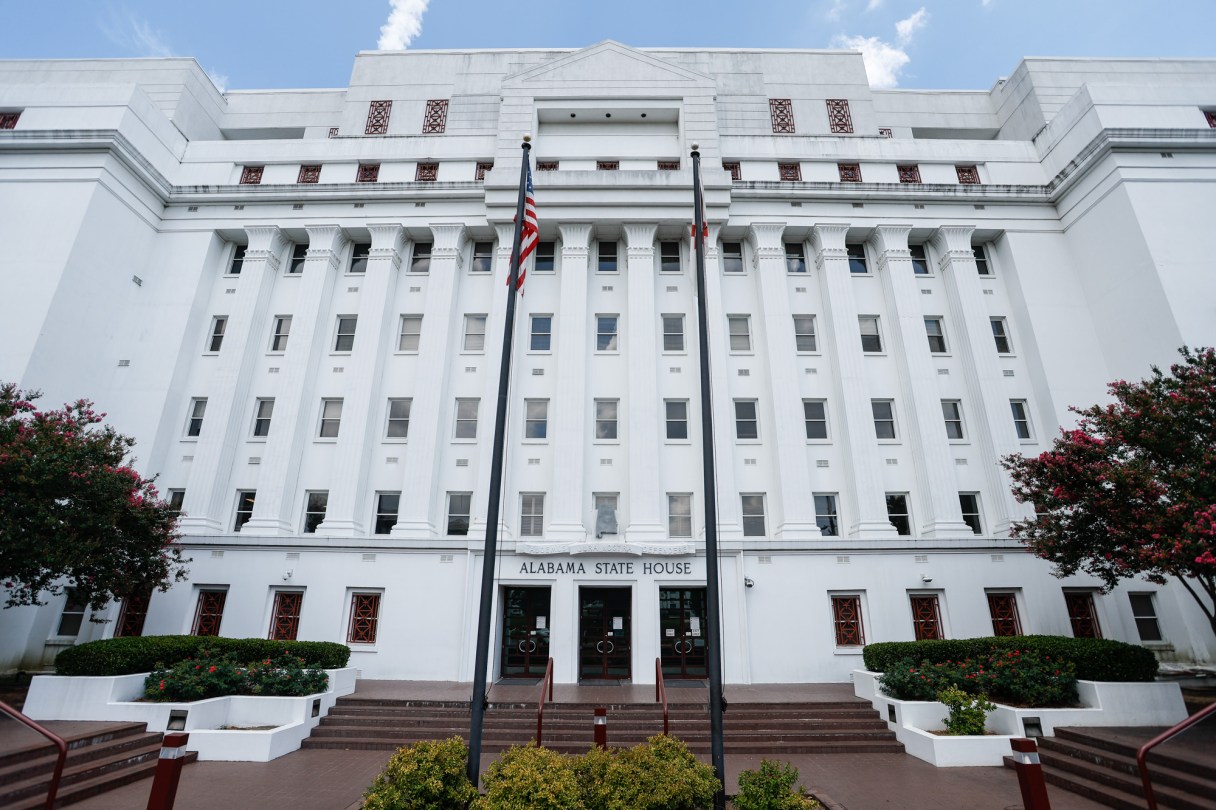
Alabama lawmakers have several priorities for a new statehouse. One is providing a place for elementary school students to safely get off their buses.
Trips to Goat Hill are a regular event for fourth graders in Alabama. But the buses taking them have to stop on South Union Street, a busy street running between the State Capitol and the statehouse in Montgomery. Traffic gets blocked.
“I want a place where the 4,000 children that come to this building every month to visit us can safely load and unload, and not on a major thoroughfare,” Rep. Chris Pringle, R-Mobile, said.
After almost four decades in the current building, that may soon happen.
In May, Gov. Kay Ivey signed Senate Bill 222, sponsored by Sen. Sam Givhan, R-Huntsville. Among other items, the bill authorized the Legislature to build a new statehouse and gave the Legislature a parking lot on South Union Street, behind the current statehouse.
The legislation did not set a timeline for construction, but Secretary of the Senate Pat Harris said “it’s definitely happening.”
Neah Scott, legislative counsel at the Retirement Systems of Alabama, which is directing the project, said the Legislature still needs to give final approval. So far, there’s only been environmental testing on the site.
“There’s still a ways to go,” she said.
(READ MORE: Pork Report hits planned Chattanooga Lookouts stadium)
No budget has been set yet, Scott said, because there are no definitive plans yet. She said the state has put out a request for proposals.
If completed, it would be the first new statehouse built in the United States since Florida finished construction on its Capitol Complex in 1977.
The current Alabama Statehouse was never meant to be a permanent location, and the building is facing significant mold and flooding issues. But lawmakers had been reluctant to authorize construction of a new building because of the political cost.
In 2020, then-Senate Pro Tem. Del Marsh floated using federal money from the Cares Act to build a new statehouse. The discussion sparked criticism.
Harris said the money for the new statehouse is not COVID-related funds, which helps.
In the new building, the Senate and House of Representatives will work on the same floor. The building, Harris said, will also have a much better use of space than the current building, which was never meant to be the “People’s House.”
DETERIORATING CONDITIONS
The Legislature moved from the State Capitol, where it had met for over 130 years, to the old Highway Department Building in January 1986.
The move was at first intended to be temporary to allow the Capitol to be renovated. The architects who oversaw the renovations designed the walls in the new building to be movable if legislators chose to relocate. Prisoners made the desks used by lawmakers.
But the Alabama Supreme Court gave legislators an opportunity to remain in the new building if they chose. Work on the State Capitol dragged on for nearly seven years, and legislators — who had offices and refrigerators in the statehouse but not the State Capitol — voted not to return.
“That was a decision made back in ’85, and in ’85 this was a nice — I mean, they made it into a nice building, but it still was not functional,” Harris said.
The temporary nature of the arrangement can still be seen. Legislators are hard to find outside hallways. Committee rooms fill up quickly with lobbyists. Some of those committee rooms don’t have live-streamed video. An everyday person who just wants to see how a bill becomes a law might find it difficult.
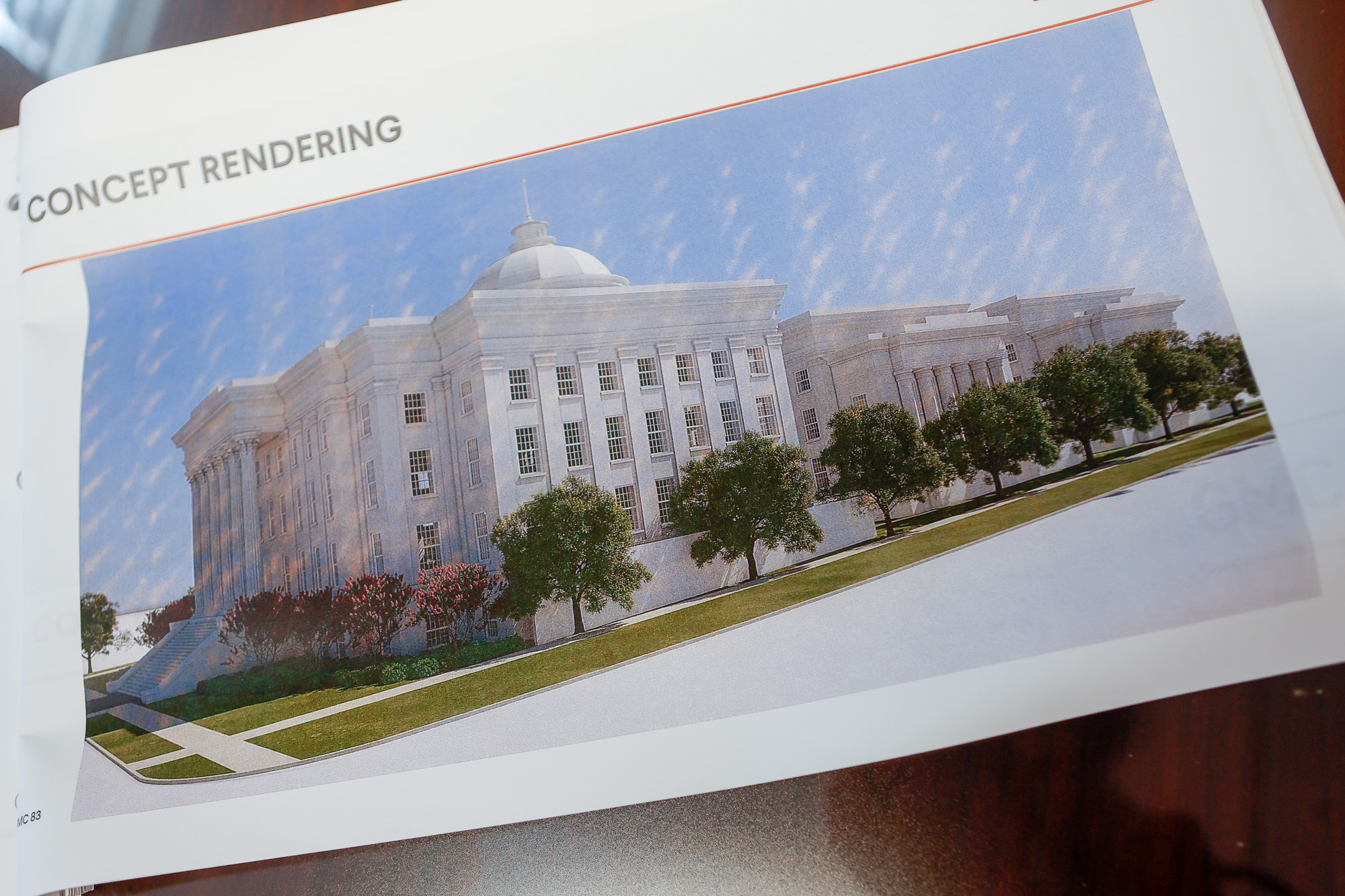 Concept rendering of a proposed new Statehouse building in Montgomery, Ala. / Alabama Reflector Photo by Stew Milne
“It’s not accessible to the public,” Harris said.
(READ MORE: Marsh’s office: COVID-19 money won’t be used for Statehouse)
The building has gradually fallen into disrepair. There’s mold. It leaks. The bathroom plumbing system poured waste into the governor’s suite on the second floor.
“To put money in this building is like putting lipstick on a dead pig,” Pringle said.
Harris said it was hard to justify paying for upkeep, rather than spot fixes, to the current statehouse. He thought employing Retirement Systems of Alabama for the new building made sense.
“If we rent it from RSA, we’ll have a permanent tenant in it,” he said. “So actually, you’re using your own money to help yourself.”
HOW OTHER STATES DO IT
Alabama is rare in that the statehouse is separate from the Capitol building. While other states might renovate their historic buildings, it’s rare to start from scratch.
“You don’t hear about that very often these days — of a state just completely starting over,” said Trait Thompson, executive director of the Oklahoma Historical Society, which oversaw the restoration of the Oklahoma State Capitol that began in 2015.
Thompson said it was important for the Oklahoma Statehouse to encompass the state’s history when it was being renovated. There’s art that depicts events from the past so visitors can learn as they move through the halls.
“I can’t imagine the building not having that, because no matter where you go, you can either be inspired or you can be educated about the state of Oklahoma,” he said.
Like most states, the Oklahoma Capitol is in a Greco-Roman style, which Thompson said dates back to Thomas Jefferson’s design of the Virginia Statehouse. Culturally, the style indicates where “big ideas of society” are discussed, he said.
“Architecture is like art. Everybody kind of has their favorite and something that speaks to them,” he said.
Virginia renovated that first statehouse about two decades ago. Susan Schaar, clerk of the Virginia Senate, said the process involved interviewing multiple architectural firms and multiple consultants.
“I never knew there were so many consultants in my life,” she said.
Previously, all of the ornate paint designs in the statehouse had been painted over.
“In the 1930s, we think,” she said.
So officials brought in paint conservators from Northern Virginia to inch-by-inch uncover ornate designs with cotton swabs and razor blades.
“Originally, it cost $18,000 to (paint) both chambers in the rotunda, and it cost us $2 million to restore (original paint), and it was well worth it,” she said.
During the restoration, officials did not add any permanent art, electing to keep historic items like a historic life-size statue of George Washington. They do have a plan for a rotating exhibit hall that would change every six months, but they have been on hold for a few years due to renovation. Schaar said one of the rotating exhibit halls had been on the indigenous tribes of Virginia. She said many people in Virginia were not aware of the history.
A PLACE TO RETURN
Acquiring land for the new Alabama Statehouse won’t be an issue, thanks to the bill. But there will be challenges.
One problem in the current statehouse is a lack of Americans with Disability Act compliance. Access in the statehouse has been a discussed problem since before a renovation in the 1980s.
Another issue is controlling costs. The 1980s renovations of the State Capitol, initially projected at a little over $10 million, reached $30 million by 1992.
The biggest item is getting the approval from the Legislature to move forward on the project and then getting some plans together, Scott said.
“Before you can pour foundation, you have to know the weight, potential weight of the building. And so that would have to happen, and that hasn’t yet,” she said.
The current building is going to be demolished. Harris said it’s going to be a green space downtown.
(READ MORE: What did the Tennessee General Assembly do this year?)
The exterior of the Alabama Statehouse is supposed to mesh with the rest of the downtown government buildings, Harris said. The exterior is going to be white, though unlike many other Retirement Systems of Alabama buildings in Montgomery, there’s probably not going to be a green roof, Harris said.
The current building is around 300,000 square feet, and the new one will be around 230,000 square feet. In the current building, Harris said, officials are using around 180,000-190,000 square feet.
“Which is not, of course, very functional,” he said.
As for the interior, Harris said it’s still being settled. There’s going to be cohesion, but he’s not sure if all of the walls are going to be blue or another color, he said.
Almost every fourth grader in the state comes to the statehouse, Harris said. He wants the new building to be a place they’ll want to come back to.
“Nobody throughout the country — all these really beautiful chambers and everything, they have been renovated, but nobody’s really built a new chamber and a new building,” he said.
Read more at AlabamaReflector.com.