
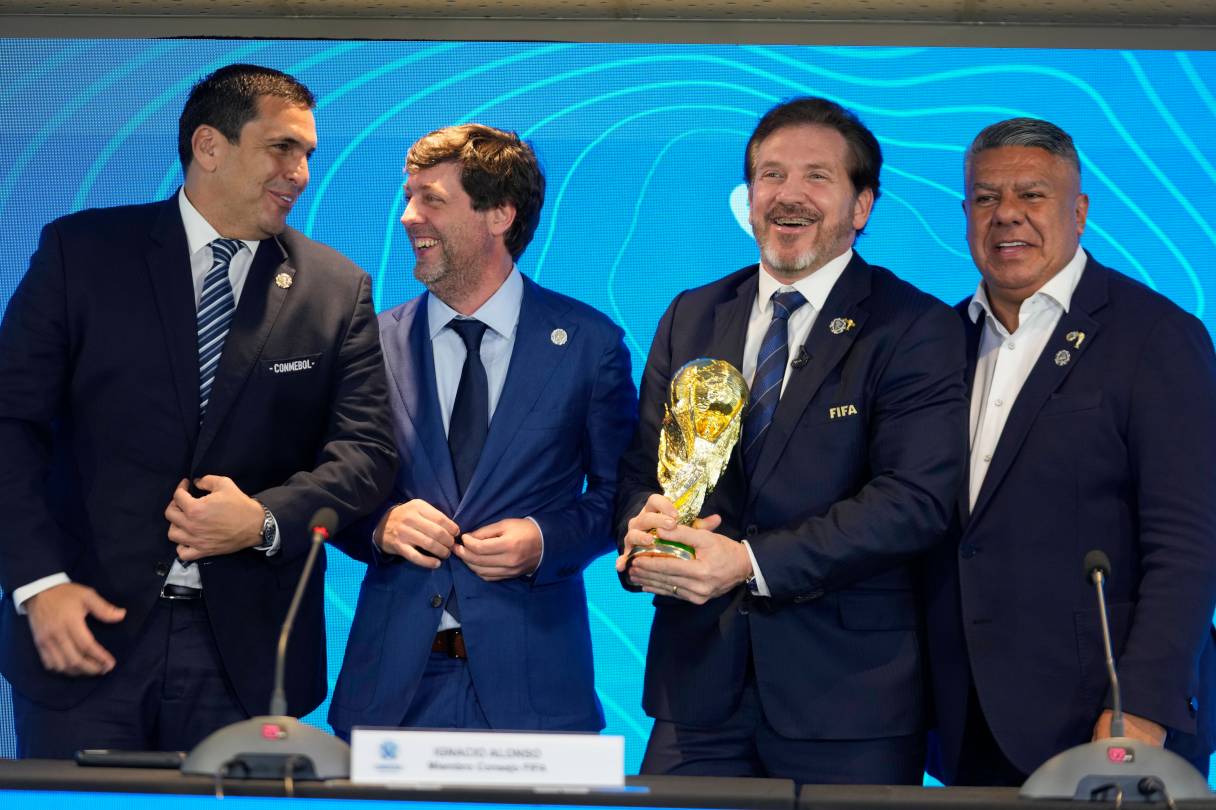
GENEVA — The 2030 World Cup will feature games in six countries on three continents, a unique format that will allow the biggest men’s soccer tournament in the world to celebrate its 100th anniversary in Uruguay.
FIFA reached an agreement Wednesday between the sport’s continental leaders to accept a bid spearheaded by co-hosts Morocco, Portugal and Spain as the only candidate for the hosting rights. The agreement also includes holding games in three South American countries — Argentina, Paraguay and Uruguay — that had earlier promoted a rival co-hosting bid.
Those three countries will each host one match to start the tournament, which allows FIFA to stage the opening game in the Uruguayan capital of Montevideo, where the Centenario Stadium hosted the inaugural 1930 World Cup final.
The bid had started out as a joint venture between Portugal and Spain on Europe’s Iberian Peninsula before expanding to include Morocco — in northern Africa and just across the Strait of Gibralaltar from Spain — earlier this year.
All six host nations will receive automatic entry to the 48-team tournament, FIFA said. It is the first time the World Cup will be played on more than one continent. The first 48-team World Cup will be hosted in 2026 by the North American contingent of Canada, Mexico and the United States.
“The centennial World Cup could not be far from South America, where everything began,” said Alejandro Dominguez, the president of South American soccer body CONMEBOL. “The 2030 World Cup will be played in three continents.”
Spain hosted the 1982 World Cup, Argentina was the 1978 host and Uruguay had the inaugural 1930 tournament. Morocco, Paraguay and Portugal will be first-time hosts.
The consensus reached by the continental soccer bodies for 2030 also allowed FIFA to open bidding for the 2034 World Cup, with only member federations from Asia and Oceania eligible to bid for the hosting rights.
Saudi Arabia immediately entered that contest, and Australia is also interested after successfully co-hosting the Women’s World Cup this year with New Zealand. Either way, the 2034 tournament will almost certainly be played in November and December — like last year’s 32-team World Cup in Qatar — in the heart of the European club soccer season.
Accelerating the choice of a 2034 host to the end of next year will be widely seen as a victory for Saudi Arabia and Crown Prince Mohammed bin Salman, who in the past six years has built close ties to Gianni Infantino, the president of FIFA.
“We want to celebrate our football culture and share our country with the world,” Yasser Al Misehal, the president of the Saudi soccer federation and a member of the FIFA Council, said in a government statement announcing its intention to bid.
The FIFA Council’s acceptance of a unified 2030 candidacy still needs formal approval next year at a meeting of the 211 member federations, but that should be just a formality. The 2034 pick will be made at a separate congress, FIFA said.
“In 2030, we will have a unique global footprint, three continents — Africa, Europe and South America — six countries — Argentina, Morocco, Paraguay, Portugal, Spain and Uruguay — welcoming and uniting the world while celebrating together the beautiful game, the centenary and the FIFA World Cup,” Infantino said in a statement released Wednesday.
The 48-team tournament scheduled for June-July 2030 is set to start in Argentina, Paraguay and Uruguay — which FIFA branded as “Centenary Celebration Matches” — before the action moves to the core host nations of Morocco, Portugal and Spain. The plan involves an unprecedented amount of travel across distances and time zones, including 13-hour flights from Buenos Aires, Argentina, to Madrid, Spain.
It was not popular with Football Supporters Europe, the fan group officially recognized by European soccer body UEFA.
“FIFA continues its cycle of destruction against the greatest tournament on earth,” FSE said in a released statement. “Horrendous for supporters, disregards the environment and rolls the red carpet out to a host for 2034 with an appalling human rights record.”
Australia and Saudi Arabia both are members of the Asian Football Confederation, yet the organization’s president, Bahraini royal Sheikh Salman bin Ebrahim Al Khalifa, stated a clear preference Wednesday.
“The entire Asian football family will stand united in support of the Kingdom of Saudi Arabia’s momentous initiative,” Sheikh Salman said in an AFC statement, adding it was committed to working for its win.
Australia was a losing candidate in 2010, when Qatar won its hosting vote for the 2022 World Cup.
The South American co-host bid has been promoted since the 2018 World Cup in Russia and had included Chile, which was not mentioned Wednesday.
Ukraine was also dropped after it was added to the European bid a year ago at a news conference at UEFA headquarters in Switzerland. Ukraine had not been mentioned in official comments about the UEFA-backed bid this year.
The 2030 decision marks a victory for Morocco, which has invested heavily in infrastructure in its largest cities and was last week chosen to host the 2025 African Cup of Nations. The men’s national team helped push its case by reaching the World Cup semifinals in Qatar, eliminating Spain in the 16-team opening round of knockout play and then Portugal in the quarterfinals. Morocco will be the second African nation to host the tournament, with South Africa the first in 2010.
In a statement released Wednesday, the royal cabinet of Morocco’s King Mohammed VI said the selection “recognized Morocco’s choice place in the ranks of great nations.”
The 2030 deal was clinched six weeks after the former president of Spain’s soccer federation became an international embarrassment for his behavior at the Women’s World Cup final in Australia.
Luis Rubiales was suspended by FIFA and eventually forced to resign after kissing a player on the lips during the awards ceremony in Sydney on Aug. 20, which drew attention away from the greatest achievement of Spain’s women’s soccer team. He is now under criminal investigation.
Pedro Sánchez, Spain’s prime minster, had expressed public concern that Rubiales could derail the bid to host the 2030 World Cup if he remained in office.
Sánchez wrote on social media: “We will show the strength of our country as champions of the men’s and women’s world titles, and we will defend the values of equality, solidarity and fair play that should always be present in sports.”