
Abe Baker-Butler, a junior at Yale University, was working on an essay in the library on Oct. 7 when his phone began buzzing and wouldn’t stop. Israel was under attack.
As president of the American Jewish Committee’s Campus Global Board, Baker-Butler was receiving texts from Jewish college students around the world, some of whom he had met during his most recent visit to Israel in June.
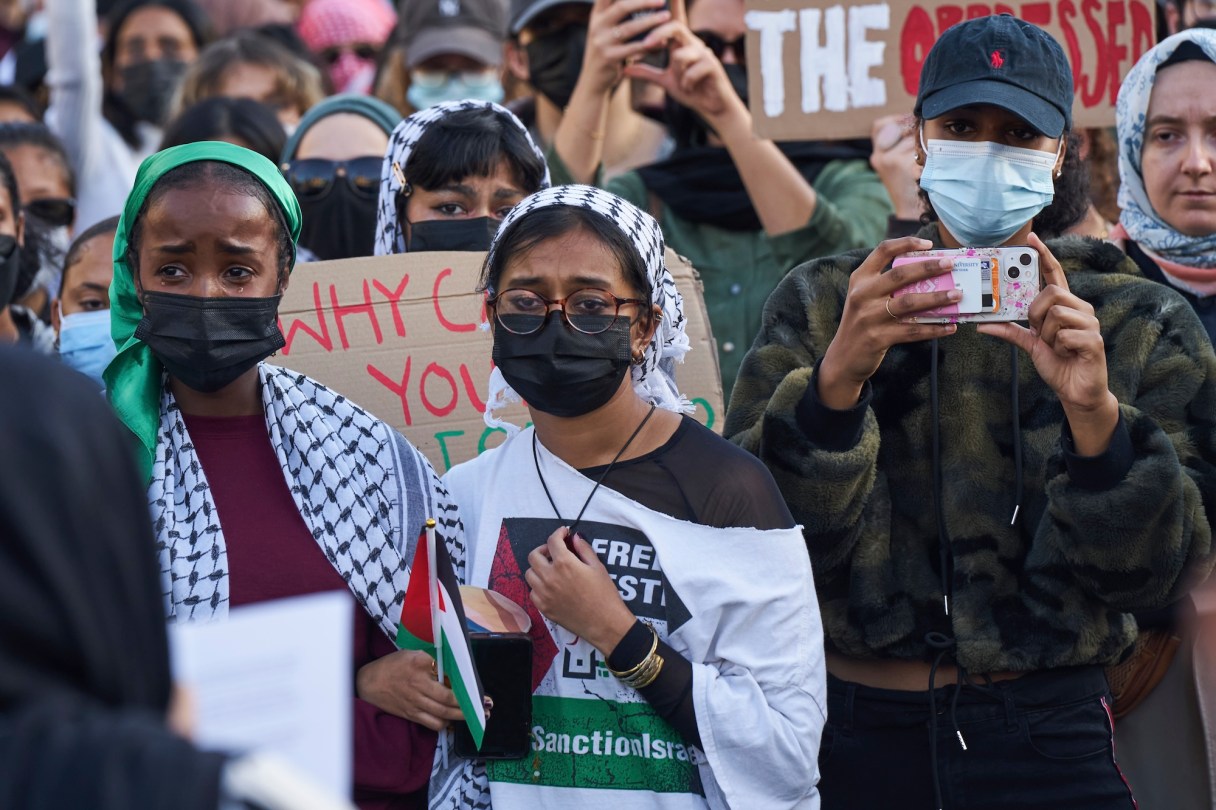
Then came the “free Palestine” protests.
“I couldn’t believe it. These campus activists were holding a rally in what they say is in celebration of the resistance,” Baker-Butler told me.
The beyond-tone-deaf rallies on campuses were a shock for a lot of people, including me. I’m currently a visiting scholar at my alma mater, Western Michigan University, and I have not seen such protests on that campus. But I did witness one at Arizona State, one of the largest schools in the country. There were a lot of pro-Palestinian young people out marching, and many drivers honked their support as they passed.
Without question, antisemitism is a significant factor behind attendance at some of these rallies.
However, another driving force is anticolonialism. And therein lies the challenge for not only Baker-Butler and the American Jewish Committee, but also the Biden administration and other progressives disturbed by pro-Palestinian rallies.
To a certain kind of educated younger audience, the modern state of Israel looks a lot like yet another byproduct of European imperialism. They aren’t all wrong about that.
Imperialism was alive and well when modern Israel was created in 1948 and hadn’t even had the decency to cloak itself under new names. England still had a “secretary of state for the colonies” until 1966. So, yes, from a certain perspective, any defense of Israel sounds like a defense of a colonial land grab. And the legitimacy of that idea has very much gone out of style.
Many progressives are no longer interested in perpetuating nonsensical folklore such as “Thanksgiving was a celebration” or “Columbus discovered America.” Indigenous Peoples’ Day is a thing now. Modern audiences get prickly about narratives that leave out messy colonial history. Many understandably want to keep complexity in our understanding of the world we inherited.
When I’ve spoken one on one with pro-Palestinian students, they acknowledge that what Hamas did was wrong. They also don’t hesitate to point out that Israel is a relatively recent creation, founded after World War II, and that Gaza — even before the bombings of recent days — was a resource-starved open-air prison.
It is my sense that for many attendees at pro-Palestinian rallies on campuses, the focus is on the past 100 years in the region, not the events from earlier this month. Today’s 20-year-olds have grown up with a historical awareness that fewer had in previous generations. That doesn’t mean they all arrive at the same interpretations.
“It’s not colonization,” Baker-Butler said. “Israel is the homeland of the Jewish people. Modern politics says Israel was established in World War II, but the Jewish people have lived on the land much longer than that.”
So how would the president of the American Jewish Committee’s campus group imagine making that point to his fellow students around the nation who are attending pro-Palestinian rallies? He says it starts with moving past fear and anger.
“The only way to have these conversations is through small-group, in-person dialogue and talking face to face,” he said.
“I have many friends in Israel, and many of them have lost friends and loved ones,” Baker-Butler said. “I was messaging one friend and asked if he was OK and he said, ‘Yeah, but a bunch of my friends were murdered.’ What kind of world are we living in?”
It’s a world that’s full of rage and violence. One in need of more compassion. One we’re counting on future generations to redeem.