
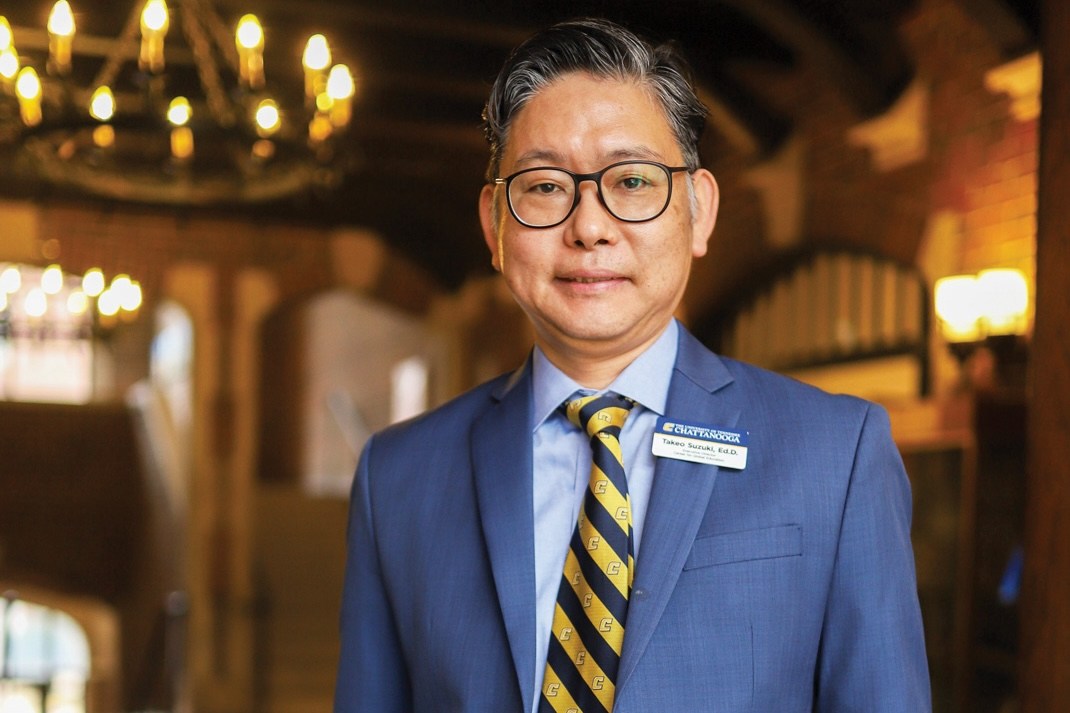
Long before Takeo Suzuki built a career helping college students from around the world study abroad, he was one of those students.
It’s been nearly 30 years since Suzuki, now executive director of the University of Tennessee at Chattanooga’s Center for Global Education, was a student in his native Kobe, Japan. That all changed when a 7.2 Richter Scale earthquake devastated the city and razed Kobe University.
“January 17, 1995, 5:46 a.m.,” Suzuki, now 48, recalls. “We were at the epicenter.”
His school having been demolished, Suzuki had to find somewhere else to continue his education. Studying online was years away from being an option, so he cast a wide net — and landed a big one.
“I was lucky enough to get a scholarship to the University of Wales,” says Suzuki, who studied business information technology there as a British Council Honors Scholar. He later earned a master’s degree from Texas A&M at Commerce.
“Before the earthquake, my dream was to be rich and fly around everywhere,” he says. “Money can change so much in people’s lives, but you can lose it overnight. Education means so much more.
“It’s really sad that now, in the 21st century, we’re still killing each other — shootings, wars,” he says. “We should be smarter than that. Education is how you stop people from even thinking about that.”
Suzuki says his father worked as a software engineer and his “stay-home” mother was a swim instructor who sometimes worked as a typist. He recalls that because Kobe was a very “international” city, his family’s neighbors came from countries including India, Australia, France and the United States.
He says he got his early education at one of several select K-through-9 “national schools” in Japan, for which about 100 new students were picked each year, but adds that his childhood learning wasn’t limited to classrooms. A self-described “outdoor person” who loves to hike and camp, he took to scouting and eventually became an Eagle Scout.
Three years ago, he and his son hiked Yosemite and climbed to the top of the park’s Half Dome.
“I was always curious about things I hadn’t tried,” he says, adding that he and some fellow Scouts volunteered for a tough job right after the 1995 earthquake.
“We’d lost everything,” he says, “but we set up tents and rode bikes around, trying to find who was still alive and identifying the deceased.”
Before coming to UTC in 2015, Suzuki spent 11 years in Arkansas — two at the University of Arkansas — Little Rock, followed by nine at UA-Fort Smith. At the latter school, he developed a global education program in which faculty and students traveled to Uganda, England, China and Greece, among other countries. He says Mike Beebe, the governor or Arkansas at the time, offered him a job in the state’s government, but he wanted to stay in academia.
Suzuki says students from other countries find UTC appealing for multiple reasons.
“First, the school and the city are not too big and not too small,” he says. “I teach two classes, and I know everyone’s name. (Students) know we care.”
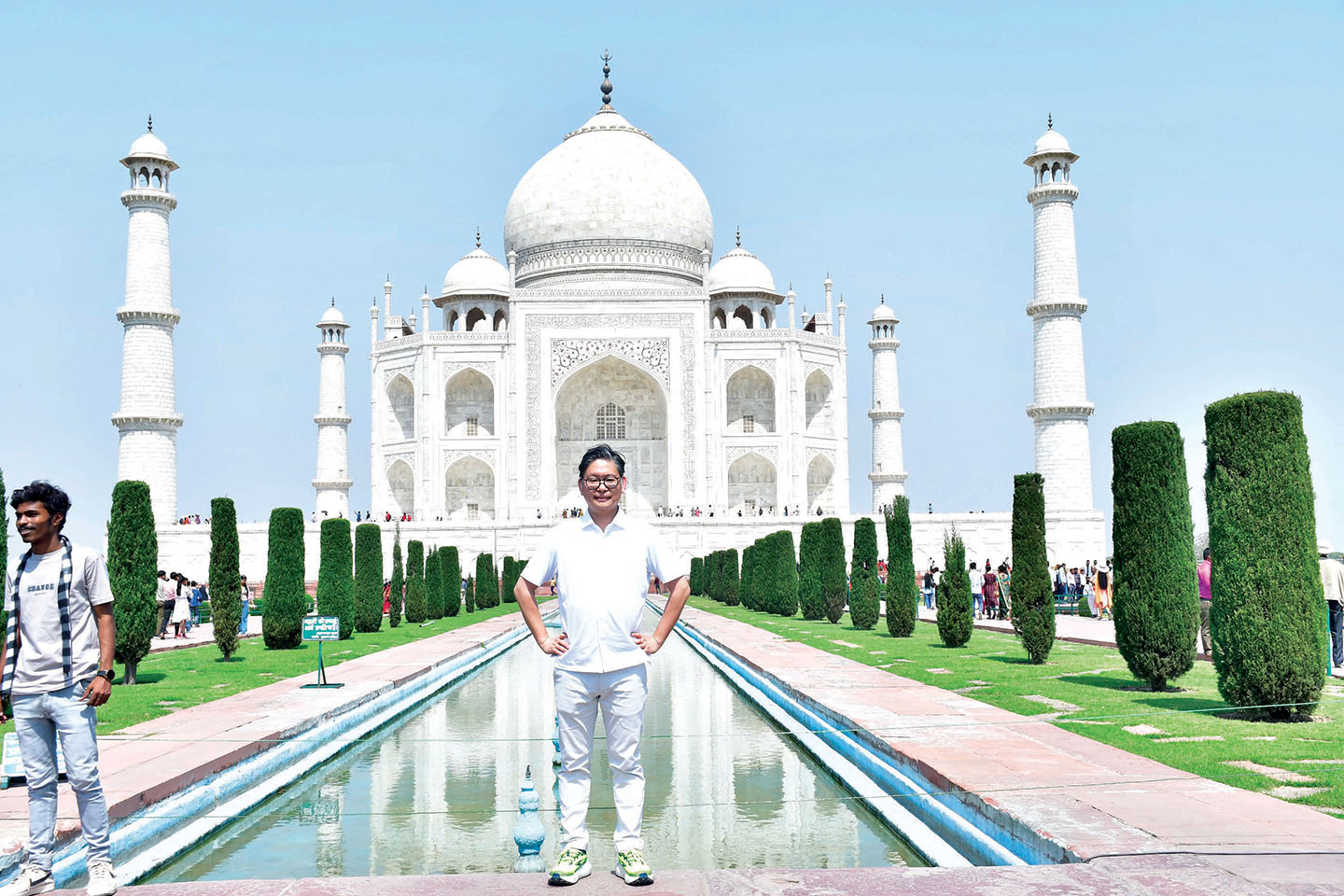 Contributed photo / Takeo Suzuki on a recent visit to the Taj Mahal in India.
Another strength, he says, is “employability.” “Chattanooga’s economy is booming constantly; even when the national economy is bad, Chattanooga’s is always growing. Students see opportunities there, and the cost of living — especially now, with inflation killing everybody — is amazing.”
On a related note, Suzuki says, Chattanooga attracts international business for a variety of reasons, not the least of which is logistics.
“Chattanooga has ready access to river, rail, air and highway (transportation),” he says. “That draws attention here, and companies look at that. Those companies also don’t want to be in cities as big as, say, Atlanta.”
Suzuki says academics can play a key role in making sure Chattanooga continues to grow. Under his guidance at the Center, the number of UTC students going abroad to study more than tripled from 2021 (115) to 2022 (357), the last year for which statistics are available.
“The most important thing we need to do is continue to educate young people to have a stronger global mindset,” he says. “We know (Chattanooga) is a good place, but not everyone knows we’re here.
“We need to shine brighter on the global map, and local companies can help us — Volkswagen sends students to Germany to study business, computer science and how things work over there (generally). Maintaining that in-depth relationship with countries and companies is a global investment, and it has to happen continuously.”
READ MORE
* Chattanooga attorney offers five things to consider when doing business with foreign companies