
Thursday, November 12, 2026Nov 12

NASA pushes back astronaut flights to the moon again

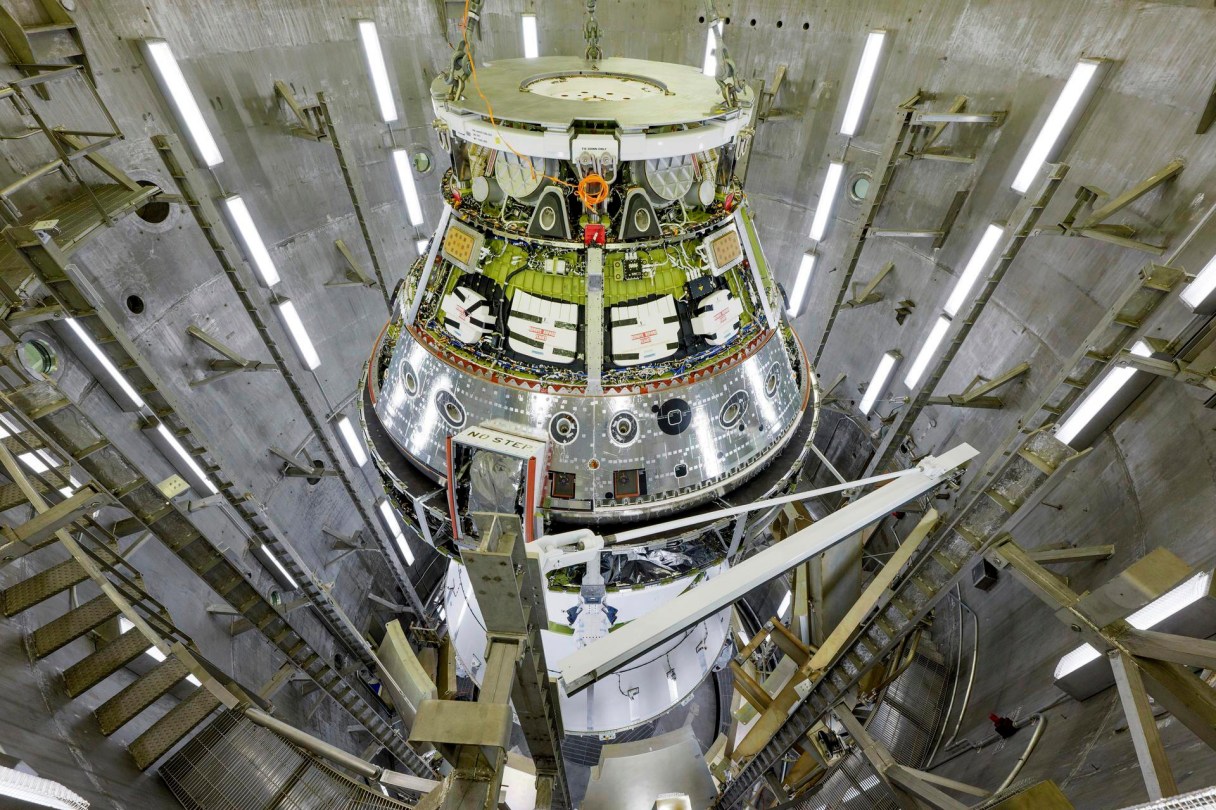
This image provided by NASA shows the Artemis II Orion spacecraft lifted from the Final Assembly and Testing (FAST) Cell and placed in the west altitude chamber inside the Operations and Checkout Building at NASA’S Kennedy Space Center in Cape Canaveral, Fla. on June 28, 2024, for a series of tests simulating deep space vacuum conditions. (Rad Sinyak/NASA via AP)
This image provided by NASA shows the Artemis II Orion spacecraft lifted from the Final Assembly and Testing (FAST) Cell and placed in the west altitude chamber inside the Operations and Checkout Building at NASA’S Kennedy Space Center in Cape Canaveral, Fla. on June 28, 2024, for a series of tests simulating deep space vacuum conditions. (Rad Sinyak/NASA via AP) This image provided by NASA shows the Artemis II Orion spacecraft lifted from the Final Assembly and Testing (FAST) Cell and placed in the west altitude chamber inside the Operations and Checkout Building at NASA’S Kennedy Space Center in Cape Canaveral, Fla. on June 28, 2024, for a series of tests simulating deep space vacuum conditions. (Rad Sinyak/NASA via AP)

CAPE CANAVERAL, Fla. (AP) — NASA announced more delays Thursday in sending astronauts back to the moon more than 50 years after Apollo.

Administrator Bill Nelson said the next mission in the Artemis program — flying four astronauts around the moon and back – is now targeted for April 2026. It had been on the books for September 2025, after slipping from this year.

The investigation into heat shield damage from the capsule’s initial test flight two years ago took time, officials said, and other spacecraft improvements are still needed.

This bumps the third Artemis mission — a moon landing by two other astronauts — to at least 2027. NASA had been aiming for 2026.

NASA’s Artemis program, a follow-up to the Apollo moonshots of the late 1960s and early 1970s, has completed only one mission. An empty Orion capsule circled the moon in 2022 after blasting off on NASA’s new Space Launch System rocket.