
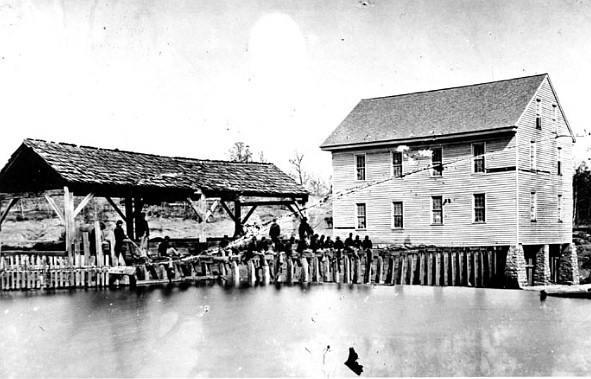
Following the widespread destruction of the 1867 flood, Chattanooga Mayor Dudley Carr pledged that the city would raise the level of streets near the Tennessee River so that “downtown” would never flood again. While Col. William B. Gaw, Chattanooga’s engineer, achieved some elevation of Market, Broad and Chestnut streets, only eight years later the city was struck again by rising storm waters.
On March 2, 1875, the Chattanooga Daily Times discussed “THE FLOODS” and explained that a severe storm was moving in an easterly direction, but that “falling water” seemed to be “carried off to a considerable extent” as the storm appeared to move off toward the mountains. The writer may have jinxed the city by noting that “there appears to be no ground for thinking the waters will reach the point” where they crested during the 1867 flood. Instead, he predicted that the high water mark would probably be at least 12 to 15 feet lower than before.
The river began to rise slowly, allowing some preparation for flooding to protect bridges, trestles and streets. Heavy boulders were scattered across the Chattanooga Creek bridge. While the water eventually crested over seven feet above the bridge, that structure survived. However, before rock could be placed on the recently constructed $12,000 Lookout Creek bridge, that span was carried away. A new structure across Rock Creek was forced off its piers.
Seeing that Nashville and Chattanooga (N and C) railroad bridges were at risk, Mr. Pryor, the company’s local agent, loaded all spans with heavy materials. The Roane Iron Company, Vulcan Words, the Brass Foundry and other manufacturers greased their machinery so that the water would not “lock the gears.” The Southern Pump Factory site was submerged the next day, but its owners had wisely removed all machinery and stock.
The waters rose faster than expected, and the railroads entering Chattanooga suddenly found themselves blocked. The N and C railroad was forced to stop at Stevenson, Alabama, while its Nashville passenger train could reach no farther east than Cowan on the far side of Monteagle Mountain. The N and C bridge over Crow Creek, three miles from Stevenson, disappeared in a rushing wave. Hewitt and Chapman’s Ringgold Mills, only recently purchased, refitted and modernized at great expense, was swept away. Little of the structure or machinery survived, resulting in a loss of more than $18,000.