
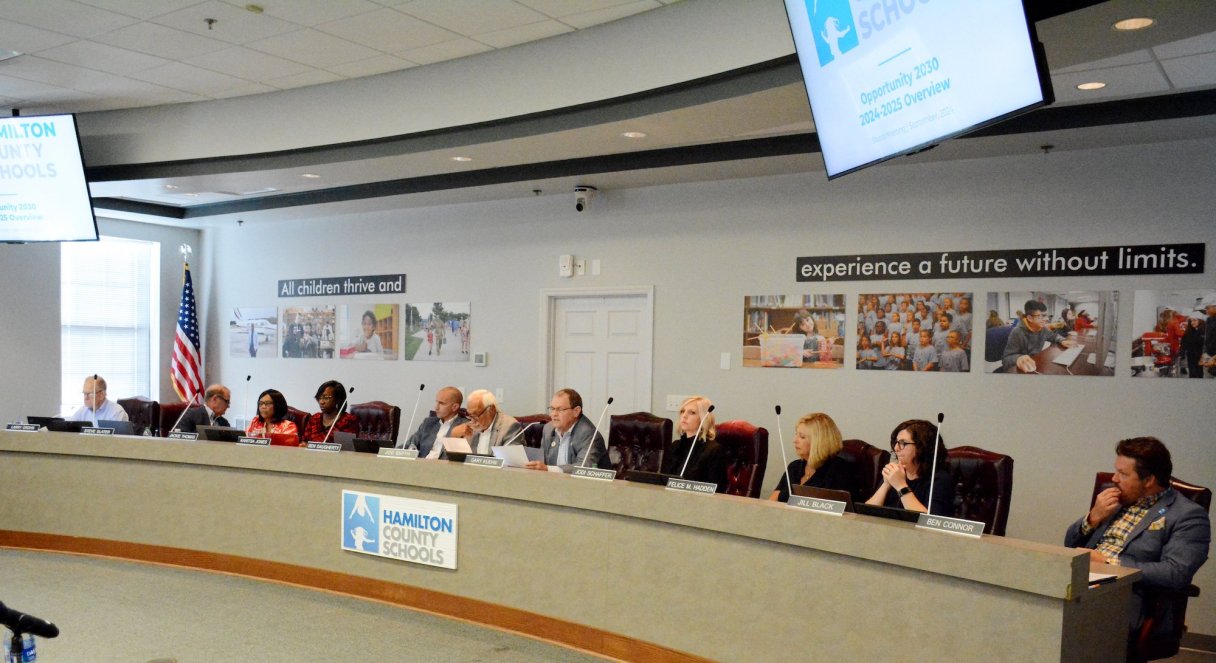
Hamilton County school board members will vote on a legislative agenda for the upcoming year, including recommendations for lawmakers related to private school vouchers and school safety.
The legislative agenda serves as the message board members use in talks with lawmakers. It shows that the board has a joint goal for the school system and the children of Tennessee, legislative chair Ben Connor, D-Chattanooga, said.
The top item on the draft agenda presented to school board members Tuesday called for eligibility and accountability requirements in a statewide universal school voucher program.
In November, Tennessee House and Senate Republican leaders introduced identical bills to give up to 20,000 students $7,075 each in public funding to enroll in private schools, starting next fall. Half of those scholarships would be reserved for students with disabilities, those eligible for the current voucher pilot program and families at or below 300% of the income limit to qualify for free or reduced-price lunches – nearly $175,000 for a family of four.
It was the first legislation introduced for the next legislative session, signaling Gov. Bill Lee’s intention to make the issue a top priority for the second straight year. A universal school voucher bill died during the most recent legislative session after Republican lawmakers failed to agree on the details.
The proposed bill requires recipients to take either the state’s standardized test or a different nationally standardized test that aligns with the private schools’ curriculum. It also gives every public school teacher a one-time $2,000 bonus and redirects 80% of the taxes collected from Tennessee’s sports betting industry to public school facilities costs.
A similar pilot voucher program currently exists in Hamilton, Davidson and Shelby counties.
The Hamilton County school board’s draft legislative agenda urges Tennessee lawmakers to retain the pilot program’s parameters, including a history of attending public schools and its income requirement. To participate in the pilot program, a family’s income can’t exceed twice the limit for federal free lunch – about $81,000 for a family of four.
It also requests that lawmakers apply the same accountability requirements for public schools to private institutions accepting vouchers, including state tests, school letter grades and growth scores, and make the results publicly available.
Connor said he would like it to say that the board strongly urges lawmakers to not expand the current voucher program in any way, as well as ask the state legislature to review the pilot.
It doesn’t seem to be working or received well, he said.
School board member Jodi Schaffer, R-East Brainerd, said the district needs to focus on competing with private schools, academically and athletically. Strong athletics and arts programs are the answer to competing, she said.
Superintendent Justin Robertson said he 100% agreed. He added that in Arizona the majority of students using its voucher program never attended public schools.
“What we’re trying to guard against by saying, at minimum keep these guardrails in place, is that you’re not funding a family that already made a choice before they even stepped foot in a public school,” he said.
Both Connor and school board member Steve Slater, R-Soddy-Daisy, said polls they posted on their social media pages showed a majority of respondents opposed private school vouchers.
SCHOOL SAFETY
The proposed legislative agenda also requests that state lawmakers provide funding for districts to hire school security officers in cases where local law enforcement agencies can’t provide a school resource deputy.
Tennessee provides funding to law enforcement agencies to hire school resource deputies, but school districts don’t get reimbursed for school security officers, Robertson said. School resource deputies are employed by a local law enforcement agency, while school security officers are employed by the school district and serve in a similar capacity but are not legally authorized to make arrests.
In Hamilton County, the district has an armed school resource deputy or school security officer in every building, as well as enough coverage to provide a replacement when an officer is absent.
The draft also urges lawmakers to support funding that prioritizes mental health supports for students, such as school counselors, licensed school social workers and behavioral health professionals.
Schaffer recommended adding language related to school safety to that item.
A lot of issues that require the need for a school resource office are behavioral, Connor said.
“If we can help to mitigate those from the get-go, where it doesn’t elevate to a situation where we need to have law enforcement involved, that’s already a win,” he said.
Other points on the legislative agenda include asking Tennessee lawmakers to work on teacher licensure and educator pipelines, amend the state’s school funding formula to include more support for certain groups of students and programs, and prioritize local needs over statewide education policies. It also advocates for federal legislators to increase funding for students with disabilities.
The board is expected to vote on the legislative agenda at its next meeting Dec. 19.
Contact Shannon Coan at scoan@timesfreepress.com or 423-757-6396.