
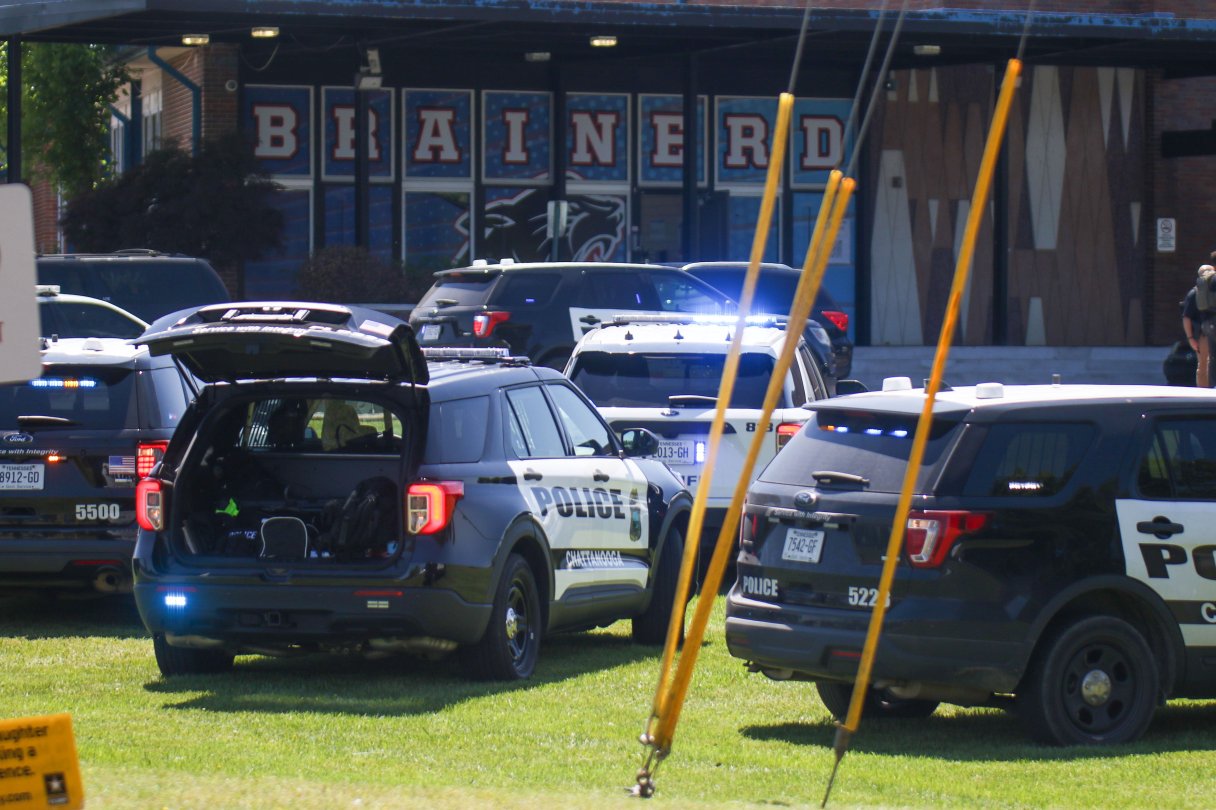
Not a week has gone by this school year without a Hamilton County student being charged with a threat of mass violence, with the first arrest happening on the second day of class.
In the first 21 days of this school year, the Hamilton County Sheriff’s Office has sent out notices of eight students being charged for making threats of mass violence.
By comparison, in the previous school year, the office published reports of seven students arrested on the same charge for the entire year, from August to May.
(READ MORE: Georgia lawmakers reconsider bills to hold adults accountable for firearm safety)
On the second day of school this year, an Ooltewah Middle student was arrested after saying there was an explosive in the student’s backpack that would blow up the school. Other threats reported so far this year have ranged from a Hunter Middle student allegedly stating he was going to “shoot down the school” to an Ivy Academy student reportedly sharing images of schematics for an explosive device and images of armor-piercing bullets in a group text, threatening the Chattanooga School for the Arts and Sciences.
In recent years, Tennessee has ramped up the consequences for making a threat against a school. Lawmakers and district officials said they hoped the significant punishments deter students from making those threats, which have to be treated as real even if there’s no plan or intent behind them.
“Students need to realize that,” Superintendent Justin Robertson said by phone. “They need to understand that their words do have consequences, and what we hope to see is that — you know, we’ve had a rise at the beginning of the year — students start to understand that it is a very serious consequence and that they will start using their words better.”
Threats of Mass Violence
— Aug. 8: An Ooltewah Middle student indicated some type of explosive in the student’s backpack would be used to blow up the school. The backpack was not found to contain any explosive device.
— Aug. 14: A Brown Middle student made a statement in a classroom that he wanted to blow up the school.
— Aug. 19: A Hixson Middle student made a threat of mass violence in a classroom.
— Aug. 25: A Red Bank High student was located after an anonymous tip reported the student made a threat of mass violence.
— Aug. 26: A Brown Middle student made a threat of mass violence.
— Aug. 27: A Chattanooga Preparatory School student made a statement in class that the student was going to “Burn down the classroom.”
— Sept. 4: An Ivy Academy student posted several images of schematics for an explosive device and images of armor-piercing bullets and requested help in getting a diagram or map of the Chattanooga School for the Arts and Sciences.
— Sept. 5: A Hunter Middle student said he was going to “shoot down the school” and framed his hand like a gun, acting like he was shooting other students.
Source: Hamilton County Sheriff’s Office
After a 14-year-old killed four people and injured nine last week at a Georgia high school, 150 miles southeast of Hamilton County, investigators found the teen had been interviewed by authorities last year about reported online threats and an interest in mass shootings.
That, lawmakers said, reaffirms the need to crack down on those threats before they become action.
“No. 1, send a message to school kids that we take threats very, very seriously, because it impacts so many people,” Sen. Jon Lundberg, R-Bristol, said by phone. “And No. 2 is also to put teeth behind that.”
NOW A FELONY
Under Tennessee law, threats of mass violence include any act that a reasonable person would conclude could lead to the serious bodily injury or death of two or more people. The threat can be made in any form, including text messages, diagrams and social media posts.
In 2023, lawmakers added threatening mass violence on school property or at a school-related activity to the list of actions considered a zero-tolerance offense, which results in a one-year expulsion, unless modified by the superintendent.
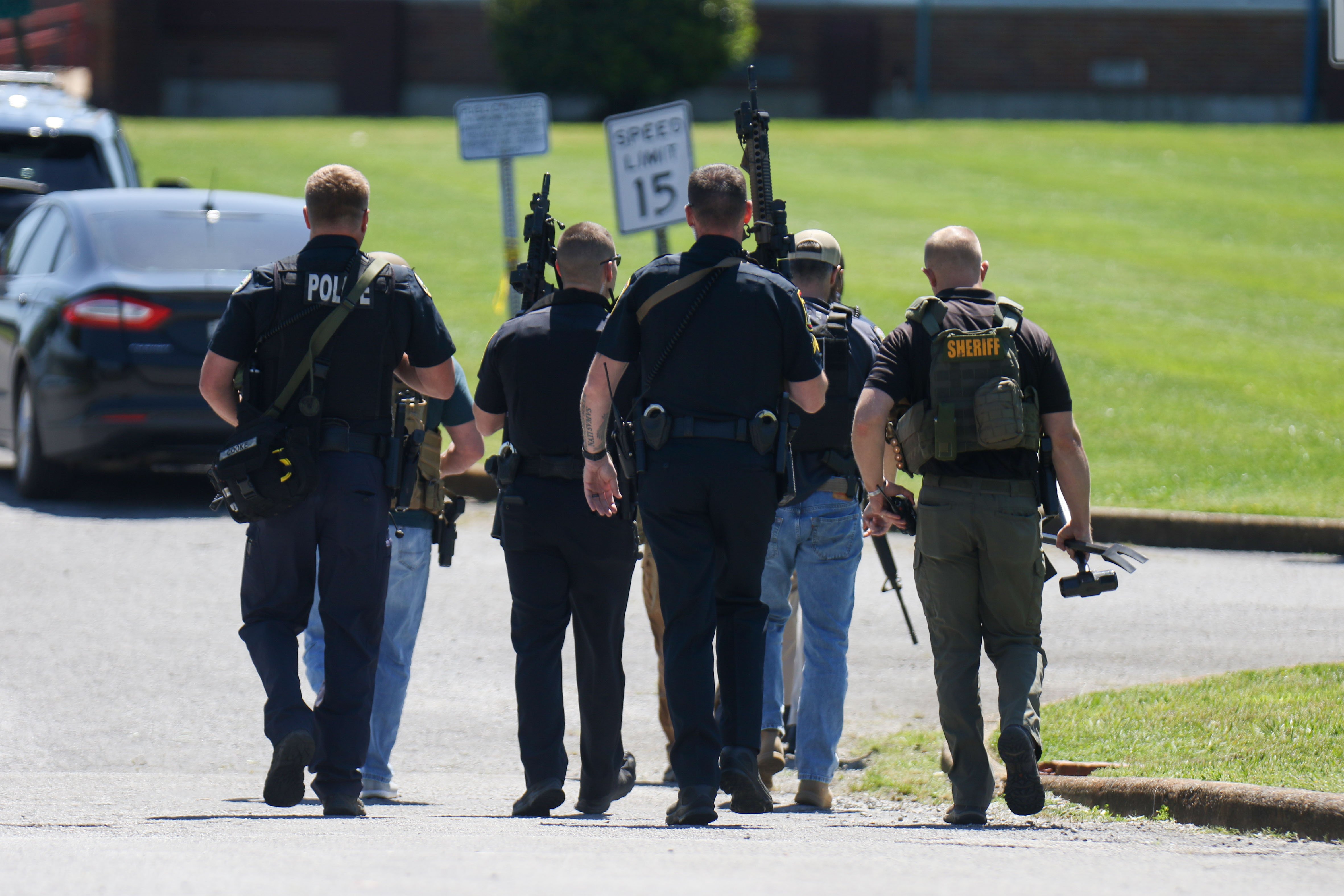 Staff photo by Olivia Ross / Chattanooga Police respond to a false call reporting an active shooter at Brainerd High School on Wednesday, May 3, 2023. Reported threats of mass violence to Hamilton County schools are on the rise so far this school year, based on notices from the Hamilton County Sheriff’s Office.
This year, a new law upgraded the criminal offense from a misdemeanor to a felony.
Superintendent Robertson said any threat is being taken very seriously and is being fully investigated.
(READ MORE: Parent arrested in connection with threats against Soddy Daisy Middle School)
It is important to recognize, he said, that the majority of the threat of mass violence incidents are not made with intent to follow through. He characterized many of them as students making comments out of an emotional response.
With the way the law is written, though, the intent doesn’t matter.
“Words matter,” he said. “They’re being charged with a felony and facing consequences there and consequences at school. I think it’s an important reminder for our families to have conversations with their students to make sure they understand you can say something and it can be out of emotion with no intent, but there are significant consequences to that.”
The district sent out a video to families asking for their help to reduce threats and is also working with schools to have conversations with all students about the topic, he said.
If a community member hears of a threat, Robertson encourages them to either report it to a school administrator or use the district’s anonymous quick tip line. The tip line is available on all school websites and the district website.
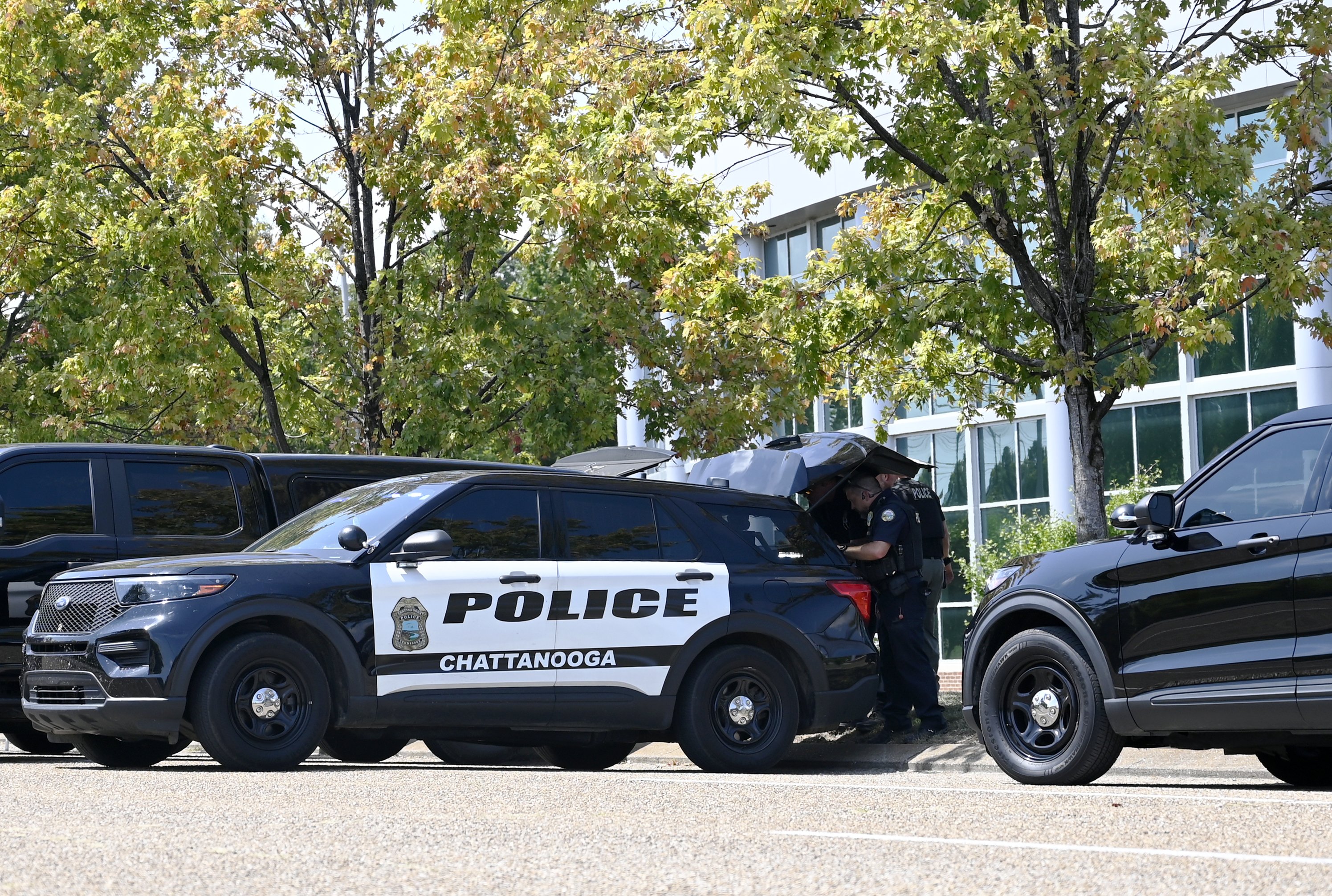 Staff photo by Abby White / Police respond after a gun threat was made at Chattanooga State on Thursday, August 29, 2024. Reported threats of mass violence to Hamilton County schools are on the rise so far this school year, based on notices from the Hamilton County Sheriff’s Office.
‘TOO MANY LESSONS’
When mass shootings like the one last week at Apalachee High School happen, Lundberg said, the discussion comes back to Tennessee.
“The legislature is constantly looking at, what else can we do?” he said.
When a shooter killed six people last year at Nashville’s Covenant School, Gov. Bill Lee called a special legislative session on public safety.
By the time the session ended, bills had been passed to provide free gun locks, streamline the state’s background check system and require a statewide human trafficking report. It also allocated money for community mental health agencies and safety improvements on college campuses.
Many, including a group of parents from the Covenant School, left unhappy that no gun restrictions were passed.
Rep. Bo Mitchell, D-Nashville, said the state needs to be proactive, rather than reacting to shootings like the ones at Covenant and Apalachee, when it comes to trying to prevent school violence.
“I think we’ve had too many lessons,” Mitchell said by phone. “It’s time for us to learn from our lessons and do something.”
Mitchell said he feels the Republican supermajority in Tennessee’s legislature is prioritizing guns over children’s safety.
“When the leading cause of death in our state for people under the age of 18 is a gunshot wound, that’s embarrassing,” he said.
Mitchell, a Democrat, worked with Lundberg and other Republicans to sponsor the bill that made mass violence threats a felony.
“I thought it was the first step,” Mitchell said. “I knew strengthening penalties was something the other side, they’re always for. So I’m more than happy to come meet them where they are in hope that they will take a step and do something proactive that my side of the aisle thinks is appropriate.”
Voices for a Safer Tennessee, a nonpartisan coalition formed by parents after the shooting at the Covenant School, believes no single law is going to solve the “current public health crisis of firearm injury and death,” Policy Director Erin Rogus said. She referred to the law as one piece of the toolbox that can be used to address the firearm crisis.
“The law is a tool that gives law enforcement the ability to better address these threats,” she said by phone. “By elevating it to a felony, you can immediately take that individual into custody temporarily to address the risk and set a bond, but you don’t have ability with a misdemeanor level charge.”
Rogus noted that the majority of school shooters access the firearm in the home. That’s part of the reason her organization advocates for secure storage because, too often, a child accesses the weapon and something unintentional or really bad happens, she said.
Lundberg also sponsored the “zero tolerance” bill in 2023 that requires a year-long suspension for students who threaten violence.
Both bills came out of input lawmakers heard from law enforcement, teachers and parents, Lundberg said.
“There’s a lot more coordination now between law enforcement and schools,” he said, “and these are all good things.”
Williamson County Schools faces two lawsuits over the “zero tolerance” law from families whose children have been expelled as a result. But Mitchell said it’s important to treat any threat seriously.
“Those kids go through the same trauma whether it was someone with a plan or without a plan,” he said.
But, he said, there needs to be discretion. For example, the new law does not apply to a person with an intellectual disability.
“I heard some story of one child that was expelled for just doing the gun symbol with their fingers, that’s going to extremes,” he said. “Now if a kid sends an email or a call with a hit list of what they’re going to do at school, that’s a different story.”
SCHOOL SAFETY
Hamilton County Schools consistently evaluates its protocols and looks to improve them throughout the year, not just after an event similar to the school shooting in Georgia happens, which is something the district will continue to do, Robertson said.
No safety measure is off the table, he said. The goal is to ensure every student, teacher, staff member and parent feels confident that schools are safe.
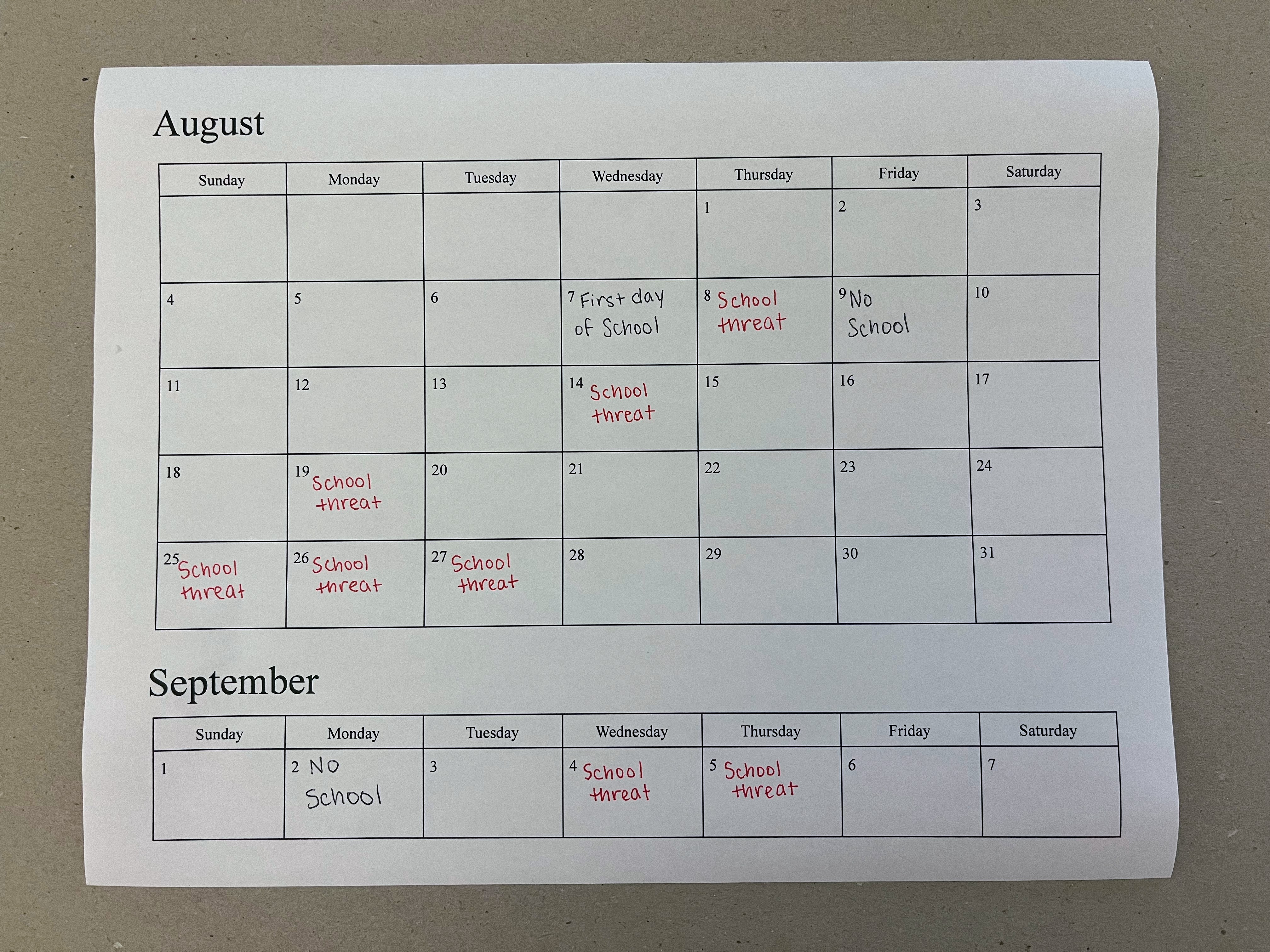 Staff photo by Shannon Coan / A timeline of the threats of mass violence in Hamilton County Schools during the 2024-25 school year.
Robertson will meet with the Hamilton County school board in an executive session in September to update members on the measures the district has been looking at and assess what the next steps are.
He added that the district learned a lot from the false report of an active shooter at Brainerd High in May 2023. During the response to the lockdown at Chattanooga State Community College in August, the district used its improved processes, he said, and it will take the lessons it learned there to implement different strategies moving forward. Two district high schools are located on the community college’s campus.
In recent years, the district has invested in student well-being by increasing the number of social workers, counselors and student support coaches to ensure students have resources to support their mental and physical health. It has also spent millions of dollars on school safety, he said.
For instance, the school system hardened entrances to buildings by creating several layers before a visitor could enter an area where students might be. It also added shatter resistant film to the glass at those entrances and other entrances to buildings and is in the process of looking at accessible windows on first floors to add the film to.
“We’re constantly evaluating and looking at what we can do to improve,” Robertson said. “That’s a good example of something that people physically see but may not see the other phases of that project.”
The district also has an armed school resource deputy or school security officer in every building. The program is fully staffed, Robertson said. School resource deputies are employed by a local law enforcement agency, while school security officers are employed by the school district and serve in a similar capacity but are not legally authorized to make arrests.
This year, due to investments from the sheriff’s office and other local law enforcement agencies, the district has overlapping coverage, Robertson said, meaning there is a replacement available to cover a school if an officer is out sick or on leave.
As a parent of a student in the school district, Robertson said he understands the concerns. School administrators and the school board carry no bigger responsibility or weight than school safety, he said.
Mike Matranga, CEO of security consulting firm M6 Global Defense and a former U.S. Secret Service agent, said he’s tired of having the same conversation over and over again.
“It’s just sick to me that we can’t get this right,” Matranga said by phone.
Matranga’s firm came to Chattanooga last year for a school safety summit, headlined by a survivor of the Sandy Hook Elementary shooting in 2012 in Connecticut.
Often, he said, those summits and conferences are more about selling things than about getting to the root of the problem, Matranga said. His booth, advertising holistic security plans and behavioral threat assessments, doesn’t get as much interest, he said.
“It’s school security theater at best,” he said. “At the end of the day, we have to get to know people and intervene early.”
Contact Shannon Coan at scoan@timesfreepress.com or 423-757-6396.
Contact Ellen Gerst at egerst@timesfreepress.com or 423-757-6319.