
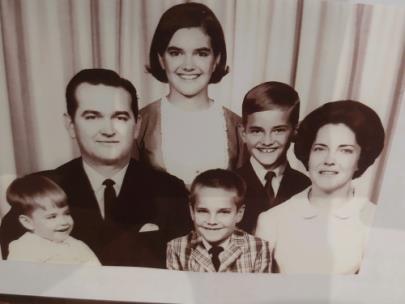
(Editor’s note: First of two parts)
His name was Charles A. Rose, but Chattanoogans remember him as “Pat,” a tall, dark-haired traffic engineer who became Chattanooga’s mayor in 1975.
Pat Rose was born in Orlando, Florida, in 1930, but he always considered himself a Georgia boy after the family moved to Rockmart in the northwestern part of the state when he was 5. He graduated from Rockmart High School, attended Georgia Institute of Technology, and then honed his skills in traffic engineering through specialized courses for the next decade. In 1954, Rose joined Atlanta city government, where he oversaw its traffic signal system — coordinating more than 500 lights needed to handle the ever-increasing traffic, Atlanta’s “gift” to commuting students and workers. Additionally, he undertook modernization of major intersections and became an asset to the planning and design division, spending the next 10 years of his career masterminding the city’s ever-evolving system.
In 1964, when the assistant traffic engineer position in Chattanooga was announced, Rose thought it would be a “grand opportunity … to deal with traffic engineering from another point of view.” He applied for the job and was hired. In the new position, Rose was charged with developing the technical and city-based information necessary to secure state and federal funding for infrastructure planning, improvements and maintenance. In addition to coordinating with governmental funding agencies, he worked closely with and under the direction of the Chattanooga City Commission.
When asked about aspects of the job by Springer Gibson, a Chattanooga Times reporter, Rose displayed his slow, easy smile. He explained that for an official to get “genuine satisfaction out of a job, that person must feel that what is done in the job is worthwhile” and “is helpful to other people.” He further noted that he was most comfortable working as part of a larger group that was united by a common goal and “enjoyed their work.” Relationships were key: “I do feel that the organization attitude is important. If you don’t have it, then it would be difficult to execute the responsibilities of this job.” When further quizzed about “Why Chattanooga?” the future mayor mentioned his family and the welcoming community. He then pinpointed Chattanooga’s forward-thinking leadership since the 1940s. “I believe this is one of the most progressive city administrations … it makes you proud to be part of the organization.”
Within five years, Pat Rose was appointed Chattanooga’s commissioner of public works by Mayor A.L. “Chunk” Bender, who had held the position, and gained a reputation as a man who could be trusted — possessing “qualities of friendliness, of thoughtfulness and of a capacity to listen to the other fellow’s point of view … a gentle man and a humble man, but a strong man.” He was sworn into his office after the Rev. Ansell T. Baker, pastor of Central Baptist Church, offered a prayer for the Rose family and the city. Rose spoke briefly acknowledging that his strength was derived from his family, his faith and his belief that “basically good government has in its background citizen involvement, professional competence and integrity on each person’s part.” With those words, the new commissioner thanked his supporters and Evelyn McBryar, his secretary who had previously served Mayor Ralph Kelley, hugged his family and cleared the office so he could begin work.
When he announced his candidacy for public works commissioner in late December 1970 (for the 1971 election), Rose cited the department’s accomplishments since his appointment 23 months earlier. It would be his first political campaign. The candidate admitted that he anticipated “a great deal of hard work in the coming months” but was thankful for the support that Chattanoogans had given him: “I am definitely convinced that I can continue to be a responsible person in attempting to serve the needs of citizens of the city of Chattanooga in a fair and equitable manner.” There were political pundits who wondered if Rose’s previous support for “consolidated government” might have lessened enthusiasm for his election, but he successfully and easily won his first campaign.
Pat Rose’s endorsement of consolidated government spoke to the future mayor’s core values. In discussing the work of an ongoing charter commission, he said, “My own hope is that our thoughts will be restricted … not to how we personally will be affected, but rather what will best serve the needs of our children … . I sincerely urge each citizen to cast a vote that represents his true feelings … .”
The citizens spoke — “No” on consolidated government but “yes” for Pat Rose.
Linda Moss Mines is the official Chattanooga-Hamilton County historian. For more on local history, visit Chattahistoricalassoc.org.