
College Football Playoff organizers unveiled a 12-team format in spring 2021 that looked like an exciting step in the evolution of the postseason, with potential to lift the sport’s national profile even further while boosting all five power conferences and keeping the other five relevant.
Three years later, the expanded playoff that fans were promised is not what they are getting. It has been twisted and distorted by conference realignment and greed, with more changes being proposed that nobody wants — outside of a few beneficiaries.
There will be at least two 12-team playoffs, this season and next, but the Power Five is now down to four (RIP, Pac-12), and even that is dominated by a Big Two: The Southeastern Conference and the Big Ten have decided to throw their weight around to protect their own interests with little regard for what’s best for college football.
Last week, CFP officials acknowledged publicly they are already looking into expanding to 14 or more teams, starting in 2026. Those discussions were prompted, at least in part, by the Big Ten and the SEC demanding they get more access to the CFP field in the the form of automatic bids.
So now the conference commissioners who manage the CFP are considering a 14-team model that includes 11 automatic bids: Three each for the Big Ten and the SEC, two each for the Big 12 and the Atlantic Coast Conference, and one for the top team from the Group of Five conferences (American Athletic, Conference USA, Mid-American, Mountain West, Sun Belt).
The current model reserves slots for the five highest-ranked conference champions, regardless of conference, and seven at-large bids. The potential 3-3-2-2-1 model would grant automatic-qualifier status to six teams that don’t even win their leagues.
If you think that sounds bad, it is better than giving the Big Ten and SEC four auto bids each, which they also suggested.
Teresa Gould stepped into this fray last week by taking over as commissioner of the Pac-12, which will be just Oregon State and Washington State after this academic year. Gould deflected questions about specific CFP models during her introductory news conference Thursday.
“There are a lot of different options on the table. To be clear, we’re very much in the infancy stages of what happens beyond 2026. We’re not discussing one model. We’re looking at many,” she said.
Expect some pushback, especially out of the ACC and the Big 12, which includes TCU, the runner-up when SEC power Georgia repeated as national champion in the 2022 season.
“I’m not involved in the negotiations of the CFP extension, but it feels as though there’s two conferences that are trying to stack the deck versus everyone else, and that’s potentially going to create a competitive inequity that I don’t think is good,” TCU athletic director Jeremiah Donati told reporters Wednesday before the latest news about a 3-3-2-2-1 model was even reported. “I don’t think it’s good for college football.”
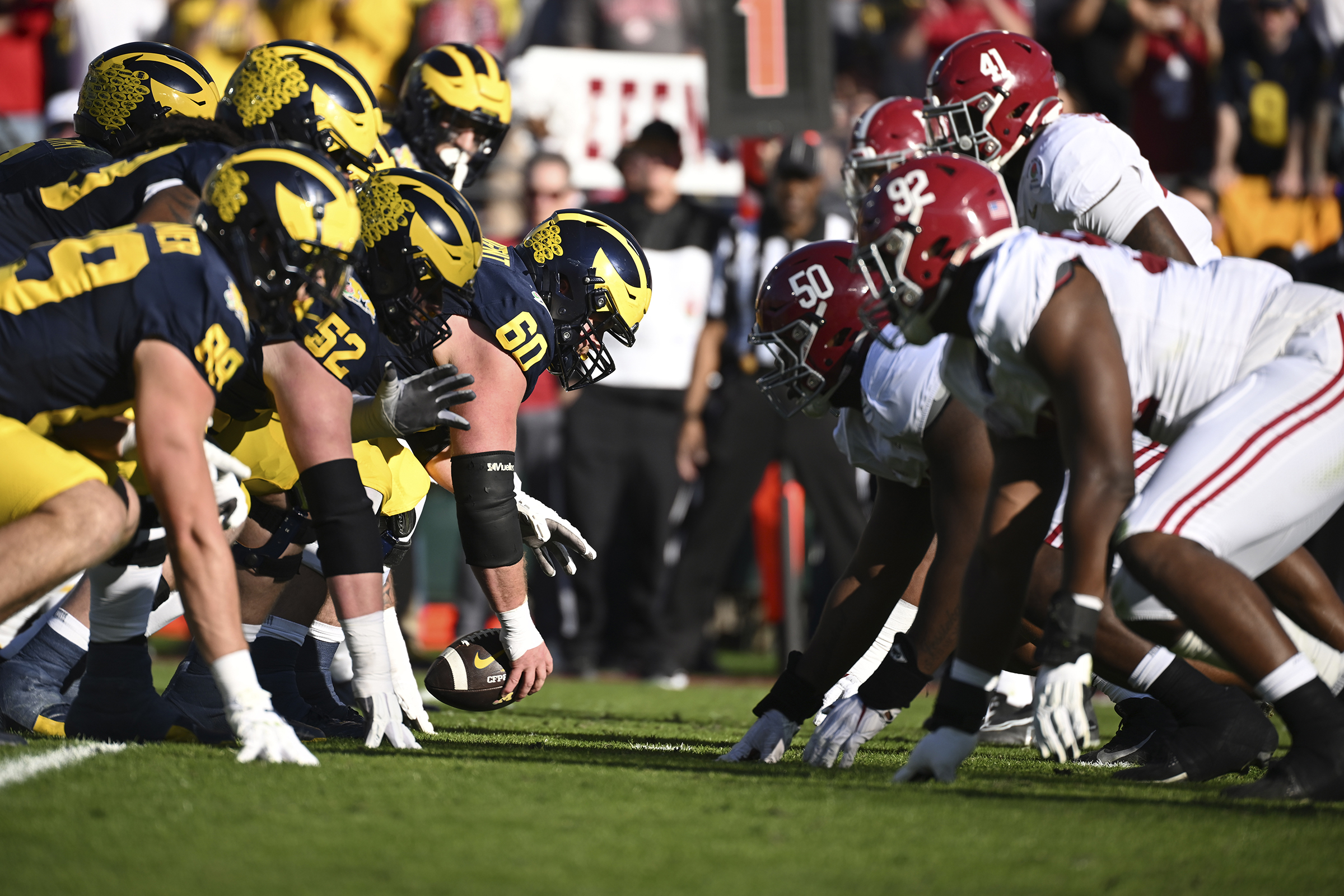 AP photo by Kyusung Gong / Michigan’s offense, left, lines up against Alabama’s defense during the Rose Bowl on Jan. 1 in Pasadena, Calif. Michigan, the Big Ten champion, and Alabama, which won the SEC, met in a College Football Playoff semifinal in the last four-team edition of the event.
Objections might not matter. The Big Ten and the SEC hold all the leverage. They could very well cut the rest of college football out altogether, do their own playoff and keep all the money — instead of most of it, which is what they want right now.
It’s also notable that expanding the field from 12 to 14 or even 16 is not likely to bring in more money. ESPN has a six-year offer worth about $7.8 billion on the table, and another first-round game or two isn’t changing that.
Everything about this screams solution in search of a problem.
The Big Ten will grow to 18 teams next season, having poached Oregon, Southern California, Washington and UCLA from the Pac-12, basically pushing its longtime Rose Bowl partner off a cliff.
The SEC will have 16 teams, adding Oklahoma and Texas. The Big 12 survived the loss of those two bell cows by raiding the Pac-12 and the AAC, but now it’s realizing it’s no longer a football peer to the Big Ten and the SEC, with their megacontracts for media rights and a recently formed joint advisory committee.
Of the top 15 teams in last season’s final AP Top 25 poll, 12 will reside in either the SEC (seven) or the Big Ten (five) next season.
So why are commissioners Tony Petitti (Big Ten) and Greg Sankey (SEC) compelled to strong-arm and marginalize the ACC and the Big 12 to guarantee access for their leagues’ third- or even fourth-best teams when it’s likely they would have had those spots through the selection process as at-large bids?
Pressure from within their own conferences, especially the Big Ten, where coaches and athletic directors will be facing fans demanding CFP appearances as a benchmark for a successful season.
The push for automatic access also suggests Petitti and Sankey don’t trust the 13-member selection committee to properly weigh schedule strength.
Sankey probably doesn’t have to worry as much. Two decades of SEC dominance in college football have all but guaranteed it the benefit of the doubt, as last season’s snub of undefeated ACC champion Florida State for one-loss Alabama showed.
The Big Ten, which plays nine conference games to the SEC’s eight, wants to ensure its 10-2 and 9-3 teams receive priority over ACC and Big 12 teams with the same or better records.
But at what cost? Automatic access cuts into the credibility of the playoff, something that was already starting to wane with the four-team CFP, which felt like a overly exclusive invitational.
The Pac-12’s Gould said athletes “want to feel like they have a fair shake and like if they achieve at a certain level, they’re going to have that access. So I think at large-berths are critically important to the viability of the sport and, quite candidly, the fan interest as well.”
The biggest problem with the four-team playoff: It reinforced the tiering of college football and further separated the haves and have-nots.
The 12-team playoff, when it was introduced in 2021, was touted as a way to increase access and maybe, just a little, redistribute some of the power that had been consolidating among a few teams in a few conferences. The first draft of the 12-team playoff emphasized teams actually winning their way into it and treated conferences as relative equals.
Three years later, it looks like an even bigger invitational that will lead to even more consolidation.