
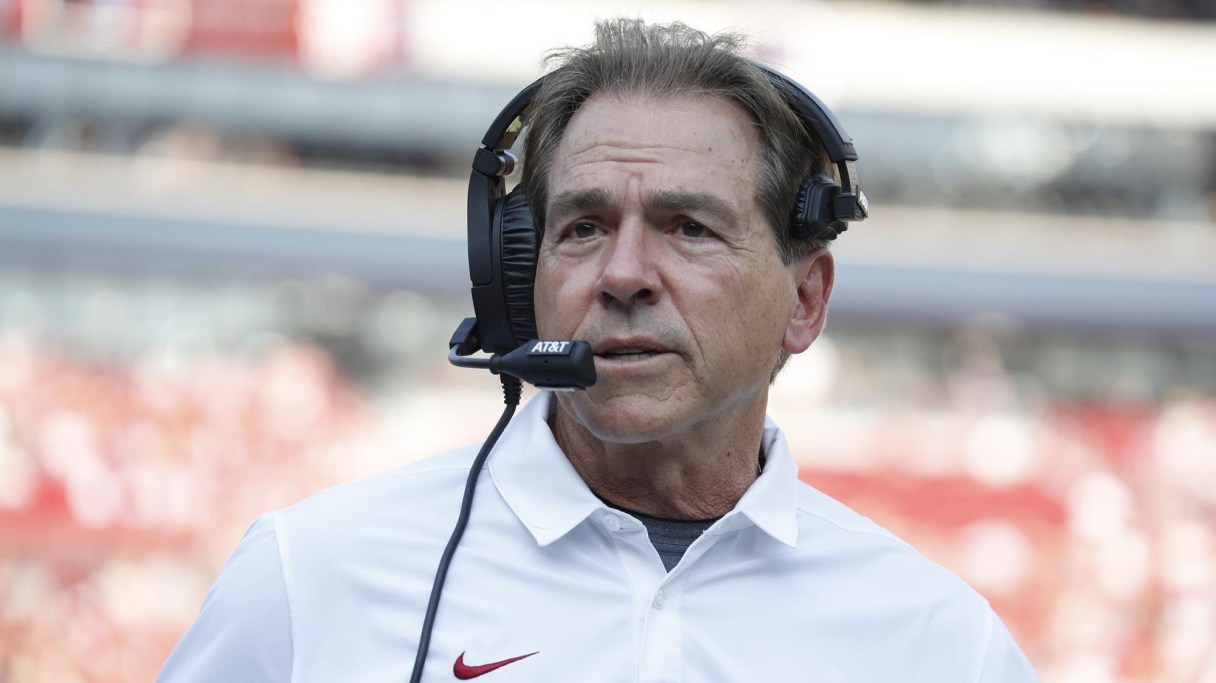

In the days leading up to the 2020 Southeastern Conference championship game, Alabama football coach Nick Saban was asked how long he planned to keep guiding the Crimson Tide.
It was not the first time Saban had heard that question, and it would not be the last.
“Obviously I love doing what I do, and I want to continue to do it for as long as I feel like I can contribute in a positive way to the program,” he said. “That’s about the only plan I have for the future. If I thought that my presence here was not something that was positive for the University of Alabama or the program or the players, then I would say it would be time not to do it anymore.”
The positives kept coming and coming.
Alabama would defeat Florida a few days later for Saban’s seventh SEC title, and he would add an eighth in 2021 and a ninth last month. On Wednesday afternoon, ESPN’s Chris Low was the first to report that the greatest coach in college football history was retiring at the age of 72.
Wednesday’s news did not provide the same shock as Steve Spurrier’s decision to leave Florida in January 2002 at the age of 56. This season felt like the last time Saban would cling to a victory cigar after a win over Tennessee inside Bryant-Denny Stadium, and what better exit to the Iron Bowl rivalry than the fourth-and-31 pass from Jalen Milroe to Isaiah Bond that delivered a 27-24 triumph at Auburn?
Although Alabama suffered an overtime loss to Michigan in the Rose Bowl national semifinal on New Year’s Day — a heartache many would not want as a final moment — Saban has picked a perfect time to call it a career.
For starters, his final season will always rank near or at the top, especially given that the Crimson Tide looked like an uncharacteristic mess in September.
“It’s been great,” Saban said in October. “The challenges are great, and I enjoy coaching this team. That’s not to say that they’ve taken years off my life, but I’m OK with that.”
In his 17 seasons at Alabama, his Tide earned nine SEC championships for a 52.9% success rate. He also won two conference titles in five seasons at LSU from 2000-04, so he celebrated an SEC crown 11 times in his 22 years in the sport’s most successful conference.
His seven national championships — six with Alabama and one at LSU — topped Tide legend Paul “Bear” Bryant to set a new standard, and he wound up with a 48-16 record with the Tigers and a 201-29 mark with Alabama. We could spend the rest of 2024 praising Saban and his dominance, but here is just a sampling:
— Saban never lost to Arkansas in 17 meetings and built winning streaks of 15 games against Tennessee, eight against Florida, LSU and Texas A&M, and seven against Georgia. Florida was the league’s team to beat when Alabama’s ascension under Saban began, but the Tide avenged a loss to the Gators in the 2008 SEC title game by routing them in the 2009 rematch and never lost to them again.
— Florida’s Urban Meyer, Auburn’s Tommy Tuberville, Tennessee’s Phillip Fulmer, Georgia’s Mark Richt and LSU’s Les Miles were revered coaches when Saban returned to the SEC in 2007, but they either resigned from their jobs or were removed because they couldn’t keep pace with what Saban had cooking in Tuscaloosa.
— People will always mention Saban’s ceiling with his national championship count, but 11-2 was the floor for his program during his final 13 seasons.
— Then there is this golden nugget: Every player who spent four seasons with Saban at LSU or Alabama experienced at least one national championship.
Saban was always a step ahead of his peers, whether on the recruiting front, building a support staff or showing up for NFL drafts that had multiple Tide players going in the first round. Tuscaloosa became a place for the likes of Lane Kiffin and Steve Sarkisian to regroup before relaunching careers that became more successful than before, but the sport’s landscape kept changing.
Transitioning from a traditional offensive attack with more spread and tempo elements was one thing, but the arrival of name, image and likeness compensation for players left Saban realizing there was no controlling the potentially deeper pockets at places like Georgia, Texas and Texas A&M. Calling out Jimbo Fisher and the Aggies for buying the No. 1 class in the 2022 signing cycle clued us all in on that.
From a personal standpoint, I will always view Alabama’s 2020 national championship team as underappreciated and as Saban at his very best. A year after LSU’s tremendous run to the title, Saban navigated the challenges of a pandemic tremendously, routing Notre Dame and Ohio State in the playoff a combined 83-38.
In an interview setting, Saban was fantastic at providing red-meat answers to issue-related questions.
I asked him before the 2015 season about whatever happened to the college football adage of chalking up a loss for every true freshman who has to play, and he lit up and responded with, “Way back in the day when freshmen weren’t eligible, I remember when Woody Hayes said that you lose one game for every sophomore you played.”
It would be later in the 2015 season when Saban had his memorable “Tin Horn” news conference, which remains a YouTube favorite today. I’m glad I wasn’t in attendance for that one, because I may have laughed to death.
Simply put, Nick Saban retired Wednesday as the best to ever do it.
Contact David Paschall at dpaschall@timesfreepress.com.