
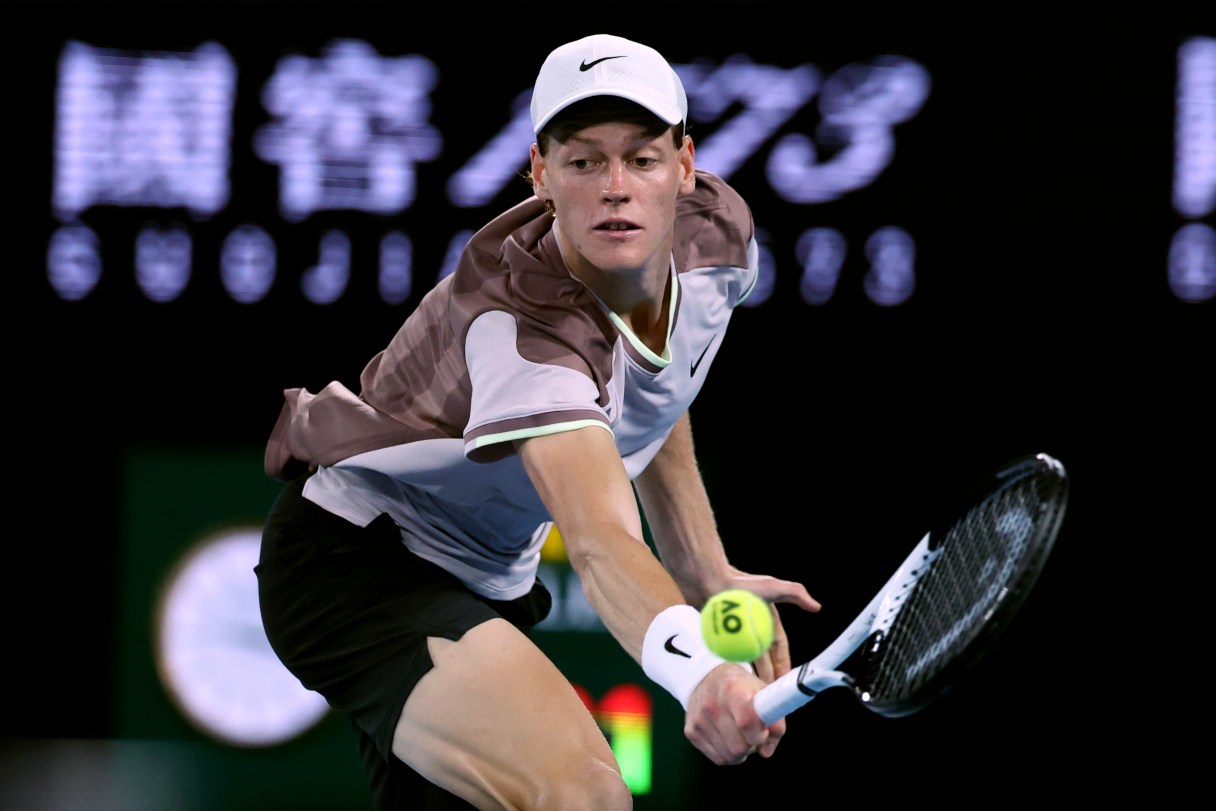
MELBOURNE, Australia — Jannik Sinner lined up a forehand, drilled it down the line, then dropped to the court on his back, giving himself some moments to process how he had managed to come back from two sets down to win his first Grand Slam title.
He found a way to turn defense into attack in his first major final, taking the Australian Open title from Daniil Medvedev, 3-6, 3-6, 6-4, 6-4, 6-3, on Sunday at Rod Laver Arena.
“I like to dance in the pressure storm,” the 22-year-old said of his seemingly serene approach to the most tense moments. “I like it because that’s where most of the time I bring out my best tennis.”
It was the fourth-seeded Sinner’s third straight win over a player in the top five of the ATP Tour rankings, coming after a quarterfinal victory over No. 5 Andrey Rublev and his semifinal upset that ended No. 1 Novak Djokovic’s long domination of the tournament. Until Sunday, only Djokovic and Roger Federer had done that in a major played on hard courts.
So he’s in great company.
Sinner is also the first Italian to win the Australian Open and the youngest winner in the men’s final at Melbourne Park since Djokovic secured his first Grand Slam title in 2008. The 36-year-old Serbian has won quite a few more since then, of course, with his 24 major singles championships — a record 10 Australian Open titles among them — more than anyone in men’s tennis history and with only his fellow members of the Big Three owning more than 14. Federer, with 20 majors, last played a Grand Slam event in 2021 and officially retired a year later, though, and the 37-year-old Nadal (22), sidelined for most of last season, had to put his most recent injury comeback on hold before making it to Melbourne.
With 20-year-old Carlos Alcaraz winning Wimbledon last year and Sinner taking the season-opening major, a generation shift seems to finally be arriving.
“I still have to process it, because … beating Novak in the semis and then today Daniil in the final, they are tough players to beat,” Sinner said. “It’s a great moment for me and my team. But in the other way, we also know that we have to improve if we want to have another chance to hold a big trophy again.”
Sinner’s success has lit a tennis fuse in Italy, where his run to the ATP Finals championship match and his leading role in the Davis Cup title win in November captured the country’s attention. The nighttime final in Australia made for pre-lunch viewing in Italy.
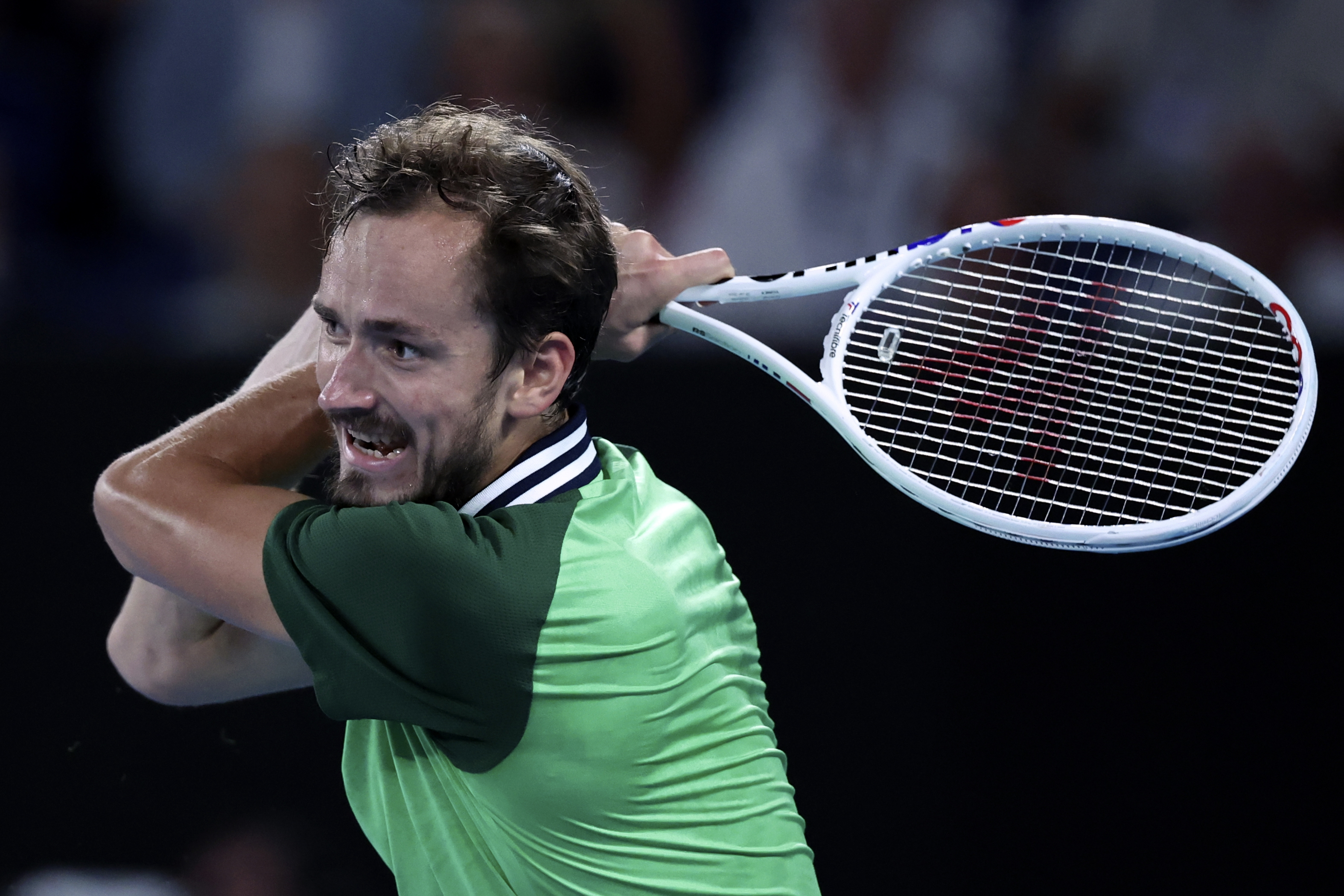 AP photo by Asanka Brendon Ratnayake / Daniil Medvedev plays against Jannik Sinner in their Australian Open title showdown Sunday at Melbourne Park. The 27-year-old Medvedev lost a two-set lead and then the match, falling to 1-5 in Grand Slam finals.
For 2021 U.S. Open champion Medvedev, the loss was his fifth in six major finals, and at age 28, the Russian player is in between the old guard and the group rising stars led by Alcaraz and Sinner.
The third-seeded Medvedev set records with his fourth five-set match of this year’s Australian Open and for time on court at a major in the Open era (dating to 1968), with his 24 hours and 17 minutes surpassing Alcaraz’s 23:40 at the 2022 U.S. Open.
“I’m in the history books for something,” he said with a laugh. “Let’s take it!”
Unfortunately for Medvedev, he is also the first player in the Open era to lose two Grand Slam finals in five sets after taking a 2-0 lead. He dropped back-to-back Australian Open finals — to Djokovic in 2021 and to Nadal after holding a two-set lead the following year — and was also the U.S. Open runner-up in 2019 to Nadal and last year to Djokovic.
“It’s very, very tough when you have a mentality, I don’t want to say champion, but a good mentality, a sport mentality, it’s very tough to lose in the final,” Medvedev said. “It kind of hurts more. But you have to try to find positives — and the positive is, well, the final is better than the semifinal and quarters.”
Sinner had dropped one set through six rounds over the past two weeks — in a third-set tiebreaker against Djokovic, whose streak of 33 straight wins in Australian Open play dating to 2018 ultimately ended that day — until he lost two straight to Medvedev. It wasn’t until a break in the sixth game of the fifth set that he really had a full grip on his first Grand Slam title.
In two of Medvedev’s five-set matches — a second-round win over Emil Ruusuvuori that finished at almost 4 a.m., and a 4-hour, 18-minute semifinal win over No. 6 Alexander Zverev — he had to come back from two sets down. Nobody had done that on the way to an Australian Open final since Pete Sampras in 1995.
Against Sinner, he started like a man who wanted to win points quickly. Standing closer to the baseline to receive serve and going to the net more regularly than usual, he broke in the third game and took the first set in 36 minutes. He had two more service breaks in the fourth and sixth games of the second set but was broken himself at 5-1 trying to serve it out. He was successful on the next try.
The third set went with serve until the 10th game, when Medvedev was a point from leveling at 5-5 until three forehand errors gave Sinner not just the set but the momentum. Sinner won the fourth set, again with a service break in the 10th game, recovering immediately to win three points after hitting a forehand so far out that it shocked the crowd.
And so the tournament equaled a Grand Slam Open era record set at the 1983 U.S. Open with a 35th match going to five sets.
In the sixth game of the fifth set, Sinner had triple break point against a fatiguing Medvedev. He missed his first chance but converted his next, a forehand winner, for a 4-2 lead. From there, he didn’t give his opponent another opportunity.
Medvedev had been saying through the tournament that he has more stamina than in the past and is mentally stronger in the tough five-setters. He certainly showed incredible endurance, but he also came up just short. Again.
Medvedev won his first six career meetings with Sinner but has now lost four in a row, including three finals.
“I want to congratulate Jannik … you showed it again why you deserve it,” Medvedev said. “Probably that’s not your last Grand Slam, but I hope I can try to get the next one if you play in the final.”