
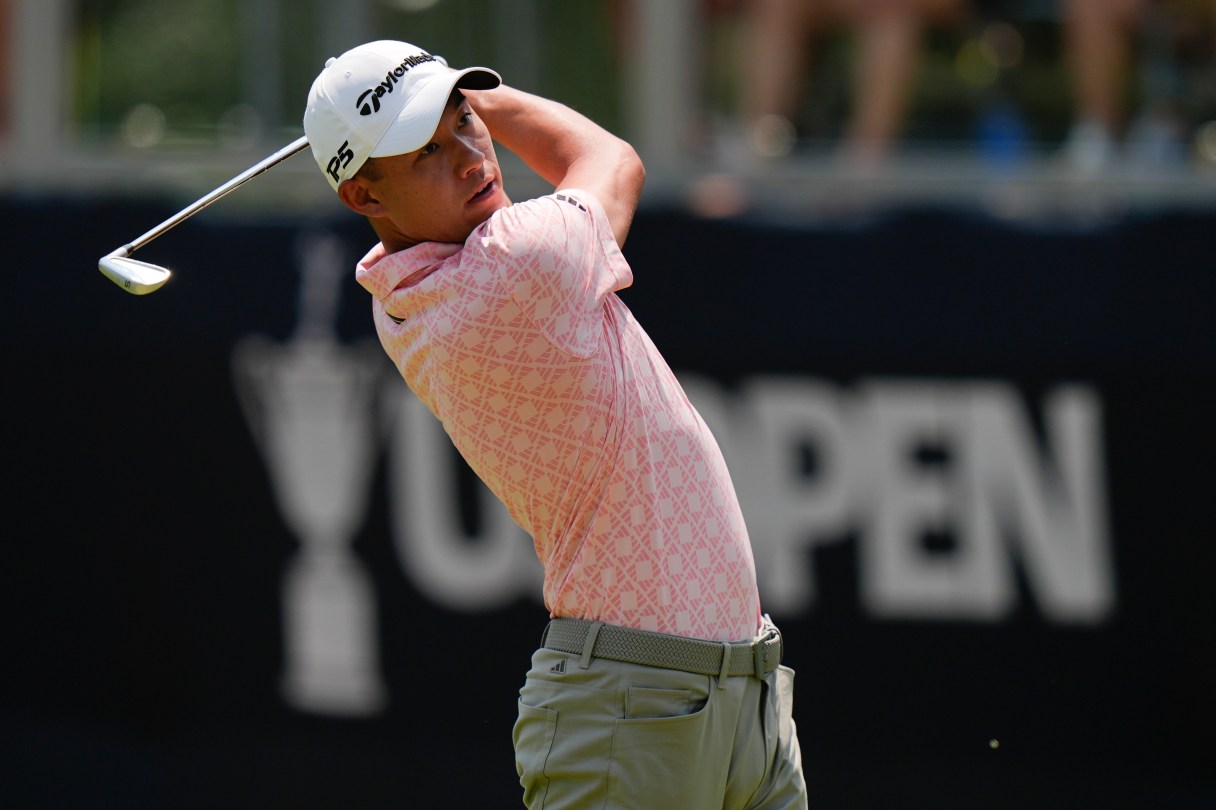
PINEHURST, N.C. — Collin Morikawa woke up Saturday nine shots off the lead and figuring he would have to get back to par to have any chance of winning the U.S. Open.
He did his part, shooting a bogey-free 66 at Pinehurst No. 2.
What Morikawa wasn’t counting on was big Bryson DeChambeau manhandling the sun-drenched course a few hours later, shooting a 67 and leaving him seven shots behind with a round left.
Now the two-time major champion needs some Arnold Palmer-type magic to win his first U.S. Open title and move a step closer to the career Grand Slam.
In the 1960 U.S. Open, Palmer trailed Mike Souchak by seven shots after 54 holes at Colorado’s Cherry Hills Country Club, but Palmer birdied six of his first seven holes in the final round and went on beat amateur Jack Nicklaus by two shots for what remains the greatest comeback in the tournament’s 124-year history. Palmer shot a 65 that day; Souchak had a 75.
“Look, if I play the way I did today, who knows what could happen,” said Morikawa, who won his first major title at the 2020 PGA Championship and added another the following year at the British Open.
Morikawa’s third round was impressive, and he has moved inside the top 10 with 18 holes to play.
With the heat index pushing triple digits, the 27-year-old Californian had an error-free trip around the brutally difficult Donald Ross design in the morning to seemingly position himself for another strong finish at a tournament where he has two top-five showings since 2021.
His birdie on the 18th hole, his fourth of the day, left him within five shots back before second-round leader Ludvig Aberg — who was 5 under at the time — had even teed off.
Morikawa believed when he walked off the course he’d have a chance to at least contend in a tournament in which Scottie Scheffler, a dominant No. 1 in the Official World Golf Ranking, surprisingly has not been a factor.
Morikawa entered the round having to balance needing to make up ground on the leaderboard with patience on a course that makes players pay for the slightest mistake. He did that masterfully, aided by going 8-for-8 on scrambles and draining big putt after big putt.
“You can’t be aggressive out here,” Morikawa said. “I think if you’re aggressive, it can put you in really bad spots. You’ve got to just kind of take your 30-footers. If you have a wedge, sometimes you’re able to go at pins. … You play aggressive to the right parts, you take what you can. If you get lucky, you get lucky.”
He added: “I made the putts that I needed to. I made up-and-downs. Made everything essentially.”
After shooting 74 on Friday, Morikawa went back to study video and realized he needed to slow things down. He wouldn’t make the same mistake on Saturday.
“For me, whenever it’s quick, it’s never good,” Morikawa said. “Just tried to be a little bit more patient out there, really stick to what I felt. Just execute as best I can.”
He had a chance to win his third major title at the Masters in April, where he was one shot back of Scheffler and in the final group.
They were tied through seven holes, but Morikawa found the trees at the ninth and made a double bogey. Then at the 11th, he pulled his approach into the pond left of the green and made another double, ruining his chances. He finished tied for third as Scheffler put on the green jacket for the second time in three years.
Morikawa has been on a run since then.
He finished ninth at the PGA Tour’s RBC Heritage the week after the Masters, tied for 16th at the Wells Fargo Championship the week before the PGA Championship, and was fourth at the Charles Schwab Challenge the week after that major. He tied for fourth at the PGA Championship and was second last week at the Memorial Tournament, where a final-round 71 made up three shots on Scheffler but left him one shot back as the world’s No. 1 player won for the fifth time in 2024.
On Sunday, Morikawa will look to parlay that momentum into a strong final round — even if he is likely out of the running.
He has not played particularly well in the final round of recent tournaments, breaking 70 just once in the final 18 holes since February. But at Pinehurst, like he said, anything can happen.
“This course is only going to get tougher,” Morikawa said. “I know it’s not going to be easy. Today was not easy by any means. I just put it in the right spot, kept the ball in front of me, really just played very simple golf.”