

East Tennessee is home to the world’s fastest computer, at the Oak Ridge National Laboratory. The $600 million Frontier supercomputer has a record-shattering computational capacity of up to 2 exaflops, or 2 quintillion calculations per second.
But within the next decade or two, the machine may be dethroned by an even more powerful quantum computer that use qubits, or quantum bits, to create more computational power using less energy. And another East Tennessee City — Chattanooga — could play a key role in developing and linking the new technology.
Chattanooga’s EPB has deployed the same fiber optic network used to create the fastest communitywide internet in the United States to build the nation’s first commercial quantum network. During the Co.Mobility Summit this week in Chattanooga, quantum scientists and developers said quantum-based computers should soon greatly expand computing and sensing capacity to power the artificial intelligence revolution ahead without the costly energy demand of today’s computers.
“This is the magic of quantum,” Margaret Arakawa, chief marketing officer for IonQ, told hundreds of business and government leaders gathered at the University of Tennessee at Chattanooga on Tuesday. “Quantum computers can solve problems that classical computers cannot, and the world does not have enough power to generate the answers that we need with classical computers.”
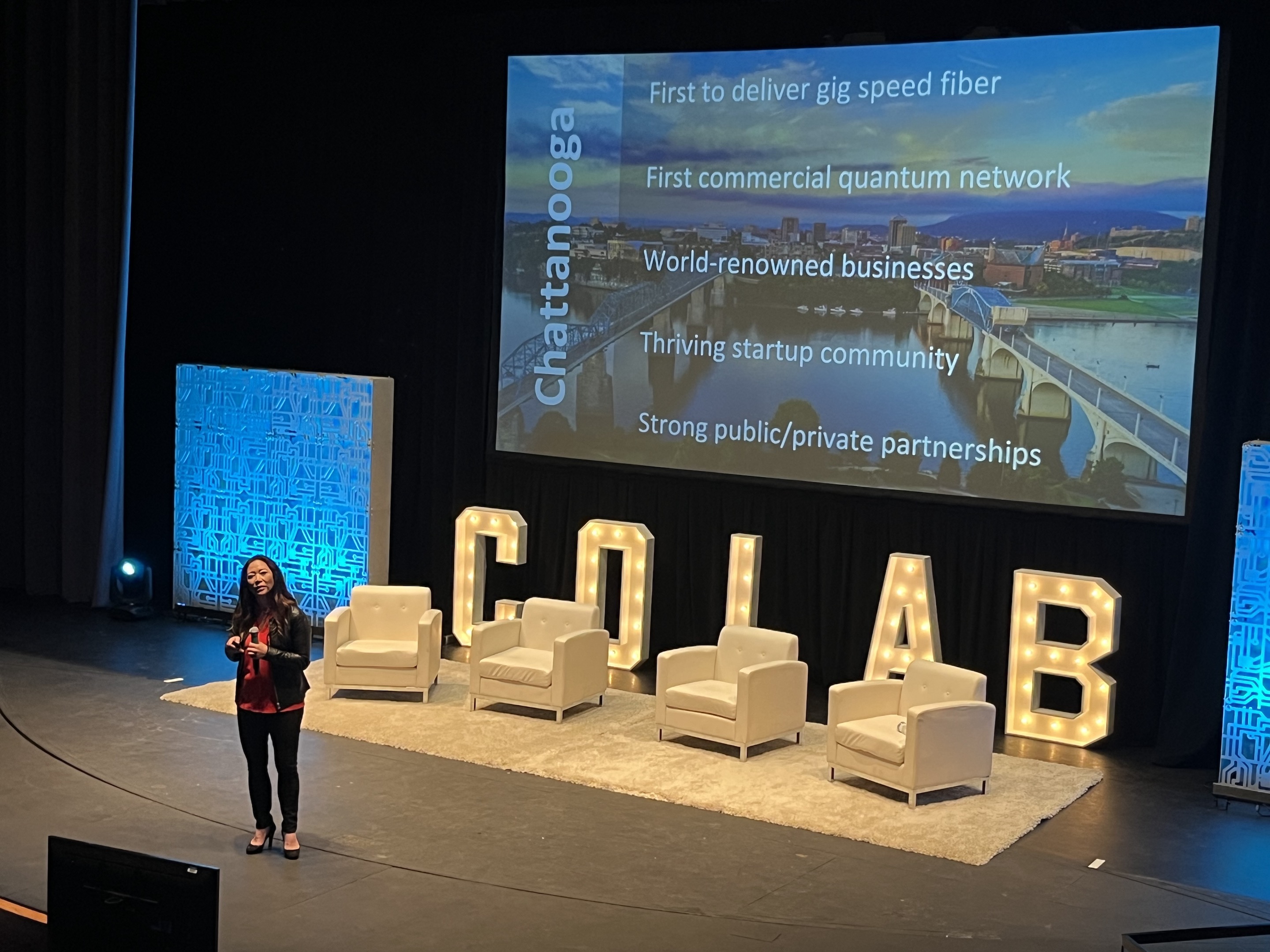


Quantum computing uses the quantum bit or qubit as the basic unit of information rather than the conventional bit, allowing for much greater computational capacity with far less energy use. Bits process information as a zero or a one, but quantum bits harness the infinite fractional possibilities in between zero and one to process information faster.
Arakawa, who worked for more than two decades at Microsoft and other computer companies, said IonQ is developing quantum computers for companies ranging from Hyundai and Airbus to General Dynamics and General Electric. Arakawa made her third visit to Chattanooga this week to meet with companies developing and using the country’s first commercial quantum network to link different quantum computers and applications.
EPB’s quantum network will help link quantum computers, such as those being developed by IonQ, a quantum computing hardware and software company based in College Park, Maryland. The quantum industry is projected to grow around the world to $46 trillion by 2035, Arakawa said. Chattanooga is poised to be an early leader in the industry with EPB’s quantum network and high-speed internet service, along with Chattanooga’s university, nonprofit, government and businesses’ support for quantum-related technologies and workforce development, Arakawa said.
“Chattanooga is special for many reasons, and with the world’s first commercial quantum network and the links with Oak Ridge National Laboratory, you have all the right ingredients to be an innovator in this important space,” Rima Alameddine, the chief revenue officer at IonQ, said during a roundtable discussion with former U.S. Sen. Bob Corker, R-Tennessee.
Alameddine said quantum computers can boost computing capacity exponentially compared with today’s digital computers and use 6,000 times less energy to perform their work than today’s computers. That will be key to powering the artificial intelligence revolution, which is boosting electricity demand significantly after a decade of relatively flat power demand.
Goldman Sachs Research estimated earlier this month that data center power demand will grow 160% by 2030 and early adopters of the technology are likely to gain the biggest share of the emerging business.
“It’s an incredible time to be in Chattanooga,” Co.Lab CEO Tasia Malakasis said at the opening of the Co.Mobility Summit designed to promote Chattanooga and its quantum network to prospective businesses and entrepreneurs.
The Company Lab works to promote and aid startup businesses and this year launched an accelerator program to capitalize on Chattanooga’s infrastructure and industrial strengths to promote sustainable mobility, which is defined as the future forward movement of people, goods, energy and data. Quantum technology is key to developing AI technologies to most efficiently propel such sustainable mobility, Malakasis said.
“We hope to be on the ground floor of this emerging technology,” EPB Vice President Evann Freeman said at the start of this week’s Co.Mobility conference.
UTC became the first academic institution to be connected to EPB Quantum Network last year. Several businesses are now building or considering adding facilities in Chattanooga to link with one of the quantum network nodes, Freeman said.
U.S. Sen. Marsha Blackburn, R-Tenn., who serves on the Senate Subcommittee on Communications, Media and Broadband, is pushing a number of bills in the U.S. Senate to aid the growth of America’s quantum industry to help compete with China.
“It is important that we establish a solid foundation in this technology,” Blackburn said in a video message to the Co.Mobility Summit. “China likes to say they are going to be the leader of the pack, but we cannot let them take the lead and set the standards.”
Blackburn has joined with U.S. Rep. Elise Stefanik, R-N.Y., to sponsor the Defense Quantum Acceleration Act, legislation that would advance work done at the Oak Ridge National Laboratory on quantum technologies. Last year, Blackburn also joined with U.S. Sen. Ben Ray Luján, D-N.M., to sponsor the Quantum Sandbox for Near-Term Applications Act to establish a public-private partnership for near-term quantum application development and acceleration.
“While communist China has publicly acknowledged their goal to lead the world in quantum communications by 2049, it’s critical the United States provide an environment for entrepreneurs and companies to promote competition and continued innovation,” Blackburn said when she introduced the legislation last year.
Contact Dave Flessner at dflessner@timesfreepress.com or 423-757-6340.