
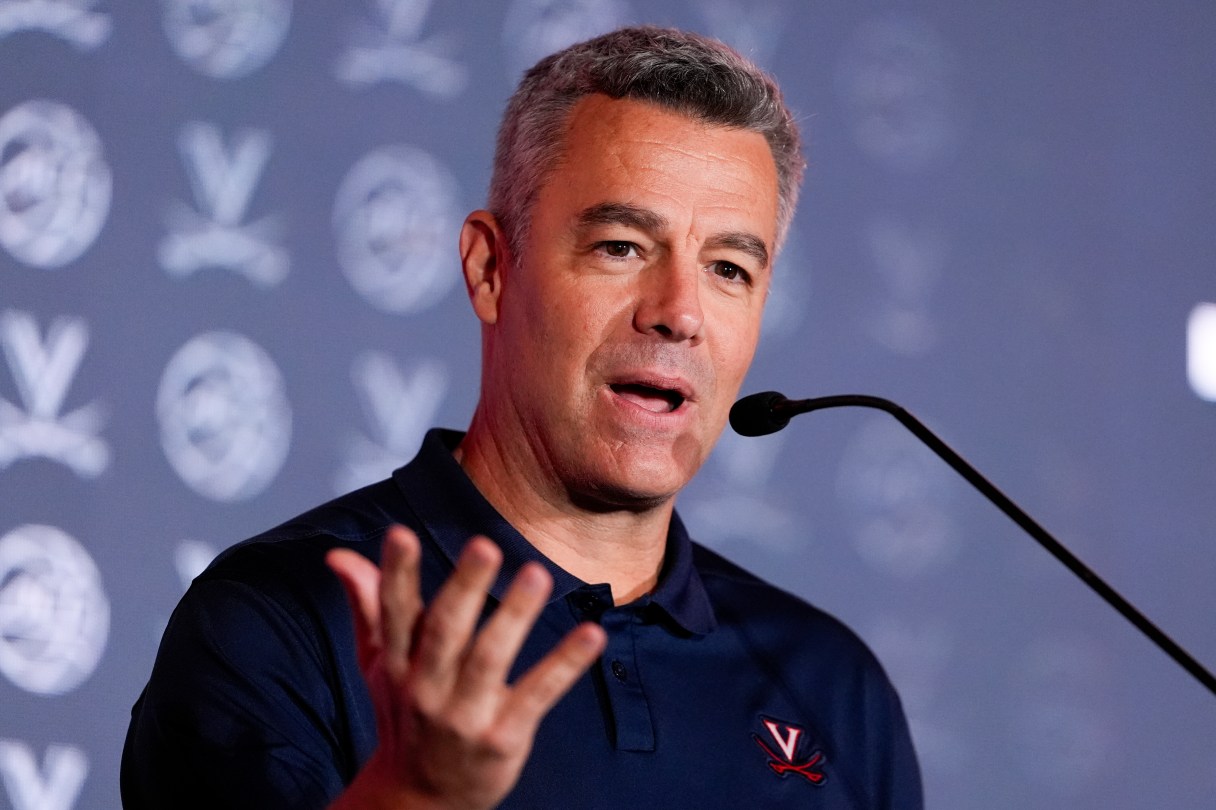
University of Virginia men’s basketball coach Tony Bennett never chased the spotlight.
That included his stunning and abrupt decision to retire effective immediately, announced on the eve of the start of the 2024-25 season.
The Cavaliers said Thursday the 55-year-old Bennett will announce his retirement at a news conference at 11 a.m. Friday. No reasons were given for his decision, which was unveiled simply in an online post by the program months after he had signed a contract extension to keep him in the job through at least 2030.
It came a week after Bennett appeared at the Atlantic Coast Conference’s preseason media days event, and with the Cavaliers’ opener against Campbell looming at home on Nov. 6.
Bennett led the Cavaliers to the Division I national championship in 2019. In his 15 seasons as the coach in Charlottesville, he made 10 NCAA tournament appearances.
He went 364-136 at Virginia, a tenure that included two ACC tournament titles and six regular-season conference championships. He was voted AP national coach of the year twice, once at Washington State in 2007 and again at Virginia in 2018.
Bennett left Pullman for Charlottesville in a cross-country move ahead of the 2009-10 season, charged with resurrecting a program that was notably a regular 1980s winner with 7-foot-4 Ralph Sampson but had reached just one NCAA tournament in eight seasons. He got the Cavaliers back to the Big Dance by his third season as he installed a defensive-oriented system that included slow-tempo offense that led to plenty of low scores and had Virginia fans roaring in approval at forced shot-clock violations.
The peak came in a run of six straight tournament bids from 2014-19, with four of those coming as a No. 1 seed. Yet that time also included an incredible one-year span: a crushing on-court humiliation followed by the highest of highs, and as part of March Madness in each case
In 2018, the Cavaliers were the top overall seed in the tournament, then they became the first-ever No. 1 seed to lose to a No. 16 seed, shocked by the University of Maryland, Baltimore County. Awkwardly, he was named AP national men’s coach of the year weeks later, an honor secured primarily on regular-season success.
Bennett handled it with a deft, steady and reassuring touch grounded in his faith, telling his wounded players (who even heard death threats) that they had a chance to write their own ending to that terrible moment, and that everyone — family, friends and critics — was waiting to see how they would respond. That next year, the Cavaliers went on to hold off Texas Tech in overtime to win the program’s lone NCAA championship in an all-time redemptive moment in tournament history coming amid multiple white-knuckle moments.
Bennett savored that finish in Minneapolis, emphatically slapping the sticker bearing Virginia’s name on the champion line of the 68-team bracket during the trophy presentation. After players had cut down the nets and danced amid confetti, they all gathered on stage to gaze at videoboards high above them as the “One Shining Moment” highlight montage that is a tournament-capping tradition began to play.
Fittingly, the humble Bennett took in the scene from the background, leaning against a railing at the stage’s edge while holding one of the nets.
Four years later, when Purdue became the second team to fall in a 16-versus-1 upset, Bennett texted Boilermakers coach Matt Painter.
“Matt is one of the best coaches we’ve got in the college game, he’s a man of character,” Bennett told the AP in February. “And not many can say, except for me: I’ve felt that pain. … So I just wanted to tell him, ‘If you ever want to talk, I’m here. I think the world of you, and hopefully your story is the same as ours.'”
It very nearly was. Purdue made it all the way to the NCAA title game this past season before falling to Connecticut in the Huskies’ last step to a repeat title.
Still, the 2019 crown proved to be the apex of Bennett’s time at Virginia. He got the Cavaliers back to the NCAA tournament in three of his final four seasons, but the Cavaliers never won another game in the championship chase. Along the way, questions grew as to whether his methodical playing philosophy could work as well in a time of veteran players moving freely between schools through the NCAA transfer portal.
This past March, the Cavaliers managed only 42 points in a 25-point loss to Colorado State in the tourney’s First Four. And still Bennett was back at the ACC’s preseason media days like usual in Charlotte, not far from the site of the UMBC upset, talking about plans for an upcoming season that had the Cavaliers picked to finish fifth in the expanded 18-team league as California, SMU and Stanford come on board.
“I think you have to look at your model and adjust it a little bit,” Bennett said then, offering no indication of what was to come Thursday.
Instead, Bennett — who was the ACC’s lone active coach with an NCAA title — became the latest high-profile coach from the storied league to call it a career of late, following North Carolina’s Roy Williams in 2021, Duke’s Mike Krzyzewski in 2022 and Syracuse’s Jim Boeheim in 2023 out the door. All three are in both the College Basketball Hall of Fame and the Naismith Memorial Basketball Hall of Fame.
“Tony Bennett embodies everything a high-quality basketball coach should be,” Florida State coach Leonard Hamilton said in a statement released Thursday. “He built strong relationships with his players, worked seamlessly with his administration, and earned deep respect nationwide — not just as a basketball coach, but as a person of great character and class. His presence will be deeply missed.”
Bennett’s first head-coaching tenure was a three-year stint with Washington State, where he won 69 games and twice reached the NCAA tourney, including a Sweet 16 appearance in 2008. Before that, the son of former college coach Dick Bennett was on his father’s staff at Washington State and Wisconsin.
He coached eventual NBA All-Star and four-time league champion Klay Thompson in his final season at Washington State, then coached numerous future NBA players such as Malcolm Brogdon, Joe Harris, DeAndre Hunter and Ty Jerome.
Bennett played in college for his father at Wisconsin-Green Bay, then was a second-round pick of the NBA’s Charlotte Hornets in 1992 and spent three seasons with the team.