
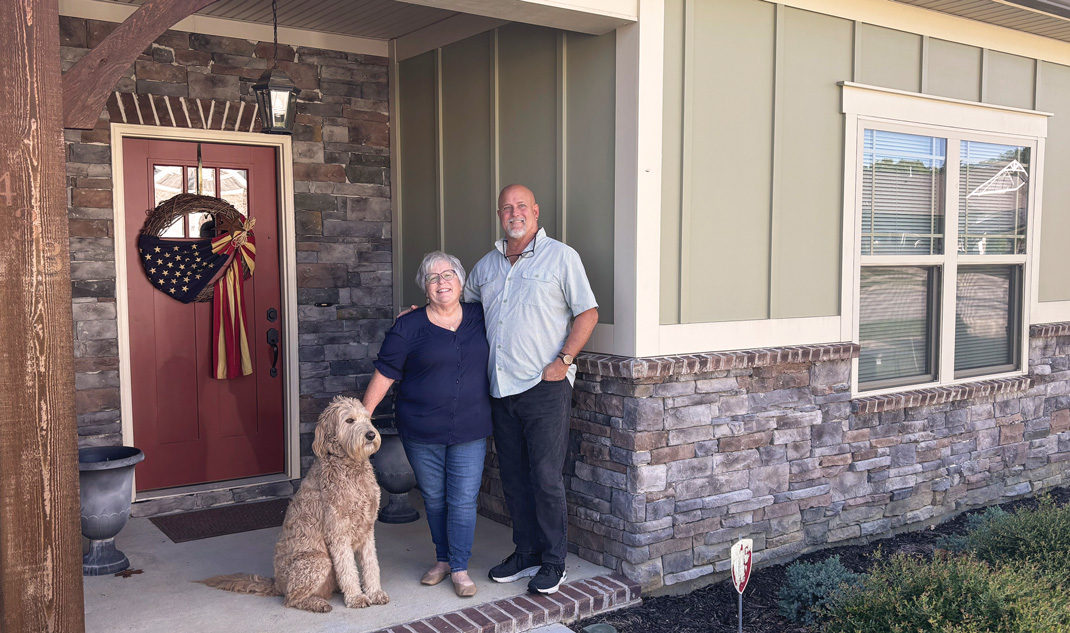
Sharon and Pete Butler thought they’d be in their longtime Hixson home for the rest of their lives.
“We’d been there 20 years and it was in my family for 70 years,” says Sharon Butler, 65. “We had it set up for old people because our plan was to be there until we died.”
But this past February, she says, their daughter moved to Ooltewah and wanted her parents to join her there. The Butlers decided to make the move and put their Hixson home on the market — where it lasted a grand total of eight days before selling. They closed that sale and the purchase of their new home the same day.
To be sure, that eight-day market run is an anomaly. According to statistics compiled by Greater Chattanooga Realtors (GCR), the average Chattanooga-area home for sale is on the market for 43 days.
The Butlers’ blink-and-you’ll-miss-it market experience hearkens back to the early 2020s; GCR numbers show that the average number of days on market for an area home dropped from 43 in 2020 to 21 in 2021, and then to just 20 in 2022. That average rose to 34 in 2023 and 43 in 2024.
All of which, says Rolanda Daniel, means that the market is going from being white-hot for sellers to being more “normalized.”
“We’re seeing fewer multiple offers and about 45 days on market is more normal,” says Daniel, a Realtor with Coldwell Banker Pryor Realty. She adds that while the Chattanooga area isn’t yet a buyer’s market, it’s headed that way.
“There’s an inventory we look at,” she says. “Right now we have 3.7 months’ worth of inventory on the market. You need a six-month inventory to call it a buyer’s market.” By way of comparison, that inventory dropped to just 24 days back in 2021.
Travis Close, a Realtor with Real Estate Partners, remembers well when — and why — the area real-estate market got a rocket strapped to it.
“That whole crazy market we were in doesn’t happen without the (global) pandemic,” he says. “It was a perfect storm of low (interest) rates because of (the coronavirus). There was a mass migration — buyers started flocking to Tennessee.
“I had a young gentleman, first-time home buyer, moving from middle Georgia for an Amazon job,” he says. “He was looking in Ooltewah. We went to look at one house and there were 12 or 13 other people there at the same time. It looked like a yard sale. You’d have buyers coming from California, where they’d sold for cash.
“If those out-of-town buyers hadn’t existed,” Close says, “we wouldn’t have had the issues we did.”
Those issues, says James L. C. Meyers, broker/owner at Block City Homes, included buyers not only making offers well above asking prices in many cases, but foregoing inspections and appraisals just to get an inside track.
“(The year) 2022 was just nuts,” he says. “I saw offers I’d never seen before. There was so much information to keep track of, to present to a client. I had a lot of spreadsheets going.
“It was a great time for sellers,” Meyers adds, “but if some of those buyers had been my buyers, I’d have made them take something in writing from me advising against some of the offers I saw.”
These days, Meyers says, “we’re seeing a lot more seller concessions.” He adds that though interest rates have gone up, prices have, in the main, not come down — GCR statistics show that the average sale price of a Chattanooga-area home went from $367,491 in 2023 to $390,133 in 2024. The market’s median sale price went from $315,000 in 2023 to $330,000 last year.
“We’re moving toward a more balanced, stable market, but I’m seeing certain types of properties moving very quickly, while others are lingering longer,” he says.
Close says that “things are selling hot” on Chattanooga’s North Shore, and Signal Mountain properties tend not to stay on the market very long. On the flip side of that coin, he adds, parts of the East Brainerd/Apison/Ooltewah area “is almost overbuilt.”
“When you have hundreds of new homes to look at in a one-mile radius, that’s going to give you higher days-on-market,” he says.
Meyers likened the area’s real-estate market to a pendulum.
“It swings both ways,” he says, adding that the circumstances that produced the turbocharged seller’s market of the early 2020s were “very unusual.”
“There are things that can happen that can accelerate or exacerbate something to an extreme,” he says. “We’re on the slide away from that, which is natural. There’s nothing going on (today) that’s not natural.”
Daniel says a hallmark of the Chattanooga-area market is that it doesn’t follow the national market in lockstep.
“I’ve been selling here since 2002,” she says, “and anytime the national market has a bubble or there’s something traumatic, we don’t necessarily experience it here.”
Close says the Chattanooga-area’s is a “stable” market.
“We’re not California,” he says. “We don’t have 20% or 30% gains year to year like some states or cities, but this is a great place to live. You can have a really good return here, and it’s almost predictable, year to year.”
With regard to the near-term future, Meyers says “there are a lot more opportunities out there for buyers than they think.” Close adds that sellers and buyers see very different things when they assess today’s Chattanooga-area real-estate market.
“Buyers think it’s a 2018 market,” he says. “Sellers think it’s a 2021 market. But nobody really knows until they put their house on the market.”
Close says that he doesn’t see big changes in the market in the upcoming 12 months.
“It’d take multiple interest-rate reductions (by the Federal Reserve), and I mean two or three of those, and other shifts in the market for us to see a whole lot (of change),” he says. “On the whole, I think we’re in this (market) for a little while.”