
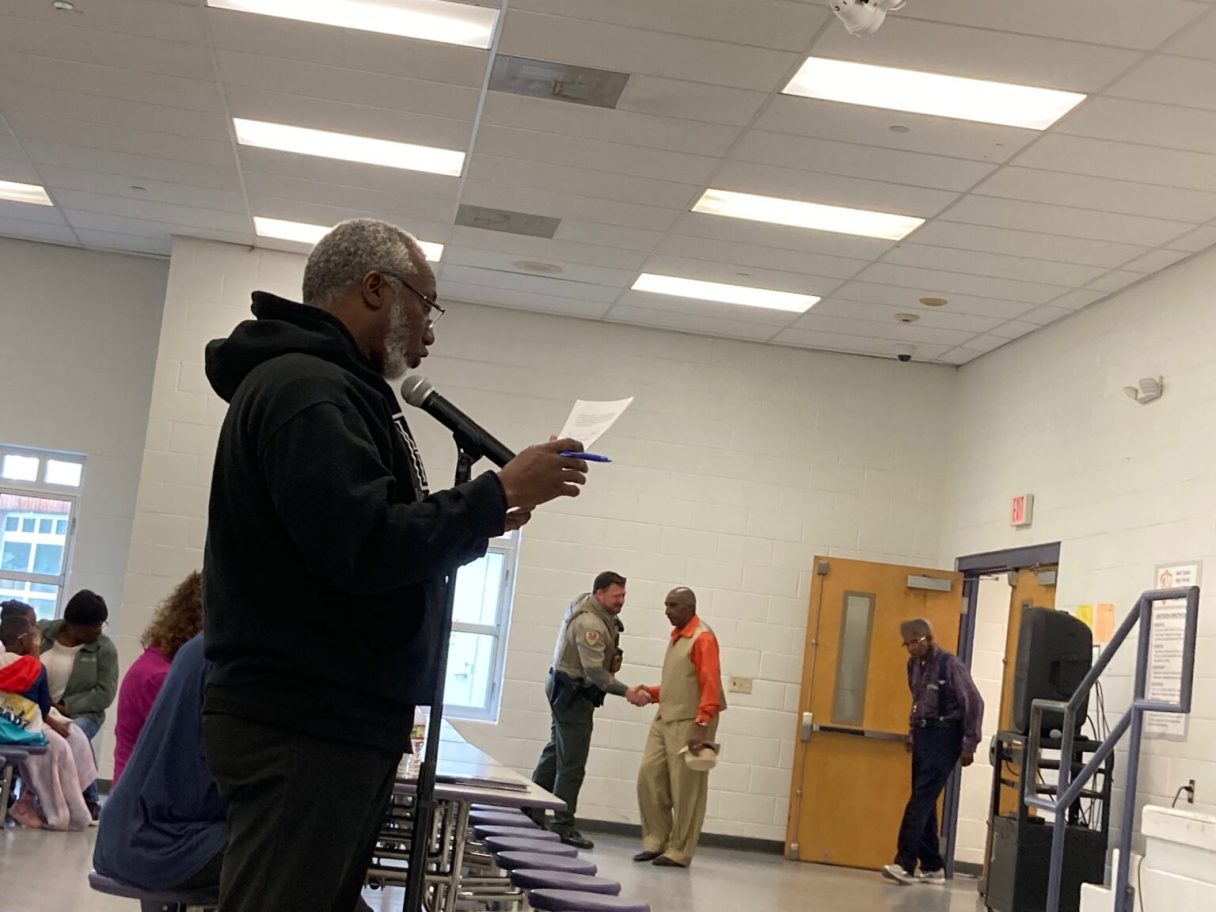
At a Fayette County School Board meeting in April, Lamar Hobson decided he’d had enough.
He had unanswered questions about the school system’s proposed budget, which was being put together without the involvement of a finance director. The district has been without one for several months.
Before he could start speaking during public comment, Board Chair Warner Speakman cut him off. “I’m gonna ask you. Are you from this county? … Do you vote here?”
“You go up to the courthouse and check. I’m on the register,” Hobson, a 1981 graduate of Fayette-Ware High School, said before turning to Board Member Becky Trimm. “I sent you an email this morning. I’m in your district. You ain’t never spoke to me. Not one time.”
Speakman waved a sheriff’s deputy toward the front of the room as Hobson turned to address a cheering audience.
“The board shows that they are not for us … They’re supposed to be representing us — the people — not a certain … hidden agenda,” Hobson shouted.
Speakman banged the gavel.
Tension has been palpable between the crowd and the school board this year, though Speakman told the Tennessee Lookout that “there has been no friction” after he read aloud a letter from the Sheriff’s Office concerning rules for crowd decorum at a June meeting.
This atmosphere comes as the board continues to push toward dissolving the consent decree that has held the school system accountable to the federal government for integrating public schools since 1965. The order was put in place after the government found that Fayette County failed to appropriately desegregate its schools.
By 2023, the school system had worked to eliminate discrimination in staffing, facilities, transportation and extracurricular activities, according to an order from U.S. District Court Judge S. Thomas Anderson.
In recognition of the district’s progress, Anderson approved a new consent decree in October 2023 that restricts desegregation obligations to a few remaining areas. This order requires the district to improve its efforts to recruit and retain diverse faculty, revise discipline policies to prevent racial discrimination and better identify and serve students through gifted programs and dual-enrollment classes, according to the U.S. Department of Justice.
It also requires the district to hold parent information and listening sessions multiple times each year and “listen and respond to questions, comments and concerns.”
Repeated comments from Hobson and other community members who attend school board meetings indicate a lack of trust in the school board’s decision-making processes and consideration of public feedback.
The majority of attendees at many of the board’s meetings are Black, mirroring the demographics of the school system itself. Nearly 55% of the school system’s more than 3,000 students in the 2020-21 school year were Black, according to the most recent data available from the U.S. Department of Education’s Civil Rights Data Collection Office.
Six of the eight sitting school board members are white.
CONTINUED SCRUTINY
In February, the board voted to declare unitary status, asserting that federal monitoring is no longer necessary and the school system’s difficulties with representation are in the past. For that decision to take effect, either the plaintiffs — including the NAACP’s Legal Defense Fund — would have to agree that the district implemented the order in good faith, or the court would need to schedule an evidentiary hearing to determine the district’s compliance.
Fayette County School District has continued to file the required reports so its “progress toward a unitary system can be monitored,” court records show. The district has not filed a motion for declaration of full unitary status and case dismissal.
In multiple social media posts, Speakman said ending the ongoing desegregation case is among his top priorities. He said the case and its requirements are costing the district money that could be better used elsewhere.
Some community members responded to the school board’s vote with apprehension that removing federal accountability could lead to a backslide in progress.
Fayette County has continued to fall under scrutiny for issues of discrimination in recent years. The U.S. Department of Justice and the NAACP Legal Defense Fund separately sued the county earlier this year over its 2021 electoral map, which the lawsuits said illegally diluted the power of Black voters to elect candidates of their choice.
Both of the lawsuits were voluntarily dismissed after the County Commission approved a new electoral map with three majority-Black, single-member districts in late June. The new map will be used in the 2026 election cycle.
Sitting school board member David Reeves drafted a letter to U.S. Rep. David Kustoff in April, asking the Memphis Republican to “(engage) the Department of Justice” to help Fayette County Public Schools end the consent decree.
Tennessee Lookout obtained the letter through a public records request that was initially denied by the board’s legal counsel. The letter was never shared with the public despite being reviewed by at least one other board member.
Using Fayette County Public Schools letterhead, Reeves wrote that the district has made “significant progress” in the decades since the case began.
“The ongoing legal oversight poses a considerable obstacle to our mission,” Reeves wrote. “The constraints imposed by the case restrict our operational flexibility, limiting our ability to make decisions best suited to the current needs of our community.”
Reeves signed the letter using his school board title. Legal counsel stated that Reeves was not authorized to write the letter as a representative of the school board and acted without the board’s permission.
It’s not clear if Reeves sent the letter. Reeves did not respond to multiple requests for comment. Representatives for Kustoff did not respond to questions about the letter.
‘HIDDEN AGENDA’
Latoya Parker, who describes herself as a teachers’ advocate, started attending school board meetings in person in May. Like Hobson, she described the board’s function as a “hidden agenda.”
She said the board votes on big items — like the budget, which was ultimately approved this summer — without much discussion at the full board meeting.
“When something is going to have to come out, they shut (discussion) down,” Parker said.
Multiple public speakers over the course of several meetings said board members failed to respond to or acknowledge emails from constituents.
Tennessee Lookout reached out to the eight sitting board members via email. Kevin Powers, a former Fayette County commissioner who was appointed by the County Commission to fill a vacancy on the board in May, declined to comment, citing his short time in the seat. Speakman also responded, referencing the Sheriff’s Office letter and declining to comment further. The remaining six members did not respond.
School board members have made some steps toward building a relationship with the community.
Parker said the board’s responses to public comment at a meeting on June 5 were markedly different from the norm. Board members said they had taken down a list of questions voiced by speakers during public comment. One board member suggested the board review rules of order to improve how meetings are run. The suggestion drew applause from the audience.
NAACP Fayette-Somerville Branch President Elton Holmes frequently attends and speaks at meetings. In early July, he entreated the board and newly selected Superintendent Don McPherson to create a policy for answering questions from community members.
“The only way we’re going to be able to work together is we’re gonna have to communicate,” Holmes said at a July 2 meeting. “By giving the answers to the questions … it probably will cut down on some of the animosity that the constituents have right now for the school board.”
At a committee meeting on July 22, Powers said he is “fully in favor” of creating a policy regarding addressing public comments.
“There’s nothing worse than putting up your thoughts about something and then having it look like, eh, we don’t care what’s going on. We do,” he said, asking community members to email all board members their ideas for such a policy.
Speakman echoed Powers as he closed the meeting.
“Anything that you have that you’d like to see, just let us know,” Speakman said.
Hobson said he keeps speaking at meetings because he feels the board isn’t listening.
“Somebody has to step up and put a voice out there and let the people in the community know that you’ve got a voice,” he said. “All you got to do is come together … and protest this. This is not right.”
Read more at TennesseeLookout.com.