
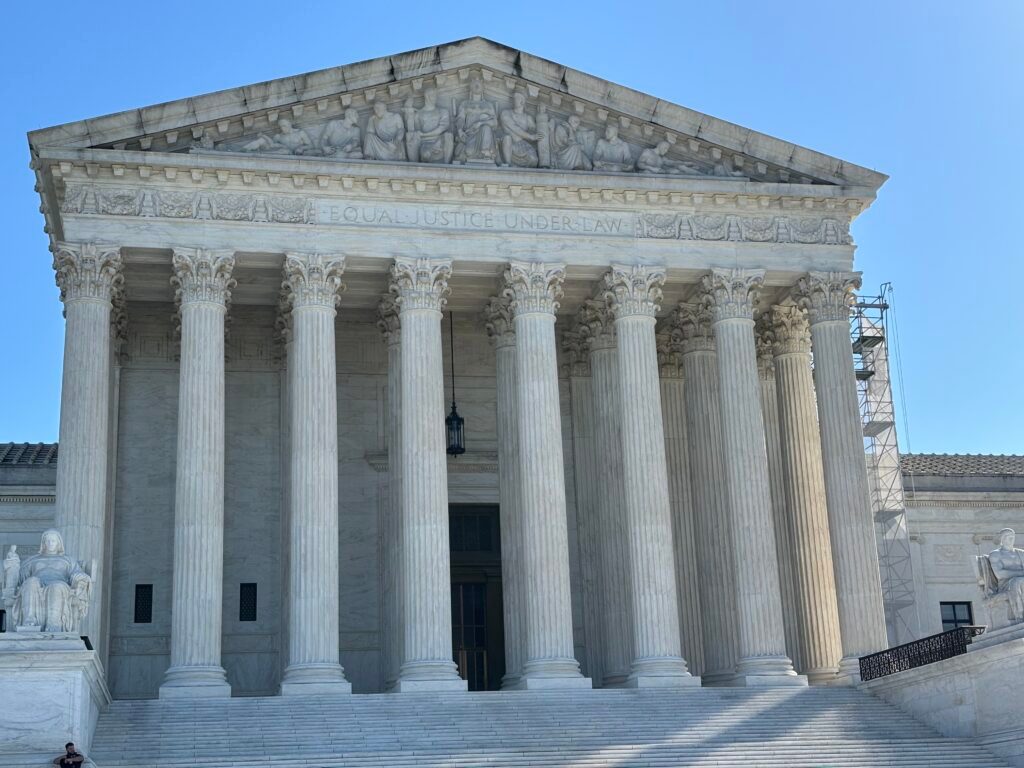
The U.S. Supreme Court’s request to the parties in a Louisiana redistricting case could affect Alabama’s similar, long-running battle over congressional boundaries.
In an order issued Friday, the justices asked parties to address whether the state’s creation of a second majority-Black congressional district violated the Fourteenth or Fifteenth Amendments of the U.S. Constitution, which provide for congressional representation and due process and forbid the denial of the vote based on race.
Experts say the move could signal that the U.S. Supreme Court is looking to overturn Section 2 of the 1965 Voting Rights Act, which forbids election laws that discriminate based on race, color or membership in language minority groups.
A lower federal court in 2023 ordered Alabama to draw a second district for Black voters after ruling that Alabama’s racially polarized voting patterns — where white voters tend to support Republicans and Black voters tend to support Democrats — meant a map approved by the Republican-dominated Legislature in 2021 did not give Black voters a chance to choose their preferred leaders.
The court’s ruling in the case, known as Allen v. Milligan, leaned in large part on Section 2 of the law, and Jason Mazzone, a professor of law at the University of Illinois Urbana-Champaign, wrote in an email that the Supreme Court’s order for supplemental briefing was “a very big deal.”