
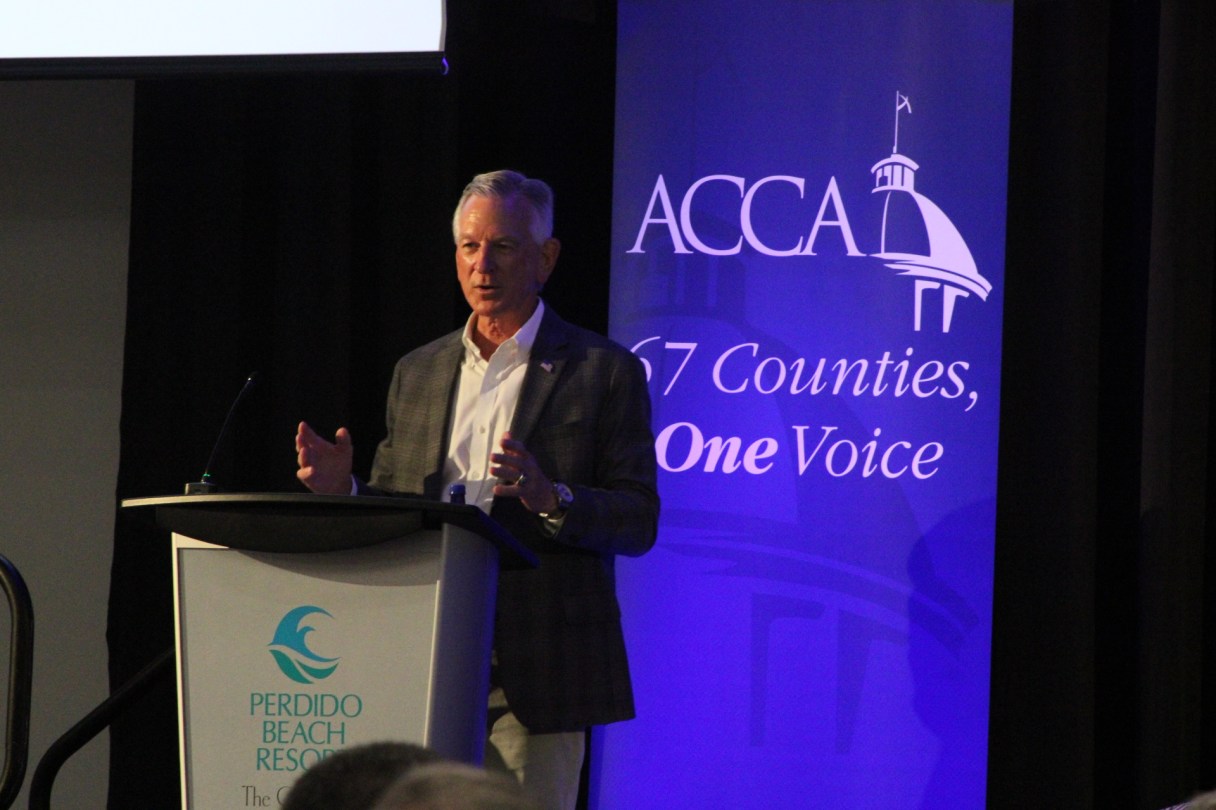
ORANGE BEACH, Ala. — U.S. Sen. Tommy Tuberville said Wednesday that if elected governor of Alabama, he would encourage some students to go into technical training after completing 10th grade as a means of building the workforce.
“I believe our education system, that I was in for 35 years, is inadequate. I’m not talking about the grades that they make. I’m talking about the procedure of how we go through K through 12, and then we send our kids off to these four-year universities like Auburn, like Alabama, like Troy, which a lot of those kids don’t need to go to a four-year school,” Tuberville said, speaking to a meeting of the Association of County Commissions of Alabama. “So we need to change our plan on educating in the state of Alabama.”
Tuberville announced his candidacy in May and has been widely viewed as the frontrunner for the GOP nomination.
“If and when we win, and I’m there for everybody, and we’re going to work with the Legislature,” he said. “We’re going to put a team together that’s going to run the state. You can’t do it by yourself. And we’re going to have a plan that is going to work again.”
The senator said Wednesday that plan includes teaching students as they are now until 10th grade, then teaching a technical skill in the final two years of high school. That way, he said, those students can get into the workforce faster after continuing their education in welding, plumbing and other trades. He did not say if it would be mandatory.
“It’s going to, obviously, cost money, but the future is in educating our kids to be able to do things that other people across the country don’t do,” he said. “Teach them electricity, teach them welding, teach them plumbing, teach them nursing at the high school level, and then have them go to another level, to where they can go for a year, and then they’re out.”
Tuberville also pledged to get people back to work when he is governor. According to the Alabama Department of Labor, 3% of Alabamians were unemployed in July, and according to the U.S. Census Bureau, 15.6% of Alabamians lived in poverty in 2023, a number that Tuberville called “embarrassing” but also appeared to blame on those in poverty.
“It’s going to cost us more tax money,” Tuberville said. “It’s going to cost us a lot of different things. That’s not going to be helpful to the state of Alabama. Now I will tell you this, a lot of that is because of their own choice. When I become governor, that’s going to change. We’ve got to get people back to work.”
Gov. Kay Ivey also spoke at the convention Wednesday, praising the Alabama Department of Workforce, run by former Sen. Greg Reed, R-Jasper, and highlighting the improvement in workforce participation in the state since she took office in 2017.
“His goal is to increase Alabama worker participation. And after only seven months of Secretary Reid’s oversight, we have seen signs of improvement in the number of workers reentering the workforce,” Ivey said. “Automatic job reports indicate the state’s workforce participant rate is nearly 58%.”
Tuberville, who was the head football coach at Auburn University from 1999-2008, said being governor is like being head coach: mistakes and problems in the state will fall to him.
“If it don’t work, you get in trouble. And I’m fine with that. I lost a lot of games,” he said.
Under the Alabama Constitution, the Legislature holds most of the effective power in state government. The governor has a weak veto that can be overridden by a majority vote of both chambers.
Tuberville also said he would plan to continue Ivey’s infrastructure efforts and increase energy production in the state. Ivey highlighted the infrastructure progress in the state in her eight years of service, namely a new state route connecting Mobile and Tuscaloosa.
“Since the enactment in 2019, the Rebuild Alabama Act has generated over $1 billion in new construction revenue, literally paving the way for countless road and bridge projects in all 67 counties,” she said. “Dozens of rural communities and at least seven counties will be better polished for economic growth.”
The gubernatorial election is on Nov. 3, 2026, and Tuberville promised to remain in “Senate mode” until the election. He updated the attendants of the convention on President Donald Trump’s agenda as it has made its way through Congress.
Medicaid and the Supplemental Nutrition Assistance Program got cut through Trump’s “One Big Beautiful Bill.” Tuberville said that Alabama will not be hit as hard as other states by the Medicaid cuts because the provider tax, which helps pay for the health care program, was not increased for Alabama. Federal cuts to food benefits, however, will impact Alabamians on the program.
“We were going to spend $1.2 trillion on food stamps. We can’t afford it,” he said. “We want to take care of people. We want to take care of single moms. We want to take care of kids. We want to take people that can’t take care of themselves. We want to take care of our elders. We want to take care of our infants, but we can’t take care of everybody.”
According to the Center on Budget and Policy Priorities, 752,200 Alabamians were enrolled in the program during fiscal year 2024. Tuberville claimed there are people enrolled that do not need the assistance, largely due to the COVID-19 pandemic. According to the Food and Research Action Center, 667,043 Alabamians were enrolled in the program in fiscal year 2018.
Tuberville vowed to reduce food benefits enrollment so that the program will not cost the state when he hopes to be governor in 2027.
“It’s going to cost us $200 million my year of starting in terms of paying for SNAP. That’s not going to happen. We’re going to get that down,” he said.
Alabama Attorney General Steve Marshall closed the program, updating the thinned-out crowd on ongoing litigation, but focussing on unity.
“All of us have our unique perspectives coming in. And sometimes, if you read too much in the paper or look at too much on social media, it always talks about the things that divide us,” Marshall said. “I want to do it a little differently today, and think about things that we can all come together on, regardless of what those differences may be.”