
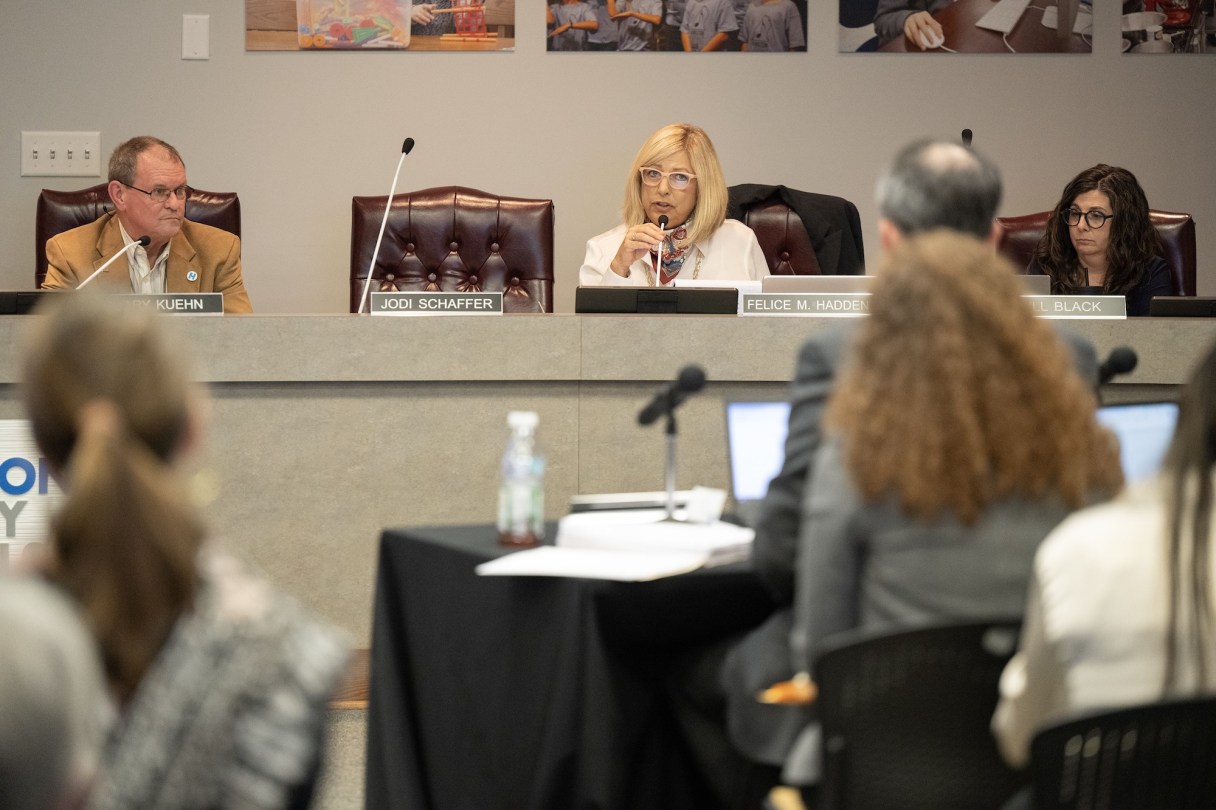
The Hamilton County school board adopted a new policy that members said would create a proactive process to address the impact new housing development has on schools’ enrollment capacity.
School board member Ben Daugherty, R-Signal Mountain, introduced the new policy Thursday. The idea, he said, is that if a developer is building a new neighborhood or apartment complex in an area zoned for a school that is over capacity, the policy creates a process by which the board could proactively rezone the new development to a nearby school that has capacity.
The board voted 7-2 to adopt the policy. School board members Ben Connor, D-Chattanooga, and Felice Hadden, R-Ooltewah, voted no, and Larry Grohn, R-East Ridge, and Joe Smith, R-Hixson, were absent.
Under the newly created policy, the superintendent will annually create a capacity and growth report that includes schools’ current and projected enrollments, capacity and utilization rate. Based on that, schools will be assigned to one of three tiers based on their utilization rate, with schools that are considered over capacity being labeled Tier 1.
If a school is classified as Tier 1, it will lead to the district considering rezoning future housing developments to nearby schools with capacity, as well as initiating a review of the school’s attendance boundaries. District officials will also provide the board with a study looking at the feasibility of adding on to the campus or building a new school.
Fifteen district schools have a building utilization rate of 95% or higher, according to data presented at Thursday’s meeting.
New housing developments often get built without anyone consulting Hamilton County Schools officials, and then the district has to respond to figure out where the children can attend school, Superintendent Justin Robertson said. That leaves the district constantly playing catch-up to address capacity issues at schools, he said.
The policy also helps ensure students aren’t displaced from their zoned school when new housing is built in the area, he said.
“Developers for years have pushed kids out of zones and schools by building on property that was within the boundary of a zone, but wasn’t either a dwelling or was just a large farm, and now we’re having to rezone kids that were already in that school,” he said. “That’s what it’s trying to avoid, practically.”
If the board was following the steps outlined in the policy and seeing where the growth was coming, it can be proactive about it, said school board member Karitsa Jones, D-Chattanooga. It may not change where developers build, she said, but the board has an obligation to do what’s right for children.
The final approval of the policy on Thursday came after two other motions — one to continue discussion in January and another to approve the policy alongside an updated school zoning map for the Signal Mountain area — did not succeed.
Hadden, who leads the policy committee, and Connor both raised concerns that Thursday night was the first time they had seen the policy and it hadn’t gone through the procedures it typically takes for policies to be finalized.
“We’re trying to push something through, and we’re asking if we can change it after we do it,” Connor said. “It’s a conversation I have with my girls all the time: Turn it in right. Don’t turn it in wrong. Get it right the first time and turn it in that way. Don’t turn in something half done that’s not fully thought through and not fully baked. We’re not there. I don’t like that politics and governance move so slow, but it’s because we’ve got to listen to our constituents.”
Daugherty acknowledged that some board members might feel caught off guard by him introducing the new policy on Thursday night, but he said he views future development as one of the largest, imminent threats in the Signal Mountain area he represents.
“If we don’t do anything, it just gets so much more messier,” Daugherty said. “It’s also more costly as well.”
Contact education reporter Shannon Coan at scoan@timesfreepress.com or 423-757-6396.