
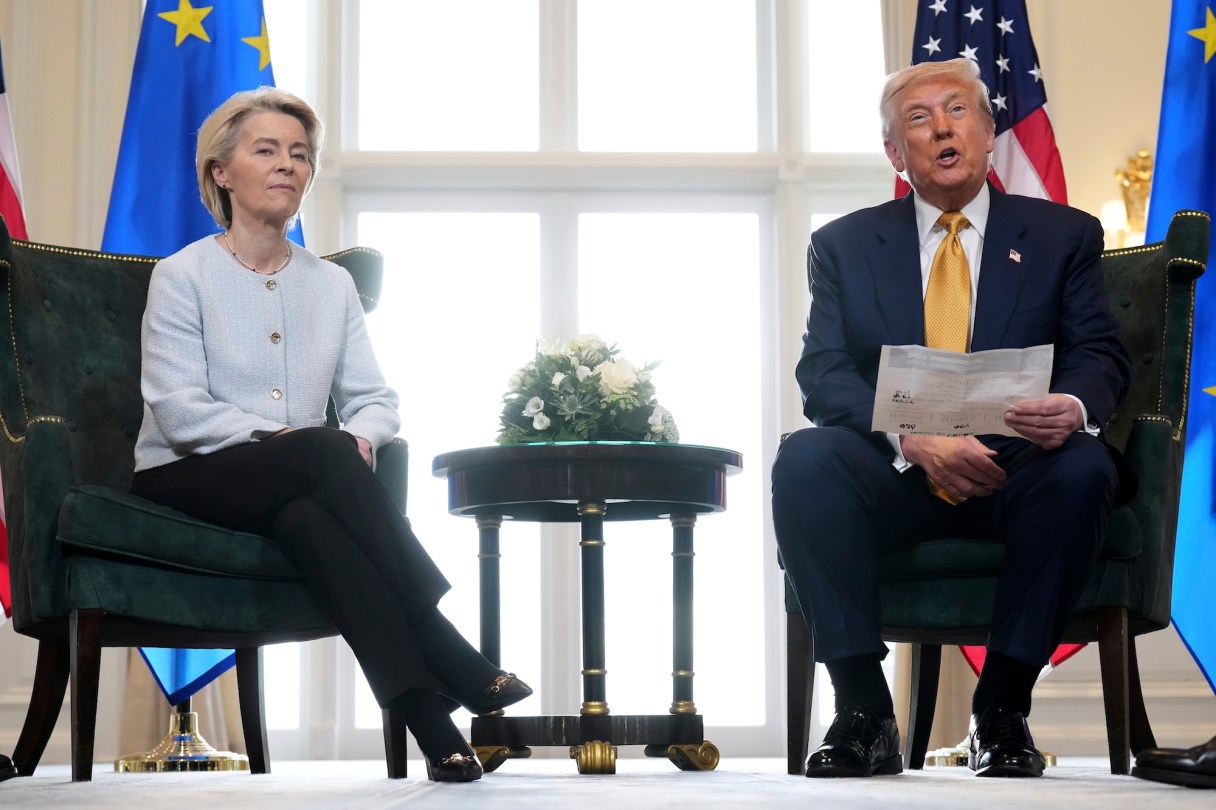
This week, the European Union agreed to a trade deal with the United States that amounts to a capitulation to President Donald Trump.
Yes, Trump had already made certain concessions in advance, by preemptively walking back his outrageous opening gambit in the tariff war when markets rebelled against the policy. But since that walk-back, the president has enjoyed a run of victories, establishing a new baseline for U.S. tariff revenue with minimal retaliation from our trading partners. The deal that Ursula von der Leyen, president of the European Commission, sealed with Trump is part of this new normal, in which most countries appear willing to pay extra for access to our markets, and it’s not America but the rest of the world that seems to be chickening out.
There is a hard lesson here, not just for observers hoping for a more muscular European trade policy, but also for anyone who has spent the early months of the second Trump administration imagining that a populist-governed United States might somehow end up isolated on the world stage.
This fantasy of isolation has been a source of both comfort and schadenfreude for anti-Trump liberals, since it offers a vision of potential political escape from populism, with liberal culture reconstituted in Toronto or Oxford or Scandinavia, and a vision of a Trumpian America suffering economic punishment as its walls rise higher and the rest of the world prospers through mutual exchange.
But both conceits — a world economic order that isolates America and a liberal order that continues on without us — are fundamental misreadings of the global situation, which the foreign leaders who have bowed to Trump’s demands seem to understand quite clearly.