
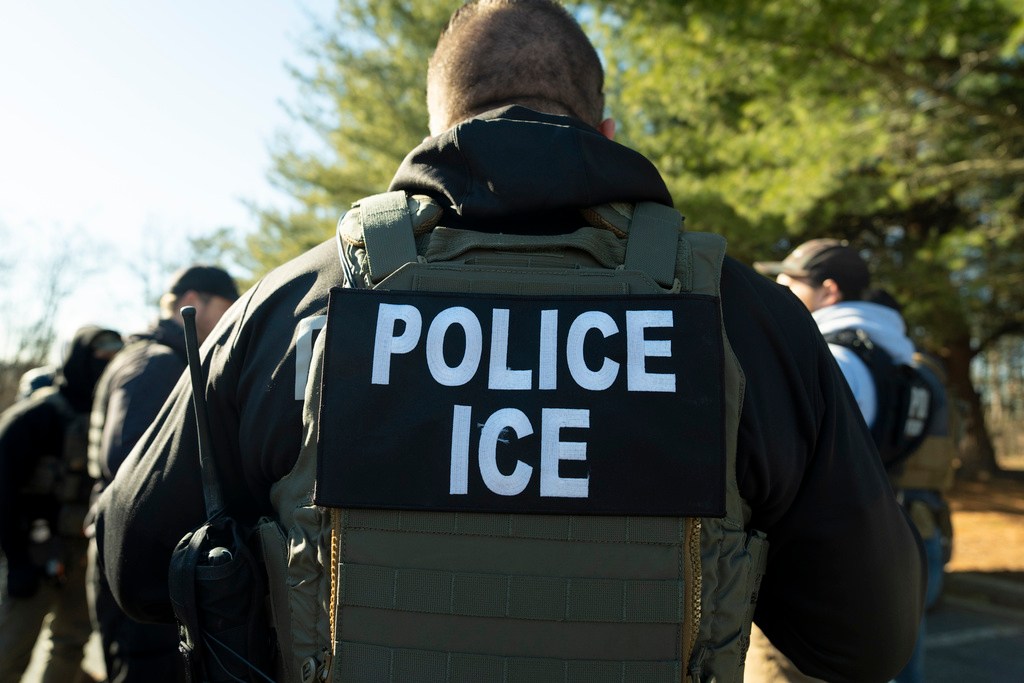
In South Nashville earlier this month, a 36-year-old man was making his way home in the same manner he had many other times. The man, who works in construction, rode a bus to a stop on Nolensville Road and started walking back home to his wife, a restaurant worker, and their 13-year-old daughter, a Metro Nashville Public School student. They came to the United States from Nicaragua three years ago and live without legal documentation.
The man’s wife, who speaks Spanish, told the Nashville Banner through an interpreter that she was talking to her husband on the phone around 11:30 p.m. when he suddenly said: “Hey, they’re detaining me.” She has not spoken to him since.
According to an arrest affidavit, Nashville police encountered the man – who does not speak English – walking in the street. It’s not clear what led officers to initiate a conversation with him, but the affidavit stated that the man “could not tell officers where he was or where he lived” and that he was unsteady on his feet, smelled of alcohol and admitted to having had at least three beers. The affidavit also stated that he had a mostly empty pint of vodka tucked into his boot.
The man’s wife told the Banner that it’s unlikely her husband was drunk. He might have been drinking, she said, but they were talking normally on the phone as he walked home. Her husband was arrested, though, and charged with public intoxication, a misdemeanor offense. Court records show the man had previously been convicted of public intoxication and charged with aggravated assault, although the assault charge was later dismissed. Davidson County Sheriff’s Office records show, he was booked into Nashville’s Downtown Detention Center shortly after 4 a.m. His case was dismissed that same morning, court records show, but by then Immigration and Customs Enforcement had already filed a request for local officials to hold him. The sheriff’s office confirmed that ICE agents picked him up that day. His wife told the Banner she doesn’t know what she or her daughter will do now. She has consulted with attorneys but is unsure who to trust.
(READ MORE: Hamilton County Sheriff’s Office applies to work with ICE)
Since President Donald Trump took office in January, after a campaign headlined by his promise to carry out mass deportations of immigrants – calling them “animals” who are “poisoning the blood of our country” – immigration enforcement activity at Nashville jails has surged. The Banner reported earlier this month that, in February, the Davidson County Sheriff’s Office received more than twice as many detainer requests from ICE as it did a year ago and that ICE had taken nearly four times as many people into custody. Now, sheriff’s office records requested by the Banner reveal more details about the people ICE has targeted for deportation, complicating the picture of the Trump administration’s immigration crackdown.
While many of the people taken by ICE from the Nashville jail have been charged with violent crimes, others had been arrested for minor offenses like driving without a license or failing to appear for court. Beyond that, the data shows how the stakes of any interaction with police or the courts have increased significantly for immigrants living without documentation in Nashville.
CHARGES TO DETENTIONS
Whenever anyone is arrested in Davidson County, the jail’s booking system automatically sends their information to ICE, the National Crime Information Center and the Tennessee Bureau of Investigation. At that point, if the person is an undocumented immigrant, ICE can make a detainer request asking local officials to hold them “for up to 48 hours beyond the time they would ordinarily release them,” so that federal agents have an opportunity to take them into custody.
According to the sheriff’s office records, between the day Trump was sworn in and March 13, ICE made 117 immigration detainer requests in Nashville. Some of those people – including men charged with homicide and rape – remain in jail awaiting court proceedings on their local charges. But 69 were released into ICE custody to face deportation proceedings. That group includes two dozen people who had been charged with assault of one kind or another, many of whom had also been charged with other crimes.
But even some of the cases of people charged with violent crimes can be more complicated than they appear on paper. A newly pregnant mother, whose ICE detention the Banner reported on earlier this month, was arrested after a man told police she’d scratched and hit him during an argument over the pregnancy at a South Nashville home. State law requires police to make an arrest in domestic violence cases where one party has been identified as the aggressor. But community members supporting the woman have said she’s actually been the victim of domestic violence herself. Metro Councilmember Ginny Welsch – who represents the woman’s district – told the Banner the woman has obtained an immigration attorney and is fighting her case from detention in Louisiana while her two young children live with her sister.
Among those not charged with any violent crime but still taken into ICE custody, 17 had been charged with driving under the influence. But there are also those who have been picked up by ICE after being jailed for minor alleged offenses. In mid-February, a person in Nashville with no criminal history was booked for driving an unregistered vehicle without insurance or a driver’s license. Four days later they were taken into ICE custody. In the first week of March, ICE picked up someone else whose public intoxication charge had been dismissed and another person with no criminal history who’d only been booked for driving without a driver’s license. The following week, another person who’d been cited for driving without a license was jailed for failing to appear in court and subsequently released into ICE custody.
LANGUAGE BARRIER
On the ground in Nashville, attorneys and advocates said that the administration’s approach has amounted to a haphazard dragnet. That dynamic, they said, is downstream of actions the Trump administration took during its first week. The day after inauguration, the administration rescinded policies put in place during Joe Biden’s presidency that, among other things, directed ICE to focus enforcement on people who posed a threat to national security and public safety. Days later, Trump administration officials issued quotas to ICE field offices, significantly increasing the number of people agents were expected to detain each day.
There is now less clarity about why one person attracts the attention of ICE agents and another doesn’t. One immigration attorney told the Banner that the constraints on ICE officials now seem to be driven less by policy than by operational or logistical circumstances, like how much room there is in a van or a detention facility. As ICE officials work to detain more people, they’ve been forced to seek assistance from other agencies. Sheriff’s office spokesperson Jon Adams confirmed to the Banner that other federal agencies, like the Bureau of Alcohol, Tobacco and Firearms, have been working with ICE agents to pick people up from Nashville jails.
Local law enforcement agencies have said they would not play a role in a Trump administration effort to carry out mass deportations. Metro Nashville Police Department spokesperson Don Aaron told the Banner ahead of the presidential election in October that the department has “no authority to investigate or enforce immigration laws” and that officers would continue “efforts to apprehend persons named in arrest warrants for crimes committed in Davidson County regardless of immigration status.”
(READ MORE: Flyers against immigration bill spread at Chattanooga senator’s church)
But while state law requires officers to arrest and jail people accused of committing felony offenses, other cases are left to officers’ discretion and application of departmental policies. If a person is pulled over while driving or questioned by a police officer on the street, the interaction can determine whether they get a warning, a written citation or a night in jail. Those instances can be fraught for U.S.-born citizens and even more so for undocumented immigrants who may fear speaking to law enforcement or not speak English at all.
Emily Stotts, a staff attorney for Tennessee Justice for Our Neighbors, told the Banner that the organization has encountered widespread concern about the language barrier during presentations in immigrant communities.
“They’re like, ‘If the officer pulls me over and says something, I don’t know what they’re saying so they’re going to think that I might be not cooperating or being aggressive or something and it’s just because I don’t know what they’re saying,'” she said.
Asked about potential language issues between officers and non-English speaking civilians, Nashville police spokesperson Kris Mumford pointed the Banner to department policies that instruct officers to get help from on-duty bilingual personnel or, in certain circumstances, use one of two private interpreter services by phone.
Those challenges would be present under any federal immigration regime, but under the Trump administration even the most minor interaction with law enforcement or the legal system can have life-changing implications.
Stotts said a lot of time in Tennessee Justice for Our Neighbors’s community presentations has been spent warning people to tread lightly.
“An easy way to get caught up in this is something as simple as getting pulled over for speeding or for not having your lights working and then getting charged with not having a license,” she said. “It’s as simple as that.”
This article first appeared on Nashville Banner and is republished here under a Creative Commons license.