
Two new ordinances could change Chattanooga’s natural and business landscapes.
Mayor Tim Kelly is proposing updates to decades-old city code that would offer businesses more flexibility on signs and require new standards for tree protection in suburban developments and commercial areas.
Kelly adviser Chris Anderson and the city’s assistant director for land use development, Darien Gilkenson, described the draft ordinances to members of city council in twin presentations Tuesday.
The city will vote twice each on the new rules before they take effect.
(READ MORE: City of Chattanooga says huge mural of flying doughnuts is illegal)
CHANGING SIGNS
Gilkenson said that if the council approves the changes to the sign code, the new rules will apply after a 60-day phase-in period.
She said the sign code largely reflects suggestions made in conversations with the city council last fall but before municipal staff met with sign industry professionals and others in the community to discuss the proposal. The proposal lifts prohibitions on advertisements like wall murals and sandwich board signs. Restrictions on placing signs in the public right-of-way would also end under the new legislation, which also provides businesses and the public with more detailed definitions, she said.
“There’s been no comprehensive update in over 25 years to the sign ordinance,” Gilkenson told city council members. “It’s hard to read and enforce as it currently stands today.”
Enforcement has also led to issues in past years. A city inspector in 2014 told a bakery owner that a mural depicting a flying doughnut, designed to advertise her business, constituted an illegal advertisement. Years later, the owners of a cat cafe were told they couldn’t use a rolling sign to advertise their business. Both incidents sparked criticism from members of the public.
Rules on city billboards would not change if the council approves the new legislation.
City council members said Tuesday that they supported the additions to the city’s code.
Council member Darrin Ledford of East Brainerd said he felt that the changes would be beneficial to the community.
“This is great,” Ledford said. “As most people know, I’m kind of in this industry.”
Ledford owns a printing company in Chattanooga.
“I’m super excited to see sign code that makes sense, that has a visual representation we can all kind of wrap our heads around,” Ledford said.
The new code represented the end of a major project, he said, addressing Anderson, who currently works on legislative initiatives for the mayor’s office.
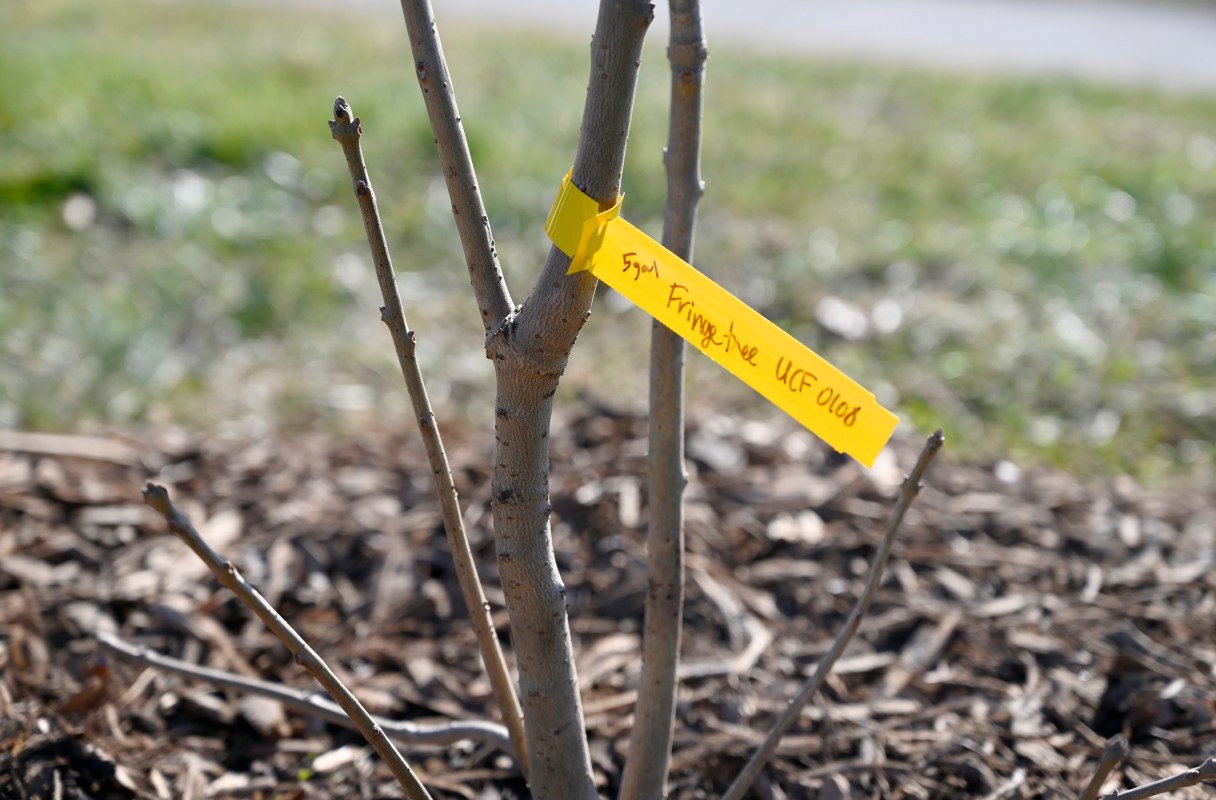
(READ MORE: Chattanooga seeks to increase tree canopy by planting hundreds of trees this winter)
BRANCHING OUT
“Trees are one of the most valuable assets a city has,” Kelly said in a news release. “This is about making sure that as Chattanooga grows, we protect the natural resources that define our city.”
Anderson, a former member of the city council, said Tuesday that drafting the changes to the city’s tree ordinance was among the most complex tasks he’d completed while in government.
The proposal is modeled in part on Knoxville’s tree ordinance. If the city council approves, the new ordinance would provide new guidelines for protecting public trees and lower some fees for tree ordinance permits — those permits are now $500, but under the proposal could run between $100, $250 or $500.
The highest fee will remain the standard for larger private developments, Anderson said. Smaller projects will require the $250 fee, and people working on nonconstruction projects — removing a tree to put in a driveway at a single-family home, for example — will pay the $100 fee, he said. The fee schedule is designed to reflect the amount of research and work required of city staff, he said.
The new ordinance would also mean that the city institutes a bonding procedure for trees used as buffers and establishes a tree bank and notable tree protection registry, among other shifts.
“Right now, if we have you plant trees to buffer your new commercial development from the neighboring residential development, if you take them down in a year and a day, we don’t know about it,” Anderson said. “There’s no mechanism for us to know that. The root system is not established. So, we’ve put in a three-year bonding period. At the end of three years, the survival rate is much, much higher.”
Only property owners could ask to place their trees on the city registry.
Anderson said in a text that he would request a 90-day phase-in period for the new rules.
The proposal is designed to affect mostly larger-scale developments, he said. In response to questions from council member Ken Smith of Hixson, Anderson said that the ordinance wouldn’t force a property owner to plant a certain type of tree in a specific place on their land.
“I would hope that our forester and his staff would offer suggestions if there’s different types of soil on a property and they knew that one type would be better for this type of tree,” Anderson said. “I would hope they would offer suggestions, but there will be no requirements.”
For years, both he and council Vice Chair Jenny Hill of North Chattanooga said Tuesday, the city was known as a place without useful rules for public tree protection.
“Our tree ordinance is currently so inconsequential, when other communities look at our tree ordinance – I actually have a document where Tallahassee, (Florida), studied a bunch, and they said, ‘There’s nothing to learn from Chattanooga,’ about our tree ordinances,” Hill said. “This is a step – an incremental step – toward better protection of our canopy, and I’ll be interested to hear from my district about it.”
Contact Mariah Franklin at mfranklin@timesfreepress.com or 423-757-6354.