
When it comes to the future of the College Football Playoff, there were as many opinions as there were coaches on hand at the Southeastern Conference and Big 12 meetings in Florida this past week.
Perhaps the most eye-opening views came from some of those with the most to lose — Kenny Dillingham of reigning Big 12 champion Arizona State and Brett Yormark, that 16-team conference’s commissioner.
The consensus at the Big 12 meetings, which wrapped up Friday in Orlando, was a preference for a CFP format starting in 2026 that would include 16 teams — five of them receiving automatic bids as the highest-rated conference champions and the other 11 as at-large invitees. That would be paired with a straight-seeding model that has already been adopted for the upcoming season’s playoff.
Had last season’s CFP, the first 12-team event after a decade with a four-team bracket, used straight seeding, Dillingham’s Sun Devils would have been seeded 11th, not fourth. Instead of a bye, they would have been stuck with a first-round road game at eventual national champion Ohio State.
Dillingham said the change for the 2025 season is fine with him, and if the increasingly popular 5-11 model takes hold for 2026, that’s fine, too.
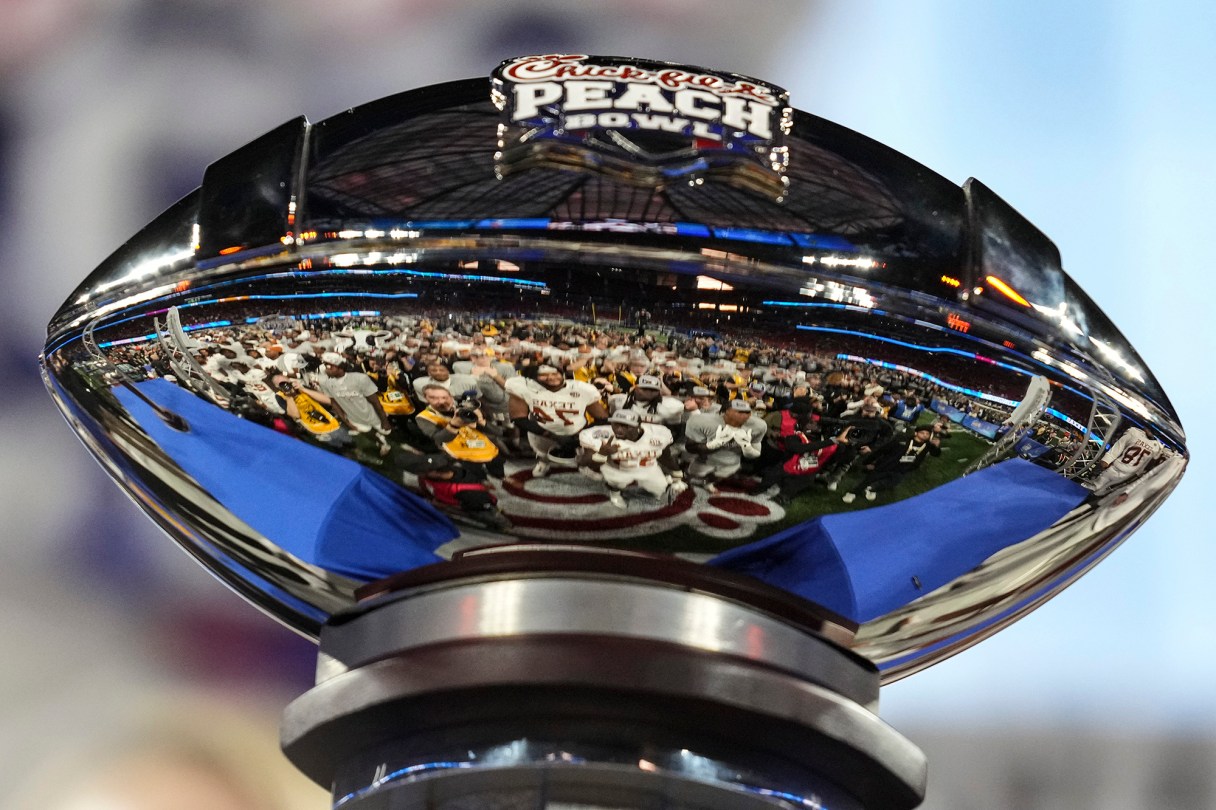
“Last season, maybe we didn’t earn the right to be the fourth seed. Maybe we earned the right to be the eighth seed,” said the coach, whose team was 12th in the CFP selection committee’s final rankings but still received the fourth seed and a first-round bye before losing 39-31 in double overtime to fifth-seeded Texas in the Peach Bowl quarterfinal.
“I believe you earn your way to those seeds,” Dillingham added, “so I’m also in support of the 5-plus-11, that same thought process.”
The 18-team Big Ten and the 16-team SEC will decide the format for the CFP starting in 2026, which is when ESPN’s new $7.8 billion contract kicks in. Yormark said the Big Ten and SEC “have a great responsibility that goes with it to do what’s right for college football and not to do anything that just benefits two conferences. And I have a lot of faith in the process.”
The 5-11 system could be less advantageous for the Big 12, which would get two automatic bids under the other system being floated, the 4-4-2-2-1 model in which the Big Ten and the SEC each would receive four auto bids and the 18-team Atlantic Coast Conference would join the Big 12 in getting two.
The best argument for that plan might have come from Florida athletic Scott Stricklin at the SEC meetings in Destin on the Panhandle: “I think anything we can do to make the postseason more objective and less subjective is going to be better,” he said, pointing to the notion that the more at-large berths there are, the more the preferences of the CFP selection committee come into play.
Yormark said the Big 12 would be willing to take its chances with more at-large bids.
“We want to earn it on the field,” Yormark said. “The 5-11 might not be ideal for the conference, but it’s good for college football, and it’s what’s fair.”
Dillingham was on the same page.
“Every year is a new year, and you never know who’s going to be good in college football, especially with the volume going through the (NCAA transfer) portal,” he said. “So anything that creates an open platform for teams like our guys last year to prove that they do belong, I’m in support of.”

Four for one?
Then again, maybe the desire for unity among the ACC, Big 12, Big Ten and SEC shouldn’t be surprising.
There are plenty of ongoing disputes between the Football Bowl Subdivision’s most dominant conferences, but a desire for more control by one single league isn’t one of them. Rumors of the SEC separating from the NCAA may have gained momentum, but SEC commissioner Greg Sankey is willing to settle for more autonomy, at least for now.
Instead of the original 65%, Sankey argued that the current four power conferences owning 68% of the vote in the proposed NCAA governance model is more optimal. Yormark was on the same page.
“There is an appetite and desire to have a little bit more autonomy, a little bit more control in decision making,” Yormark said. “In what’s currently being discussed, I think we will land in a very desirable place. We understand the importance of being part of the institution and also being very collegial with our peers. But at the same time, we do feel that when it comes to control and autonomy, that there needs to be a little bit of a shift to the (Power Four), at least more so than what currently exists.”
By the sound of it, the Power Four may have the NCAA president on their side.
“Charlie Baker has been terrific throughout the process. He has listened to all the key stakeholder groups, but he does recognize that not everyone looks the same, operates the same, and there needs to be a bit of an adjustment and a modernization of what’s being done there in the NCAA as a whole is, like you said, but also as it relates to the Power Four,” Yormark said.
Window 1.0
As for the aforementioned NCAA transfer portal, from locker rooms to the commissioner’s office, the Big 12 is unified in its stance on timing for players on the move to be available. Rather than two transfer windows, including a 20-day slot with the College Football Playoff in sight in December, the Big 12 is pushing for one window in January.
“As coaches, we unanimously support one portal window, and that is in January,” Kansas coach Lance Leipold said. “You’re signing most of your guys in December. You know what your roster will be like to start the second semester, and you have the opportunity to work and develop and build those relationships and evaluate your team and get ready for the next season.”
Coaches can find solace in knowing their commissioner will fight for the cause. Adjusting the portal windows is one of many items on the list of topics Yormark will discuss with fellow conference commissioners in the coming weeks.
“We discussed the portal window with the coaches,” Yormark said. “We know what their preference is. We’ll discuss that amongst the Power Four commissioners here shortly, but I advocate for their position. They want a January portal, and we’ll discuss that again with our peers and see where we can land this thing.”
Talking walk-ons
While SEC football coaches are also in favor of one window, a few of them hedged when asked what they were telling walk-on players who were in jeopardy of losing their roster spots under terms of the multibillion-dollar settlement on the House v. NCAA antitrust lawsuit, with the final approval by a federal judge still hung up on the issue of roster limits.
“Certainly it’s challenging for us to manage our roster,” Texas A&M coach Mike Elko said. “But it’s more challenging for a 19-year-old to not know what his place on a football team is as we head into the summer.”
Under terms of a reworked agreement, football rosters would be limited to 105 players, all of whom would be eligible for scholarships, though walk-on players who had roster spots before would not count against the limit.
Leipold conceded that many decisions had already been made regardless of how the settlement works out. Indeed, some of his walk-on players had already left, as the Jayhawks made preparations for the upcoming season with the expectation the settlement would be approved.
“When a walk-on maybe decides that now that their roster spot might be in jeopardy, he has a chance to go somewhere else where he may see more real playing time in games, you’ve got to be happy for him,” he said. “I guess we all wish we had a little bit more clarity sooner.”
Room to grow
It wasn’t all about football at the meetings.
Baker, who spoke Thursday at the Big 12 session, made his most definitive statement yet about expanding the Division I men’s basketball tournament from its current 68 teams to 72 or 76, with the third-year NCAA president saying it’s a decision that needs to come in the next few months.
Sankey, the SEC commissioner, has long been in favor of that expansion, so long as it’s done a certain way. His model would bring more at-large teams — presumably from big conferences — into the main draw of 64. It would push more automatic qualifiers from weaker leagues into what would be an increased number of so-called “play-in” games, what’s known now as the First Four.
He used the example of North Carolina State in 2024 as a team that was seeded 11th (the Wolfpack didn’t have to take part in a play-in game, but often a No. 11 seed does) and made the Final Four.
“I don’t think all the 10- and 11-type seeds should just be placed in the First Four,” Sankey said at the SEC meetings. “That’s my opinion. You could go ask my colleagues in the (automatic qualifier) conferences what should happen, and I’m certain they’d want the split to continue.”