


Three large structures going up near Chattanooga highways should help keep local wastewater systems from overflowing during heavy rain, officials said.
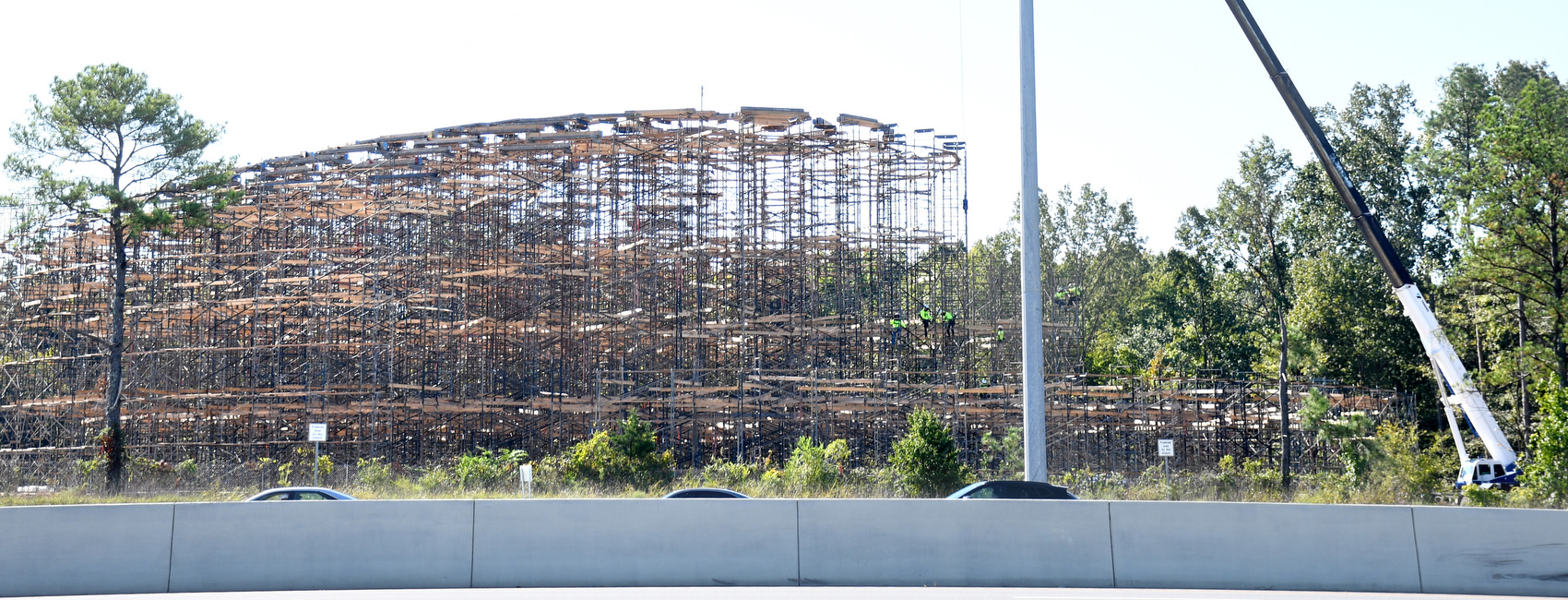
Right now, depending on where you spot them, they may look like a mountain of scaffolding or the skeleton of a Roman amphitheater.
But once completed, they will be equalization tanks, meant to store millions of gallons of stormwater in an effort to stop overwhelming Chattanooga’s sewer system, said Mark Heinzer, city wastewater director.
“When we get a big rain event, we get this big rush of water,” Heinzer said by phone. “And a lot of that gets into the sanitary sewer — where we don’t want it to get into — but it finds its way in because of our system being kind of older, and the pipes aren’t as watertight as they should be.”
Heavy rains can infiltrate pipes through the ground and increase their pressure, which can cause overflows. When wastewater overflows, it can go directly into local waterways before it’s treated.
(READ MORE: Hamilton County looking at alternatives as growth strains waste capacity)
“This project would then be able to alleviate that pressure on the pipes,” Heinzer said.
Two of the tanks will hold 15 million gallons each at a site near Camp Jordan and the Interstate 75/Interstate 24 split, and a third will hold 10 million gallons off Lee Highway near Standifer Gap Road.
Construction began about 18 months ago, Heinzer said, and is expected to be done by February 2027. The project is estimated to cost around $153 million, funded with sewer fees and bonds from the city and county and a low-interest federal loan for that kind of project, officials said.

“It provides capacity for future expansion of the region, whether it’s industry coming in or new developments coming in,” Heinzer said. “It provides capacity for growth — economic as well as population growth that we anticipate.”
Work on the tanks near the split has also closed part of the South Chickamauga Creek Greenway between the access point at Camp Jordan and the Brainerd Road trailhead at Greenway View Drive.
(SIGN UP: Get our top headlines in your inbox every morning by going to timesfreepress.com/morning)
Hamilton County plans to purchase 9 million gallons of capacity at the new tanks, said Mike Patrick, director of the county Water and Wastewater Treatment Authority.
When finished, the tanks should look like ones the city built off Hamm Road, near the Moccasin Bend wastewater facility, in 2022, Heinzer said. They’re made of reinforced concrete, with pump stations and valves to control the flow.
When sewer pipes fill up to a certain level during rain, it’ll trigger a pump that directs flow to the tank, Heinzer said.
“That way the elevation in the pipe never gets above the elevation where it can get out into the creek,” he said.
Historically, overflows from rain have often impacted that part of Chattanooga and nearby parts of East Ridge, Hamilton County and into North Georgia.
The tanks are on a “main spine” for the system, at a convergence point for lines that run as far as Ooltewah, Collegedale and Ringgold, Patrick said.
“This project will help to eliminate those kinds of overflows,” Heinzer said. “Will it do it completely? I don’t know, because sometimes the pipes get overwhelmed before it could even get to the station.”
For example, the extra capacity may not have helped during severe flash flooding in that area Aug. 12, he said.
(READ MORE: Heavy rains caused Chattanooga area sewer systems to overflow)
“We didn’t have significant sanitary sewer overflows with that particular event, thank goodness,” he said, ” because the water came down so quickly it ran off instead of absorbing into the ground and getting into the pipes.”
The tanks are more likely to help during longer, more sustained rain that lingers over a longer period, Heinzer said.
The project is part of the city’s work to comply with a federal decree agreement that mandates repairs and updates to its aging wastewater system. The city entered the agreement with the Environmental Protection Agency in 2013 because the system was reporting too many overflows from heavy rains.
Hamilton County entered a similar agreement with the EPA in 2023.
Ideally, the county system would get to a point at which it didn’t need the extra capacity, Patrick said. But tanks like these can address overflow problems quickly, while longer-term rehabilitation projects are underway, he said.
“Because basically every bit of extraneous rainwater that goes through the sewer, into the sewer system, we have to pay the city of Chattanooga to treat,” Patrick said. “So it’s in our best interest to reduce as much extraneous water as we can.”
Contact growth reporter Ellen Gerst at egerst@timesfreepress.com or 423-757-6319.